Why does Strox become addictive so quickly?
In a study published in 2021 of 284 people who used both synthetic cannabinoids and cannabis, a large majority described synthetic cannabis as faster in onset, shorter in duration, and quicker to build tolerance than cannabis. These characteristics are precisely the recipe for rapid addiction:
The effect appears within a short time, and substances that reach the brain faster are higher in addiction potential.
The effect wears off quickly, so the person goes back to using more times during the day.
Response to the substance falls quickly, so the person needs more to get the same effect.
Insomnia, irritability and depression after stopping push him to go back to escape them.
Because the substance is a full agonist of cannabinoid receptors, the brain adapts to it by reducing the number or sensitivity of the receptors, and after a while the person feels unable to sleep, eat or relax without it.
What happens in the brain of someone who becomes accustomed to Strox?
The brain learns what gives it pleasure and repeats it, through reward circuits in which dopamine plays a key role. When use is repeated, the brain links the substance with particular places, people and feelings, so these triggers alone become able to provoke cravings. At the same time, the frontal lobe areas responsible for planning and impulse control perform less well.
The result is that a person may sincerely decide to stop, then find himself using again at the first pressure or meeting with friends who use. This is what the US addiction research institutes mean when they describe addiction as a brain disease that affects behavior, not merely a wrong choice.
How do misconceptions contribute to the spread of Strox?
Among the things that most often push young people to try Strox is wrong information that circulates among them:
- “It’s just natural herbs,” when its active ingredient is entirely chemical.
- “It’s mild hashish,” when it is far stronger and more dangerous.
- “It doesn’t show up in tests,” so people who are tested at work, school or in treatment turn to it.
- “I tried it and nothing happened,” when the composition changes from one pack to another.
Does heredity play a role in Strox addiction?
Addiction research in general indicates that genetic factors explain a significant part of a person’s vulnerability to addiction; the risk is higher for those whose father, mother or siblings have addiction. A family history of psychotic disorders also makes a person more likely to develop psychosis from Strox. But heredity is a predisposition, not a fate, and environment and upbringing make a big difference.
Mental health conditions and dual diagnosis
Some young people turn to Strox to relieve undiagnosed psychological suffering, such as social anxiety, depression or chronic insomnia, and the temporary relief turns into a cycle of addiction that makes the suffering itself worse. Among the disorders most associated with cannabinoid use are:
- Depression and anxiety disorders.
- Untreated attention-deficit/hyperactivity disorder.
- Post-traumatic stress disorder (PTSD).
- Personality disorders and impulsivity.
- Predisposition to psychotic disorders.
In these cases, treating the addiction alone is not enough; the accompanying disorder must be treated in the same plan, or the reason that drove the drug use remains in place.
Trauma and stress
Abuse or neglect in childhood, the loss of a loved one, bullying, or severe academic and financial pressure all raise the likelihood of turning to substances. Strox gives a temporary feeling of detachment from reality, which can seem tempting to someone carrying psychological pain, but it does not treat the pain; it postpones and magnifies it.
Environment and friends
- Starting use at an early age: the adolescent brain is more sensitive to addiction because the self-control areas have not finished developing.
- Peer pressure: the wish to belong to the group is one of the strongest motives for a first try.
- Ease of hiding it: its appearance, close to shisha tobacco and herbs, makes it harder for the family to detect.
- Idle time and unemployment: no goal, routine or alternative activities.
- Poor family communication: lack of dialogue, constant conflict or lack of supervision.
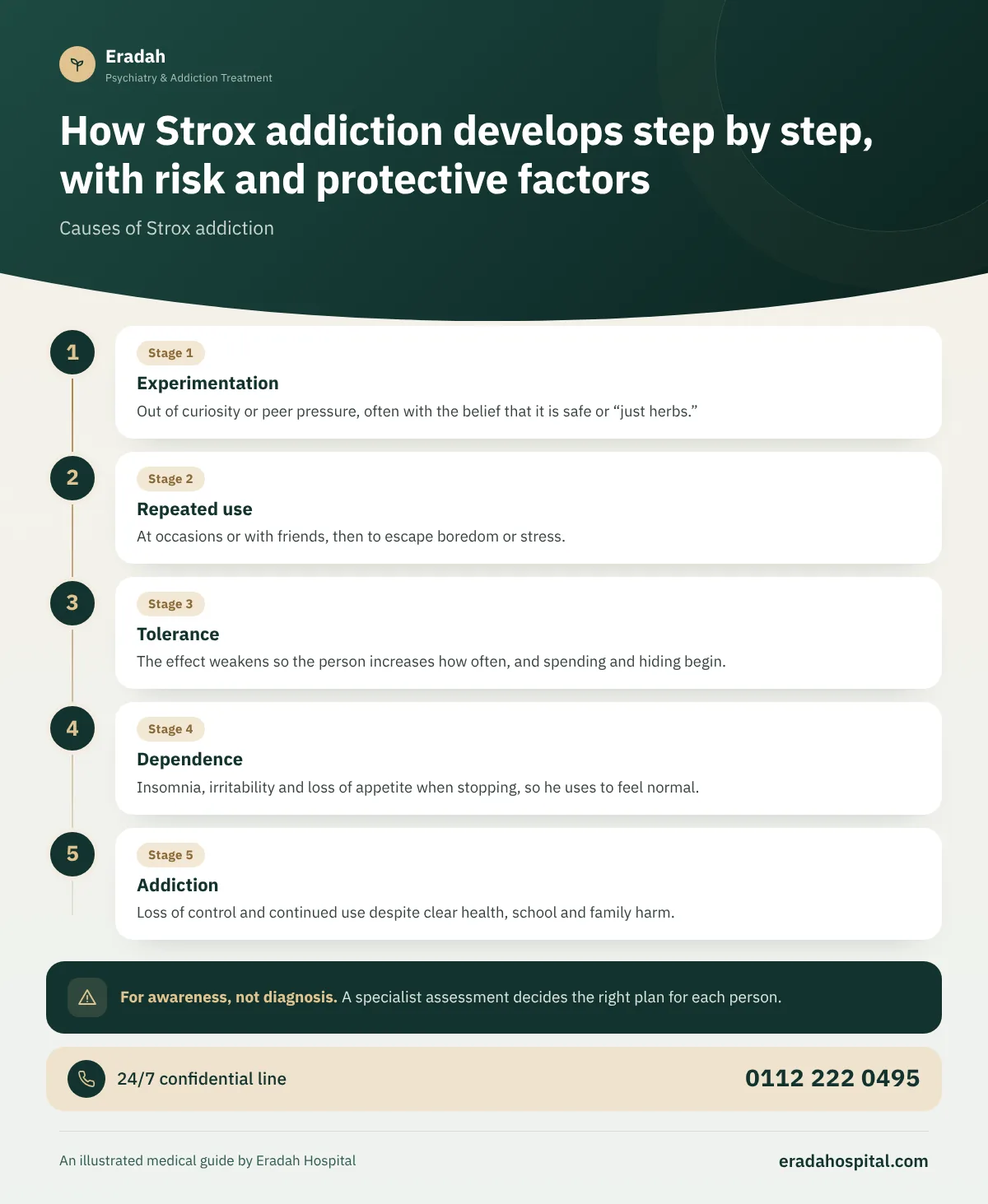
How does experimenting turn into addiction?
- Stage 1Experimentation
Out of curiosity or peer pressure, often with the belief that it is safe or “just herbs.”
- Stage 2Repeated use
At occasions or with friends, then to escape boredom or stress.
- Stage 3Tolerance
The effect weakens so the person increases how often, and spending and hiding begin.
- Stage 4Dependence
Insomnia, irritability and loss of appetite when stopping, so he uses to feel normal.
- Stage 5Addiction
Loss of control and continued use despite clear health, school and family harm.
Risk factors versus protective factors
| Risk factors | Protective factors |
|---|---|
| Starting use at an early age | Delaying any experimentation with substances as long as possible |
| Untreated mental disorder | Early diagnosis and treatment of anxiety and depression |
| Friends who use | Supportive relationships and healthy sports and social activities |
| Wrong information about the substance | Accurate knowledge of the risks of synthetic cannabis |
| Weak family dialogue | A family that listens and does not rely on punishment alone |
How do you protect your children from Strox?
- Start the conversation early and calmly, and ask your son what he hears about Strox instead of giving a lecture.
- Correct misconceptions with facts: it is not herbs, it is not mild hashish, and it can be detected by specialized tests.
- Pay attention to psychological changes and seek early help for anxiety, depression and sleep disorders.
- Know your children’s friends and encourage alternative activities and sports.
- Agree that asking for help in a dangerous moment, even for a friend, matters more than fear of punishment.