Why do Strox and Voodoo withdrawal symptoms happen?
Strox and Voodoo are names for products containing synthetic cannabinoids that act as full agonists at the brain's cannabis receptors. With repeated use, the brain adapts to this intense stimulation by making the receptors less sensitive. When use stops, the brain suddenly finds itself without the substance it has grown used to, which disrupts the regulation of sleep, mood and appetite, and withdrawal symptoms appear.
And because these substances are stronger than THC and shorter-acting, their withdrawal usually appears faster and is more severe than withdrawal from hashish and bango.
Voodoo withdrawal: why does severity differ from person to person?
The main ingredient in Voodoo is synthetic cannabinoids that activate the brain's cannabis receptors far more strongly than the THC in hashish. With repetition, the brain reduces the sensitivity of these receptors to adapt, so if use stops suddenly the balance is upset, and symptoms appear in sleep, mood, appetite and the nervous system.
But Voodoo is not a single substance. In an analysis of seized samples in Egypt published by researchers from Ain Shams University, the samples were a mixture containing the synthetic cannabinoid FUB-AMB and other substances, including tramadol and oxazepam, a sedative from the benzodiazepine group, along with amphetamine. For this reason, Voodoo withdrawal may be mixed with withdrawal from substances the person did not know they were using.
Does everyone who stops have withdrawal symptoms?
Not everyone is affected to the same degree. In a 2021 study of 284 people who had used synthetic cannabinoids, about 83% reported at least one withdrawal symptom, and symptoms were more severe in those who used more frequently and in larger amounts. Also, 90% of them described synthetic cannabis withdrawal as more severe than cannabis withdrawal.
Source: Craft et al., Psychopharmacology, 2021. The figures come from a research sample and are not an estimate for all users.
Timeline of Strox and Voodoo withdrawal
The length varies with the compound, the duration and frequency of use, and physical and psychological health, and a systematic review of withdrawal cases published in 2025 points to the following approximate course:
- First 6 – 48 hoursThe start
Symptoms begin in most cases within one to two days: irritability, anxiety, insomnia, cravings, and possibly sweating and nausea.
- Days 2 – 5The peak
Severe insomnia and loss of appetite, a fast pulse and sweating, and sharp mood swings, and in some cases complications such as psychosis or seizures may appear.
- End of the first weekEasing
Severe symptoms usually ease within about a week with medical care.
- The following weeksThe prolonged phase
Insomnia, anxiety, low mood and cravings may continue in waves for weeks and need psychological follow-up.
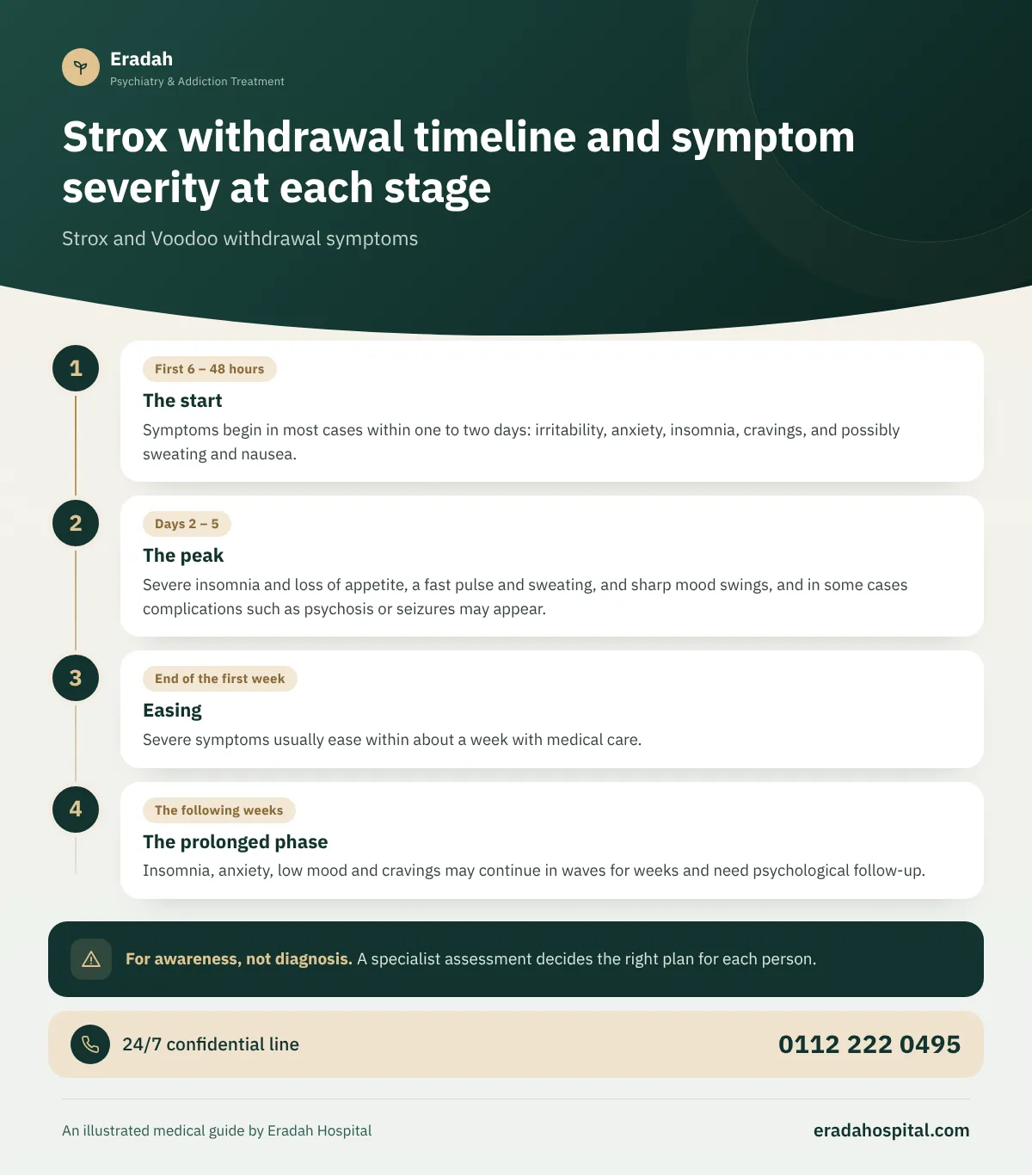
These are approximate durations based on studies and case reports, and they differ from person to person.
Physical and psychological symptoms of Strox and Voodoo withdrawal
| Type | Symptoms |
|---|---|
| Common psychological symptoms | Insomnia, disturbed sleep and nightmares, irritability and quick temper, depression, anxiety, and cravings to use. |
| Common physical symptoms | Loss of appetite, sweating, nausea, headache, tremor, palpitations and a racing pulse. |
| Severe and less common | Severe agitation, psychosis and hallucinations, seizures, delirium, and severe vomiting that causes dehydration. |
Studies note that synthetic cannabinoid withdrawal includes more marked signs of “overactivity” in the autonomic nervous system, such as sweating and a racing pulse, than hashish withdrawal does.
Is Strox withdrawal dangerous?
Most cases of withdrawal are unpleasant but not life-threatening. However, the systematic review of case reports recorded serious complications in some heavy users, including:
- Seizures, especially in people who use daily and over long periods.
- Acute psychosis with hallucinations, paranoid thoughts and agitation.
- A very fast pulse and heart rhythm disturbances.
- Delirium and muscle breakdown in rare cases.
- Suicidal thoughts and severe depression, which call for urgent intervention.
Why is it hard to predict the severity of withdrawal?
Because the person using usually does not know which compound they took, and because many people mix Strox or Voodoo with other substances such as hashish, sedatives, alcohol or stimulant pills. Withdrawal from sedatives and alcohol in particular can cause dangerous seizures and requires medical supervision. That is why the person should tell the doctor everything they were using, so that a safe plan can be made.
Why is stopping at home not advised for someone who uses heavily?
Someone who used only occasionally may be able to stop with outpatient follow-up, but a person who uses daily, or has a history of seizures, psychosis or a mental health condition, or mixes other substances, needs a medical setting, where it is possible to:
- Monitor pulse, blood pressure, temperature and fluids around the clock.
- Respond quickly to seizures, agitation or psychosis if they appear.
- Use medication for a short period and under supervision to ease anxiety, insomnia and agitation.
- Protect the person from relapse during the hardest first days.
- Start psychological therapy right after the condition stabilizes.
How is Strox withdrawal eased medically?
There is no medication approved specifically for synthetic cannabinoid withdrawal, so treatment relies on easing symptoms. Studies mention the short-term use of benzodiazepine-group medications to ease agitation and anxiety and prevent seizures, and antipsychotics when hallucinations or paranoid thoughts appear, along with fluids, nutrition and rest. The doctor decides the medication and its duration for each case.
What comes after the first week?
After the acute symptoms end, a person may go through weeks of mild insomnia, mood swings, boredom and waves of cravings, especially when exposed to triggers such as friends or places linked to use. This stage is among the periods of highest risk for relapse, and regular psychological follow-up, a steady daily routine and physical activity help during it.
How can the family support someone going through withdrawal?
- Expect irritability, insomnia and mood swings, and do not take them personally.
- Provide a calm environment and a simple routine for sleeping, eating and drinking fluids.
- Remove any substances or non-prescribed medications from the home.
- Watch for danger signs: seizures, hallucinations, thoughts of self-harm, chest pain.
- Encourage them to move from detox to a full treatment program.
Detox on its own is not treatment for addiction, and the full plan is explained on the page about Strox and Voodoo addiction treatment.
Signs of acute Strox poisoning: call an ambulance (123) immediately
- Convulsions or violent shaking of the whole body
- Loss of consciousness or great difficulty waking the person
- Chest pain, a very rapid heartbeat or shortness of breath
- Severe agitation, violence, or hallucinations and complete detachment from reality
- A severe rise in body temperature with heavy sweating or hot, dry skin
Call an ambulance on 123 immediately, move dangerous objects away from the person, and do not restrain them by force or put anything in their mouth during a seizure. If they lose consciousness or the seizure ends, place them on their side in the recovery position, stay with them until the paramedics arrive, and tell them what was taken.
Call the ambulance 123