What is synthetic cannabis?
Although its name contains the word “hashish”, synthetic cannabis is not a kind of hashish or of cannabis; it is a huge family of chemicals made in unlicensed laboratories.
The scientific name for these substances is synthetic cannabinoid receptor agonists, known for short as synthetic cannabinoids. They were originally designed in research laboratories to study the cannabinoid system in the brain, and none of them has been approved as a medicine for humans. Unlicensed laboratories then copied and modified their formulas, and they began to be sold worldwide in the mid-2000s under names such as “Spice” and “K2”.
These products reached Egypt under the name Strox, then other names appeared, most notably Voodoo. The herbs in these products are just a carrier for the chemical, while the active substance is entirely synthetic. To learn about natural cannabis itself, see the guide to cannabis and its derivatives.
Why is synthetic cannabis much stronger than hashish?
The brain has a natural system called the endocannabinoid system, which helps regulate mood, memory, appetite, sleep, pain perception and body movement. The THC in hashish activates the receptors of this system only partially, so its effect has a ceiling.
Most synthetic cannabinoids, by contrast, are full agonists that bind to the receptors with much greater strength, driving them to maximum activity with no clear ceiling. That is why their effects are not limited to mood and perception, but extend to the heart, the nervous system and the kidneys.
Hashish knocks on the door of the cannabis receptors; synthetic cannabis breaks the door down. The difference in strength is what makes the difference in danger.
A short euphoria often followed by severe anxiety, confusion, hallucinations and paranoid thoughts.
Racing pulse and high blood pressure, which can reach heart rhythm disturbance or a heart attack.
Lowering of the seizure threshold, so epileptic seizures appear in people who never had them before.
Repeated vomiting, high temperature, muscle breakdown and kidney strain.
Types of synthetic cannabis
Strox and Voodoo are two commercial names for one problem, and each has its own guide. Here is a brief profile of each:
Strox
StroxA synthetic drug that has spread in Egypt and causes seizures, loss of consciousness and unpredictable violent behavior.
- Classification
- Synthetic cannabinoid
- Medical use
- Not used medically
- Addiction potential
High- Withdrawal
High
Main risk: seizures, loss of consciousness and severe psychosis
Voodoo
VoodooAnother trade name for synthetic cannabinoid mixtures, similar to Strox in its effects and risks.
- Classification
- Synthetic cannabinoid
- Medical use
- Not used medically
- Addiction potential
High- Withdrawal
High
Main risk: composition that varies from one mixture to another
Chemical
Synthetic cannabinoidsAlso known as: Spice, K2
Synthetic cannabinoids sprayed onto herbs or paper, much stronger than hashish and with unpredictable effects.
- Classification
- Synthetic cannabis
- Medical use
- Not used medically
- Addiction potential
High- Withdrawal
Moderate
Main risk: seizures, heart attacks and psychosis from the very first use
Powder drug
Powder (street mix)Also known as: powder
A street name for a mixture usually based on Strox or Voodoo with unknown substances and sedatives, with no fixed composition.
- Classification
- Synthetic cannabis mixture (street name)
- Medical use
- Not used medically
- Addiction potential
High- Withdrawal
Moderate
Main risk: unknown composition combining the dangers of cannabis and sedatives
Paper drug
Spice paperAlso known as: paper drug, Spice paper
Paper soaked in synthetic cannabis, then dried and smuggled in letters, which may also carry strong opioids in uneven concentrations.
- Classification
- Synthetic cannabis on paper
- Medical use
- Not used medically
- Addiction potential
High- Withdrawal
Moderate
Main risk: uneven concentration and possible strong opioids
What is the difference between Strox and Voodoo?
Many people ask which is more dangerous, and the more accurate answer is that the difference between them lies in the name and the marketing more than in the substance. Both are herbs sprayed with changing synthetic cannabinoids, and doctors approach both with the same plan of diagnosis and treatment:
| Point of comparison | Strox | Voodoo |
|---|---|---|
| What is it? | The best-known name for synthetic cannabis in Egypt | A commercial name that appeared later for similar mixtures |
| Active ingredient | Variable synthetic cannabinoids | Variable synthetic cannabinoids |
| What it looks like when identified | Chopped herbs resembling bango or molasses tobacco | Chopped herbs in bags with attractive names and colors |
| Marketing method | Became a general name for all synthetic cannabis | Sometimes marketed as “herbs” or “strong bango” |
| The risk | Seizures, heart attacks and psychosis | The same risks, and no one knows what is in the bag |
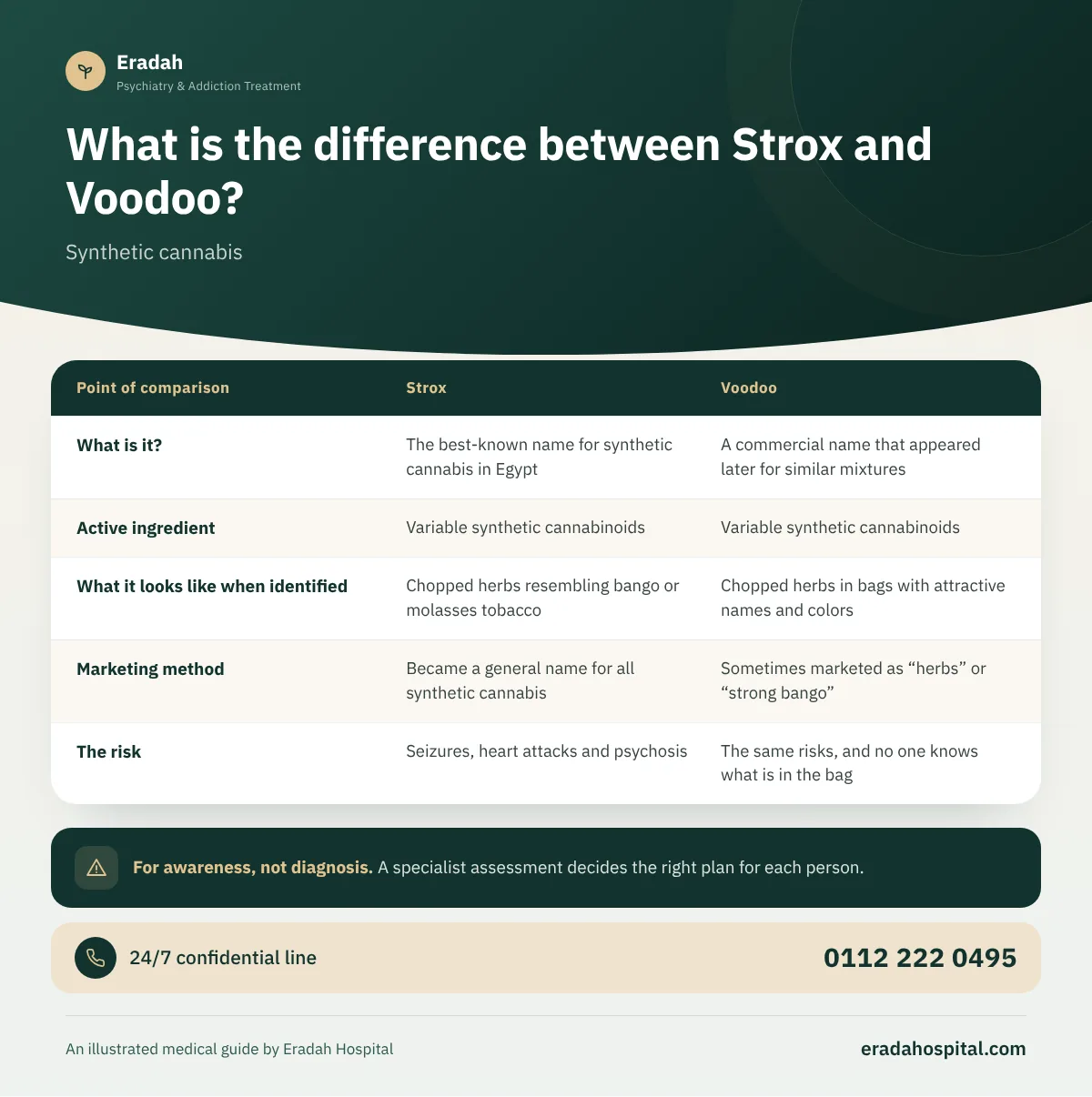
What matters is that the name does not mean a fixed composition: when one compound is banned it is replaced by a new one and the name on the bag stays the same. So a “Voodoo” bag may be stronger than a “Strox” bag or the reverse, with no sign to tell.
Synthetic cannabis and natural cannabis: why must they not be confused?
Many families hear that their son “smokes hashish” and deal with it by the logic of natural cannabis, when the substance may actually be Strox. The danger differs fundamentally:
| Point of comparison | Synthetic cannabis | Hashish and bango |
|---|---|---|
| Source | Manufactured chemicals on herbs | The cannabis plant itself |
| How it works | A strong full agonist of the cannabis receptors | THC, a partial agonist with a ceiling |
| Predictability | Its strength cannot be predicted, even within a single bag | Varies, but it is the same substance |
| Seizures and heart rhythm disturbance | Clearly documented even in healthy young people | Not typical with natural cannabis |
| Detection | Often not detected by the usual hashish test | Detected by the usual hashish test |
This does not mean hashish and bango are safe; they have addictive and psychological harms explained in the guide to cannabis and its derivatives. But synthetic cannabis adds to them the risk of acute poisoning and sudden death.
Why can the effect of synthetic cannabis not be predicted?
Some young people say, “I tried it before and nothing happened.” But a previous experience does not protect against the next one, for reasons that have to do with the nature of the product itself:
- The chemical compound changes from one production batch to another with no sign on the package.
- Spraying the chemical on herbs distributes it unevenly, creating highly concentrated “hot spots” within a single bag.
- Newer compounds may be far stronger than earlier ones.
- Products have been found mixed with other substances the user does not know about, including toxic ones.
Sources: the Early Warning Advisory of the United Nations Office on Drugs and Crime, and the European Union Drugs Agency.
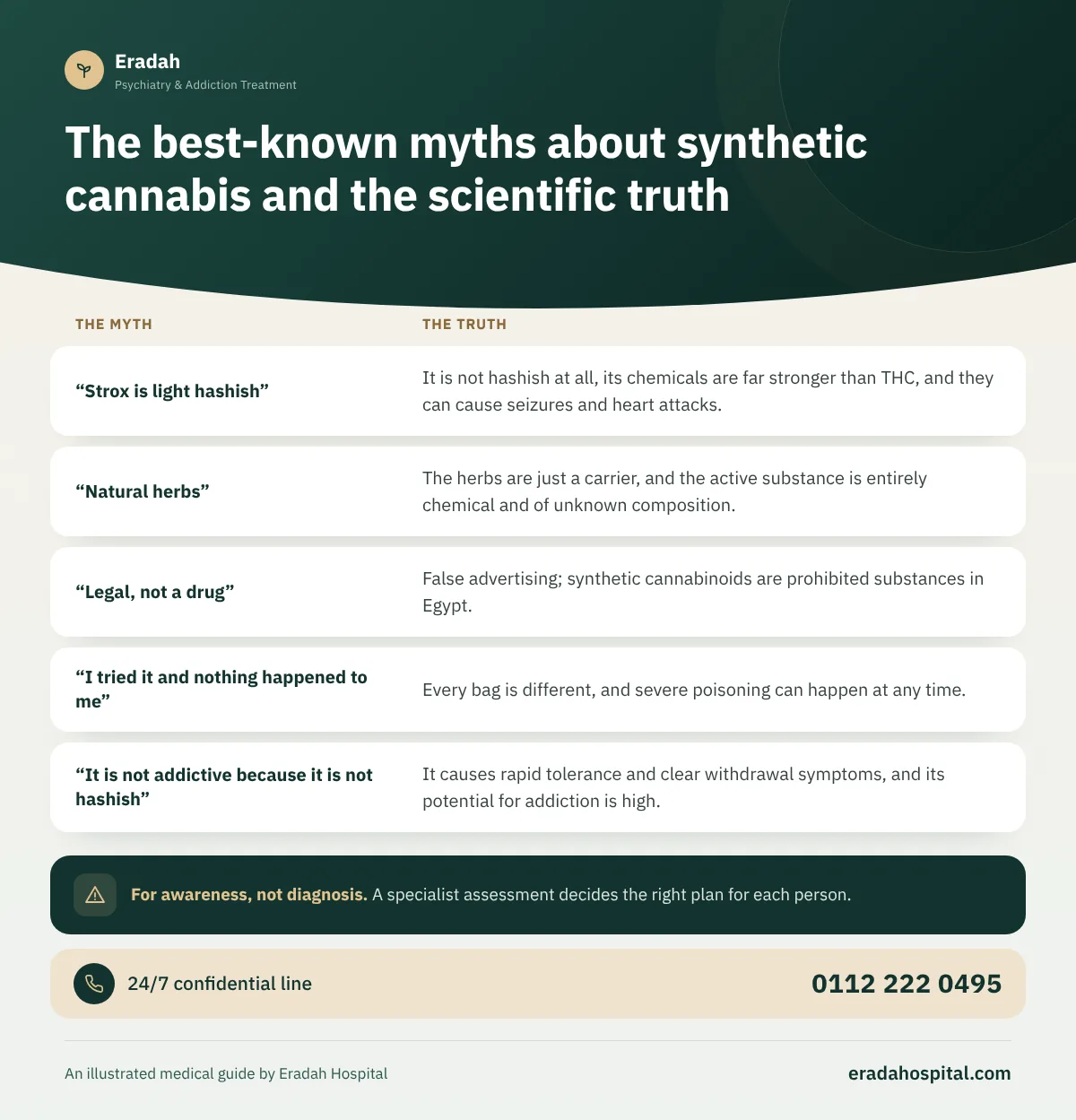
Is Strox “light hashish”? Myths and facts
| The myth | The truth |
|---|---|
| “Strox is light hashish” | It is not hashish at all, its chemicals are far stronger than THC, and they can cause seizures and heart attacks. |
| “Natural herbs” | The herbs are just a carrier, and the active substance is entirely chemical and of unknown composition. |
| “Legal, not a drug” | False advertising; synthetic cannabinoids are prohibited substances in Egypt. |
| “I tried it and nothing happened to me” | Every bag is different, and severe poisoning can happen at any time. |
| “It is not addictive because it is not hashish” | It causes rapid tolerance and clear withdrawal symptoms, and its potential for addiction is high. |
What dangers does synthetic cannabis share?
The US Centers for Disease Control and Prevention and the European Drugs Agency document harms not usually seen with natural cannabis, including acute kidney injury in healthy young people, and an outbreak of serious bleeding in the United States in 2018 linked to products contaminated with an anticoagulant. The main dangers include:
- Seizures, heart rhythm disturbance and heart attacks.
- Severe psychosis, agitation and unpredictable violent behavior.
- Kidney injury, muscle breakdown and high temperature.
- Addiction with rapid tolerance and unpleasant withdrawal.
- Accidents and injuries during loss of awareness.
Details are on the pages harms of Strox and harms of Voodoo.
Synthetic cannabis in Egypt: why has it become a concern?
Strox has spread in Egypt in recent years among teenagers and young people, and reports of poisoning cases and violent behavior linked to it have recurred. Its spread is helped by the fact that it is presented as a substitute for hashish, and that its herbal look reassures those who do not know what it really is.
Legally, synthetic cannabis is a prohibited substance in Egypt, and synthetic cannabinoid compounds have been added to the narcotics schedules attached to Law No. 182 of 1960. This is general educational material and not legal advice.
Withdrawal, treatment and testing in brief
Stopping Strox or Voodoo in people who use it regularly causes symptoms such as irritability, insomnia, anxiety, loss of appetite and cravings, and severe cases may need medical care because of acute anxiety or psychosis. Details are in Strox and Voodoo withdrawal symptoms. Treatment includes medical and psychological assessment, safe withdrawal and long-term rehabilitation, as in Strox and Voodoo addiction treatment.
Because the usual hashish test often does not detect these substances, the doctor may need specialized tests. Approximate details are on the page Strox testing. In treatment programs, testing is a supportive tool, not a tool for accusation.
How can the family protect their children from synthetic cannabis?
- Talk to your children clearly: “Strox is not hashish, and a single try can end in the emergency room,” without exaggeration or threats.
- Do not be fooled by colorful bags or phrases like “incense” and “herbs” on packages of unknown origin.
- Watch for sudden changes: unexplained fits of agitation or confusion, declining school performance, withdrawal from others, and new friends.
- If you suspect use, start with a calm conversation and seek an early medical and psychological assessment.
- Learn the emergency signs below, and do not hesitate to call an ambulance; saving a life comes first.
Signs of synthetic cannabis poisoning: call ambulance (123) immediately
- Seizures or an epileptic fit, even if it stops within minutes
- Loss of consciousness, difficulty waking the person, or abnormal breathing
- Chest pain, severe palpitations or fainting
- Severe agitation, violence, or hallucinations and confusion with a danger to themselves or others
- Very high body temperature with sweating or muscle stiffness
- Unexplained bleeding from the gums, nose or in the urine
Call ambulance (123) immediately. If the person loses consciousness, place them on their side, move hard objects away from them during a seizure, do not put anything in their mouth, and do not leave them alone. Tell the paramedics that you suspect synthetic cannabis, and keep the packaging if there is any.
Call the ambulance 123