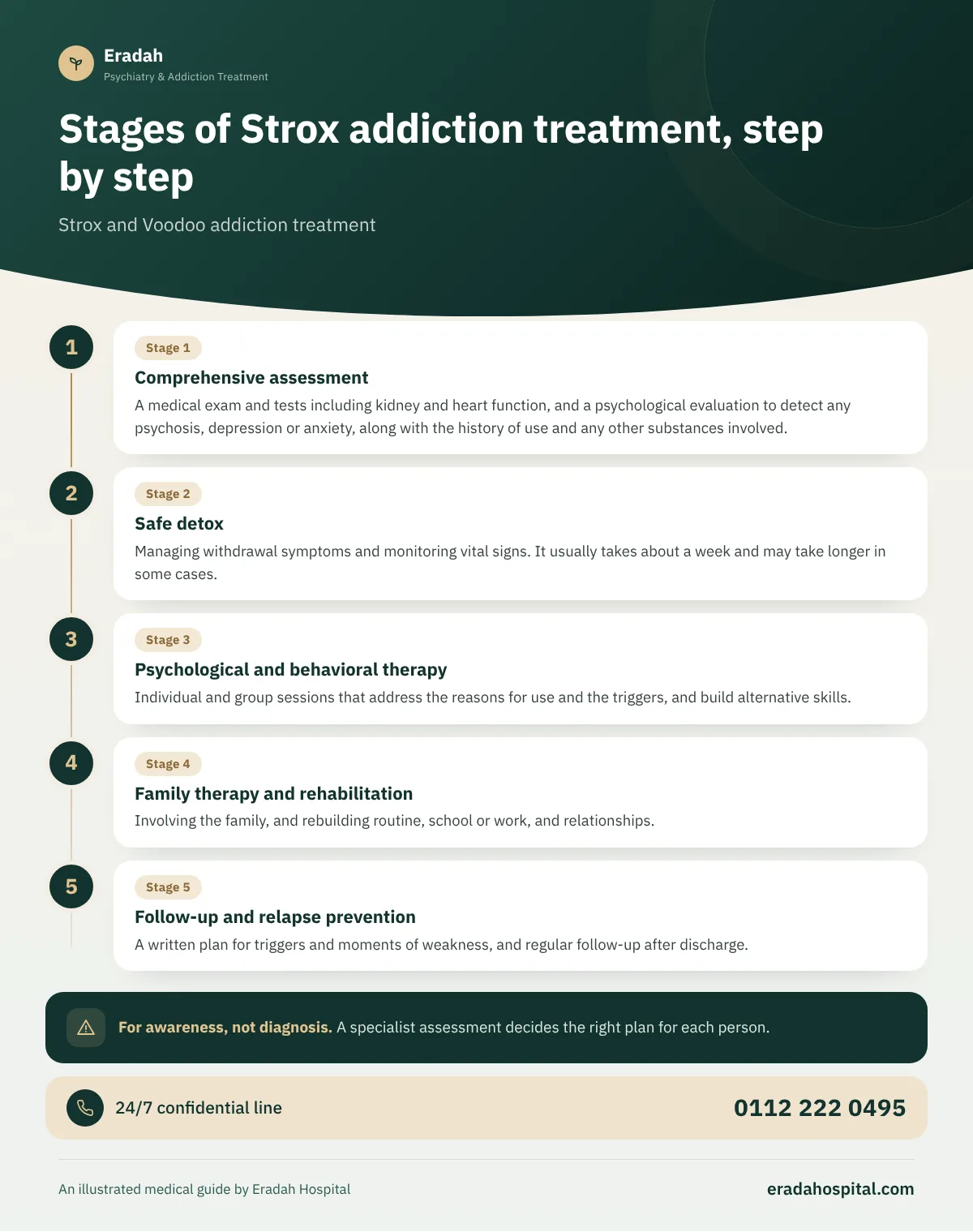
Stages of Strox and Voodoo addiction treatment
- Stage 1Comprehensive assessment
A medical exam and tests including kidney and heart function, and a psychological evaluation to detect any psychosis, depression or anxiety, along with the history of use and any other substances involved.
- Stage 2Safe detox
Managing withdrawal symptoms and monitoring vital signs. It usually takes about a week and may take longer in some cases.
- Stage 3Psychological and behavioral therapy
Individual and group sessions that address the reasons for use and the triggers, and build alternative skills.
- Stage 4Family therapy and rehabilitation
Involving the family, and rebuilding routine, school or work, and relationships.
- Stage 5Follow-up and relapse prevention
A written plan for triggers and moments of weakness, and regular follow-up after discharge.
Why does treatment begin with a comprehensive assessment?
Strox and Voodoo can leave physical effects that need checking before anything else, such as kidney strain or heart rhythm disturbance. A considerable proportion of people who use them also have psychotic symptoms, depression or anxiety, and may be using other substances alongside them. A careful assessment determines the right place for treatment, how long it should last, and the medical and psychological priorities.
Voodoo addiction treatment: what is different?
Voodoo is a brand name for herbs sprayed with synthetic substances. When researchers from Ain Shams University analyzed samples of it in a study published in 2020, they found it to be a mixture with varying concentrations. They detected the synthetic cannabinoid FUB-AMB in it, along with substances such as THC, amphetamine, tramadol and oxazepam, and one of the samples differed from the other two in its ingredients.
In practical terms, this means two people who both say “I use Voodoo” may be in very different situations: one may be dependent on a synthetic cannabinoid alone, while the other may also, without knowing it, be dependent on an opioid or a sedative. That changes the tests needed, the way of stopping, and how long supervision is required.
Voodoo with other substances: a different plan for stopping
The same study found that 53.5% of Voodoo poisoning cases involved a mix with other substances, most often hashish and tramadol. This is where the plan changes:
- With tramadol: the person needs an opioid withdrawal plan, and may also be at risk of seizures.
- With sedatives: these must not be stopped suddenly after regular use, and the doctor sets out a tapering plan.
- With hashish: cannabis dependence is treated within the same plan, with care to avoid going back to Voodoo because it seems “cheaper” or “stronger.”
Detox: the first step, not the last
Detox aims to get through the first days of withdrawal safely: monitoring pulse, blood pressure and temperature, managing insomnia, anxiety and agitation, and intervening quickly if seizures or psychosis appear. But it does not treat the addiction on its own, because cravings and the psychological drivers remain afterward. The details of the symptoms and duration of this stage are on the page about Strox and Voodoo withdrawal symptoms.
Is there a medication for treating Strox addiction?
So far there is no approved medication specifically for treating synthetic cannabinoid use disorder. But the doctor may use medication to treat symptoms or co-occurring conditions, choosing among them according to each case:
| Drug class | Their role | Note |
|---|---|---|
| Benzodiazepines | Easing severe agitation and anxiety and preventing seizures during withdrawal | For a very short period and under supervision, because they can cause dependence |
| Antipsychotics | Treating hallucinations, paranoid thoughts and psychotic agitation | The doctor decides how long to continue depending on how the condition progresses |
| Antidepressants | Treating co-occurring depression or anxiety after assessment | Takes weeks to show benefit |
| Sleep and symptom medications | Easing insomnia and nausea in the first days | For a set period and by prescription only |
Psychological and behavioral therapy: the foundation of treatment
Because there is no medication that treats the addiction itself, treatment results depend mainly on psychological and behavioral programs, used together with methods that have proved helpful in cannabis and other substance use disorders:
Helps the patient understand their thoughts and triggers, and build new ways of coping with stress and cravings.
Strengthens the patient's own motivation to change, especially in hesitant young people.
Encourages commitment to treatment with tangible rewards linked to negative test results.
A safe space to learn from others going through the same journey.
Rebuilds trust and teaches the family how to support without covering up the drug use.
Treating co-occurring psychosis, depression or anxiety within the same plan.
Residential stay or outpatient treatment?
| Residential treatment is suitable when there is | Outpatient treatment may suit when |
|---|---|
| Heavy daily use or mixing with other substances | Occasional use with no complications |
| A history of seizures, psychosis or thoughts of self-harm | Psychological stability and no psychotic symptoms |
| Previous attempts to stop that failed | Strong motivation and commitment to appointments |
| An unsupportive home environment or easy access to the substance | A supportive family and a safe environment |
How long does treatment for Strox and Voodoo addiction take?
| Stage | Approximate duration |
|---|---|
| Detox | About a week, and longer in complex cases |
| Residential treatment and rehabilitation | 4 to 12 weeks or more, depending on the case |
| Outpatient treatment | Several months |
| Follow-up and relapse prevention | At least a year, and it may extend longer |
Addiction treatment research indicates that staying in treatment for long enough is one of the most important factors for success. The treatment team sets the length according to each patient's progress, not a fixed number.
Preventing relapse after Strox treatment
- Knowing your personal triggers: places, friends, feelings, free time.
- A written plan for moments of weakness: whom to call and what to do.
- Staying away from hashish and other substances, since they are often the gateway back.
- A steady routine for sleep, exercise, and school or work.
- Keeping up psychological follow-up even after you start to feel better.
The family's role during treatment
The family is an essential partner in treatment, especially with teenagers and young adults. It helps to attend family counseling sessions, learn the difference between support and enabling, set clear boundaries without violence, and celebrate small progress. The family itself also needs psychological support, because living with a person who has an addiction is exhausting.
How do you choose a suitable treatment center?
- An official license and a team that includes a psychiatrist, an internal medicine doctor and psychologists.
- A real medical and psychological assessment before the plan is set, not one program for everyone.
- The ability to handle acute complications such as seizures and psychosis.
- A clear psychological and family program after detox, and follow-up after discharge.
- Respect for the patient's dignity and confidentiality, and rejection of any violent or humiliating methods.
How to choose a hospital for Strox and Voodoo addiction treatment
Strox and Voodoo are not a single fixed substance but mixtures of synthetic cannabinoids whose strength varies from one packet to another, so use or stopping can bring seizures, acute psychosis, heart rhythm disturbance or kidney strain. More than half of Voodoo poisoning cases involved a mix with hashish or tramadol. The right place is therefore the one able to handle an emergency, before it is a comfortable one.
| Sign of a qualified facility | Sign to be cautious about |
|---|---|
| A doctor present at night who can handle a seizure or agitation | Relying on supervisors with no doctor on site |
| Heart and kidney checks as part of the assessment | Starting the program with no medical examination at all |
| A clear transfer plan to the nearest general hospital when needed | No answer to the question: what if the condition gets worse? |
| A plan that takes account of any co-occurring tramadol or hashish use | One program for all substances with no distinction |
| Rejection of any violent restraint or humiliation | Isolation and beatings in the name of discipline |
At Eradah there is a doctor and nursing care around the clock, and a patient is taken by ambulance to the nearest hospital if general care is needed, then continues with a psychological and behavioral program. If hashish is part of the picture, see hashish addiction treatment, and to learn about the possible complications, read the harms of Strox.
Strox and Voodoo addiction treatment at Eradah
At Eradah we start with a comprehensive medical and psychological assessment that includes heart and kidney checks, then safe detox with round-the-clock monitoring when needed, followed by a treatment program that combines cognitive behavioral, motivational, group and family therapy, with treatment of any co-occurring psychosis or depression within the same plan, then regular follow-up after discharge. All of this is in complete confidentiality from the first call.