“I stopped the medication when I felt I was fine, and two days later I started feeling electricity in my head every time I turned it, plus dizziness and irritability.” At this moment many people think depression has come back, or that they have become “addicted” to the medication. The truth is that these are usually antidepressant withdrawal symptoms, a known phenomenon with an explanation and a solution.
What are antidepressant withdrawal symptoms?
When a person takes antidepressants for weeks or months, the brain adapts to their presence. If the medication suddenly disappears, the nervous system needs time to reset itself, and during this time discontinuation symptoms appear. The 2022 guidelines of the UK's National Institute for Health and Care Excellence (NICE) state that these symptoms can appear with sudden stopping, with missed doses, or when a full dose is not taken, and that they do not affect everyone and differ in type and severity from person to person.
Antidepressant withdrawal symptoms in detail: the FINISH rule
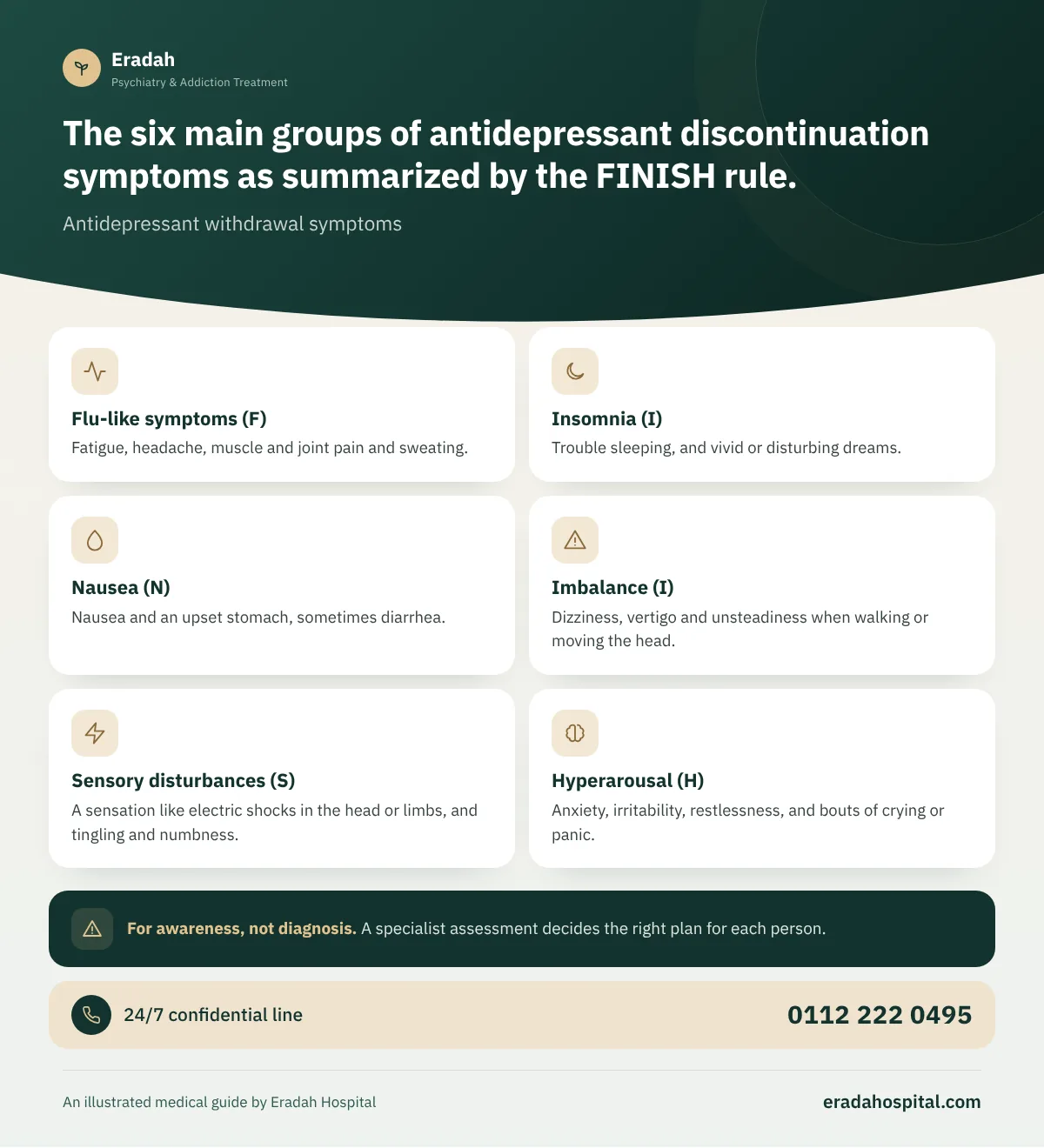
In a letter published in the Journal of Clinical Psychiatry in 1998, a physician summarized discontinuation symptoms in the word FINISH, the initials of six groups of symptoms:
Fatigue, headache, muscle and joint pain and sweating.
Trouble sleeping, and vivid or disturbing dreams.
Nausea and an upset stomach, sometimes diarrhea.
Dizziness, vertigo and unsteadiness when walking or moving the head.
A sensation like electric shocks in the head or limbs, and tingling and numbness.
Anxiety, irritability, restlessness, and bouts of crying or panic.
The UK's Royal College of Psychiatrists (RCPsych) adds that turning the head to the side may increase these “zaps,” and some people may feel that things are not real. NICE notes that suicidal thoughts may appear in very rare cases, which calls for contacting the doctor right away.
How many people experience withdrawal symptoms?
The figures are a matter of scientific debate. A pooled analysis published in Lancet Psychiatry in 2024, covering 79 studies and about 21,000 patients, found that 31% of those who stopped an antidepressant had at least one symptom, compared with 17% of those who stopped a placebo. After subtracting the non-specific effect, the researchers estimated the true proportion at about 15%, that is, one patient in 6 or 7, and severe symptoms were about 3%.
By contrast, an earlier systematic review published in Addictive Behaviors in 2019 estimated the average occurrence of symptoms at about 56%, and reported that 46% of those who experienced them in four large studies described them at the most severe level available. The practical conclusion is that the symptoms are common enough to plan the stop in advance, without being a reason to fear starting treatment when a patient needs it.
Which antidepressants are most likely to cause withdrawal symptoms?
- Highest risk: NICE notes that paroxetine, one of whose best-known brand names is Seroxat, and venlafaxine, one of whose best-known names is Effexor, are more linked to withdrawal symptoms and need special caution.
- In the 2024 pooled analysis: desvenlafaxine, venlafaxine, imipramine and escitalopram were linked to a higher frequency of symptoms, and imipramine, paroxetine and venlafaxine or desvenlafaxine were linked to greater severity.
- Often lower: fluoxetine (Prozac), because its effect lasts a long time in the body and so it tapers off gradually by itself, as NICE explains.
- Also need caution: medications with a short half-life in general, including duloxetine, and tricyclic antidepressants such as Anafranil.
When do antidepressant withdrawal symptoms start and how long do they last?
According to NICE, symptoms may appear within a few days of reducing the dose or stopping, are usually mild, and go away within one to two weeks. But withdrawal can sometimes be harder, and symptoms last several weeks, and sometimes several months, and can be severe, especially with sudden stopping. The 2019 Addictive Behaviors review found that a considerable share of people with withdrawal have symptoms lasting more than two weeks, and that lasting several months is not rare.
Withdrawal symptoms or a return of depression?
This is the most important question, because confusing them can lead to wrong decisions. NICE states that a person with withdrawal symptoms should be reassured that they are not having a relapse, and that relapse does not usually happen immediately after stopping. These differences, which RCPsych explains, help:
| Point of comparison | Withdrawal symptoms | Return of depression |
|---|---|---|
| Timing | Within days of stopping or lowering the dose | Usually gradually, after weeks or months |
| Type of symptoms | New symptoms: dizziness, “electricity” in the head, flu-like symptoms | The same original depression symptoms: sadness, loss of enjoyment, hopelessness |
| How patients describe it | “I've never felt like this before” | “I'm back to the same old state” |
| When the medication is restarted | Improves quickly, within hours or days | Takes weeks, as antidepressants usually do |
Do withdrawal symptoms mean I became addicted to the medication?
Not in the usual sense of addiction. Antidepressants do not produce a high, patients do not seek to raise the dose for its effect, and compulsive drug-seeking behavior is not linked to them. But RCPsych explains that the body can become physically dependent on a medication and adapt to it, and that a medication does not need to produce a high to cause this dependence, just as with many other medications. The difference between addiction, dependence and discontinuation symptoms is explained in the guide Do psychiatric medications cause addiction.
How do you stop antidepressants safely?
NICE advises anyone who wants to stop to talk first to the doctor who prescribed the medication, and explains that it usually requires lowering the dose in stages, and that most people stop successfully. The usual length of time to continue before stopping is explained in the antidepressant guide. Among the principles NICE gives for a stopping plan:
- The reduction should be in stages, and smaller as the dose gets closer to zero.
- It should be slower with short-acting medications and after a long course of treatment.
- Do not move to the next step until the symptoms disappear or become tolerable.
- The pace of stopping should be agreed with the patient themselves, and it may take weeks or months.
- If symptoms become severe, the doctor may restore the previous dose and then lower it in smaller, slower steps.
When should you contact the doctor right away?
Contact the doctor who prescribed the medication if the symptoms do not improve or get worse, stop you from working or driving safely, or if sadness and hopelessness return weeks after stopping. If suicidal thoughts appear, this is an emergency: call the ambulance (123) or the mental health support line 16328. If the depression comes with substance or sedative use, at Eradah we assess the whole picture within the dual diagnosis program, and the first consultation is free and confidential.