What happens if the disorder is left without care?
Borderline personality disorder harms a person not only in moments of crisis but also with a cumulative effect on health, education, work and relationships. The longer the delay before reaching specialist care, the more complications the person has to repair later.
Even so, complications are not inevitable. Long-term studies show that a large share of patients see their symptoms settle over the years, and that specialist treatment speeds this up and reduces crises. This page explains the harms to encourage early intervention, not to cause fear.
Does the risk of suicide rise in borderline personality disorder?
Yes, and this is the most serious complication. The US National Institute of Mental Health notes that people with the disorder are more likely to harm themselves, and scientific reviews indicate that the rate of death by suicide among them is clearly higher than in the general population and than in many other personality disorders. The risk rises with co-occurring depression, substance use, and acute emotional crises such as a breakup.
Self-harm without the intent to die is also common, and is usually used to relieve emotional pain that feels unbearable. Although it is not a suicide attempt, it deserves serious medical and psychological care, and it must not be downplayed or described as "attention-seeking."
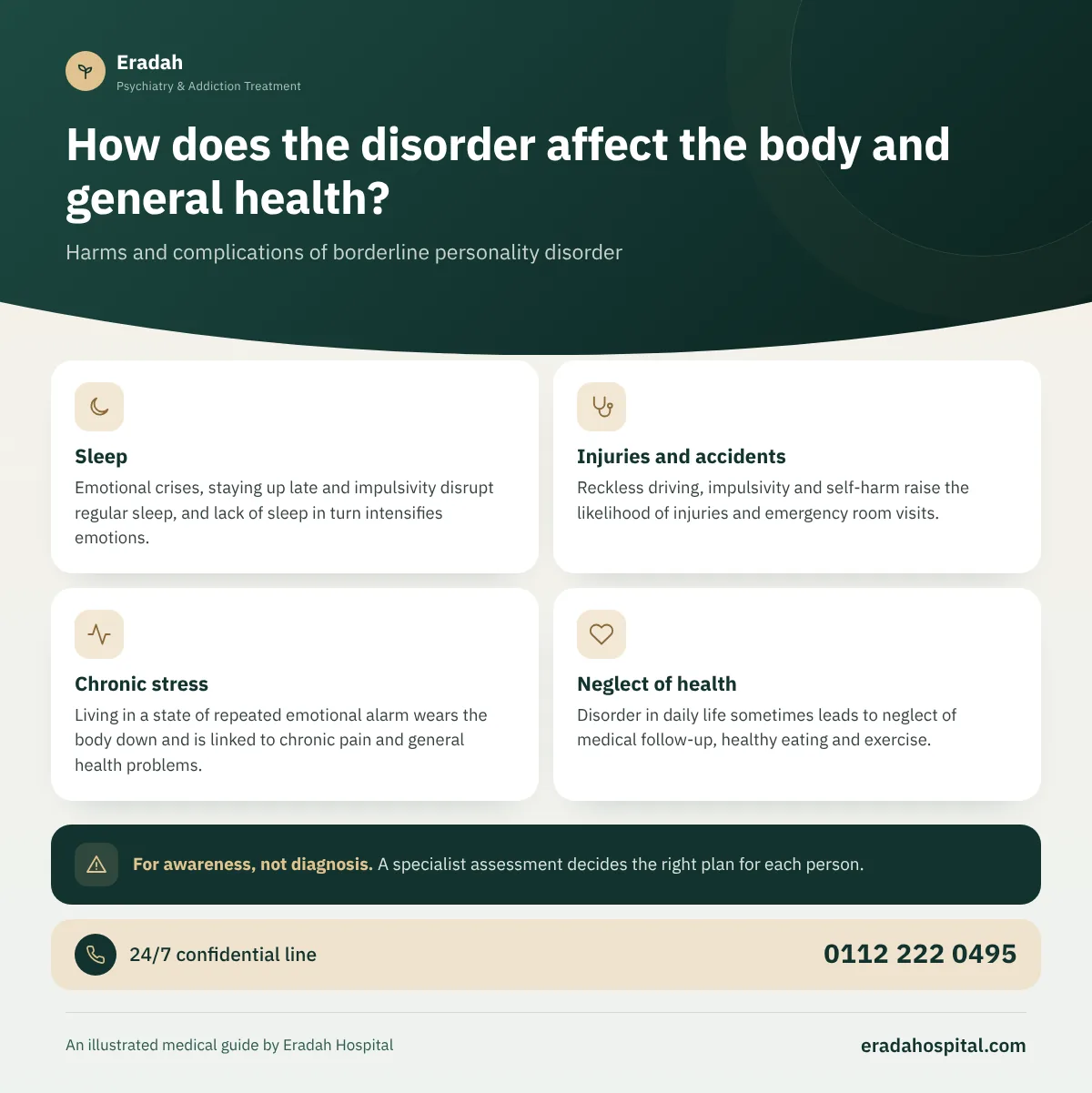
How does the disorder affect the body and general health?
Emotional crises, staying up late and impulsivity disrupt regular sleep, and lack of sleep in turn intensifies emotions.
Reckless driving, impulsivity and self-harm raise the likelihood of injuries and emergency room visits.
Living in a state of repeated emotional alarm wears the body down and is linked to chronic pain and general health problems.
Disorder in daily life sometimes leads to neglect of medical follow-up, healthy eating and exercise.
Eating problems such as binge eating are common with the disorder, and co-occurring eating disorders may be diagnosed in some patients. These problems need assessment within the same treatment plan.
What are the co-occurring mental health conditions?
Borderline personality disorder rarely comes alone. The US National Institute of Mental Health notes that it often occurs together with depression, post-traumatic stress disorder (PTSD), anxiety disorders, bipolar disorder, eating disorders and substance use disorders.
| Co-occurring condition | How it intertwines with borderline personality disorder |
|---|---|
| Depression | Increases hopelessness and raises the risk of suicide, and may be treated on its own while the underlying disorder stays undiagnosed. |
| Post-traumatic stress disorder (PTSD) | Shares sensitivity to threat, and may need specific trauma treatment. |
| Anxiety | Feeds the fear of abandonment and constant tension. |
| Substance use | Often starts as a way to calm emotions, then becomes a separate problem that increases impulsivity. |
| Eating disorders | May be another way of controlling painful emotions. |
How does it affect school and work?
Shifting goals, impulsively leaving school or a job, and conflicts with colleagues and managers because of sensitivity to criticism can lead to an interrupted education and career path. Reviews indicate that work difficulties may persist in some patients even after acute symptoms settle.
This is why good treatment puts the goal of "building a life" first: stability in a job or studies, managing time, and developing skills for handling feedback without falling apart. Success in this area itself reduces symptoms.
How does it affect relationships and marriage?
Close relationships are the most affected. Repeated breakups, jealousy, angry outbursts and fear of abandonment can exhaust a partner and push them away, so the very fear that started it all comes true. In a marriage, intense arguments followed by emotional reconciliations may repeat in a cycle that is exhausting for both.
This is not the end of the story; treatment teaches skills such as expressing needs without attacking and calming yourself before responding, and these skills clearly improve relationships. A partner can also benefit from family counseling sessions.
What about the family and children?
Family members often live in a state of watchfulness and worry, fearing the next crisis or self-harm, and may become exhausted or depressed. Children need stability and predictability, and the mood swings of an affected parent may confuse them.
A mother or father with the disorder can be a loving and capable parent, especially when receiving treatment and with support from a partner or extended family. A simple explanation suited to the child's age, such as "Mom is sick and getting treatment, and it's not your fault," protects the child from blaming themselves.
Are there financial or legal harms?
Impulsive spending, suddenly quitting a job, and debt are common complications that add pressure. Angry outbursts or substance use may sometimes lead to legal problems, although this is less common than people assume.
During calm times, the family can agree with the person on a simple financial plan, such as postponing major financial decisions for an agreed period, instead of monitoring or controlling, which may be taken as rejection.
Why does substance use become a serious complication?
Many people with the disorder turn to alcohol, sedatives or drugs to calm emotional pain quickly. The problem is that these substances raise impulsivity, weaken self-control, increase the risk of self-harm during crises, and then lead to dependence. This is covered in detail on the borderline personality disorder and addiction page.
Can complications be avoided?
- Early assessment when a repeated pattern of crises or self-harm appears.
- Commitment to specialist psychological treatment that is long enough, not occasional sessions.
- Creating a written crisis plan together with the therapist and family.
- Treating co-occurring depression or substance use within the same plan.
- Training the family in a communication style that calms rather than inflames.
The earlier intervention begins, the fewer complications build up for the person and their family. You can learn about care options on the treatment page.
Suicidal thoughts or risk of self-harm? Get help now
- Talking about wanting to die, that “nothing is worth it,” or that they are a burden on others
- Self-harm or hints of it, especially if it is becoming more frequent or more dangerous
- Severe emotional collapse after a breakup, a quarrel, or a feeling of rejection and abandonment
- Sudden withdrawal from people, saying goodbye to them, or getting rid of important belongings
- Heavy use of alcohol or substances in the middle of an emotional crisis, with intense agitation or a feeling of being detached from reality
Stay with the person and do not leave them alone. Listen calmly, without blame or lectures, and ask them directly about suicidal thoughts; asking does not plant the idea. Keep anything they could use to hurt themselves out of reach as far as you can, and call ambulance (123) or go to the nearest emergency department, or call the mental health support line 16328, available around the clock.
Ambulance 123 Mental health support line 16328