What are the main symptoms of borderline personality disorder?
The UK National Health Service groups the symptoms into four clusters: unstable emotions, disturbed patterns of thinking and perception, impulsive behavior, and intense but unstable relationships. Not every symptom has to appear in every person, since the disorder takes different forms.
What distinguishes these symptoms is that they are a pattern that repeats across many situations and over years, not a reaction to a single difficult circumstance, and it usually begins in adolescence or early adulthood. It shows most clearly in close relationships and at times of stress or feeling rejected.
What are the nine criteria doctors rely on?
The American diagnostic manual, the DSM-5, describes nine criteria, and diagnosis needs at least five of them. We present them here in simplified form for understanding, not for self-diagnosis:
- Frantic efforts to avoid abandonment, real or imagined, such as persistent calling, pleading, or anger at any distance.
- Intense and unstable relationships that swing between idealizing the other person and then belittling or rejecting them.
- Identity disturbance: an unstable image of oneself, and frequent changes in goals, values and interests.
- Impulsivity in at least two areas that may harm the person, such as excessive spending, reckless driving, binge eating or substance use.
- Recurrent self-harm or suicidal behavior or threats.
- Marked mood swings that usually last hours and rarely stretch to days.
- A chronic feeling of inner emptiness.
- Intense, inappropriate anger or difficulty controlling it.
- Fleeting paranoid thoughts or a sense of detachment from oneself or reality under stress.
What do the emotional symptoms look like?
In borderline personality disorder, feelings come fast and strong and settle slowly. A person may go from excitement to despair, or from calm to anger, within hours because of a word or a look taken as rejection. This is often accompanied by shame or self-loathing after an angry outburst.
- Very high sensitivity to criticism, being ignored or delayed replies.
- Deep sadness or intense anxiety that appears suddenly and disappears after hours.
- Angry outbursts followed by regret and guilt.
- An inner emptiness that some describe as "I feel nothing" or "I don't know who I am."
How does the disorder show up in relationships?
Relationships are the main stage for the symptoms. At the start, the person may see the other as ideal and attach strongly and quickly, then at the first disappointment or distance that admiration may turn into anger or a sense of betrayal. Therapists call this "black-and-white thinking": people are either completely good or completely bad.
The result is repeated breakups and emotional reconciliations, constant worry that a loved one will leave, monitoring of messages, and insistent contact. It is important for the family to know that this insistence comes from real terror of loss.
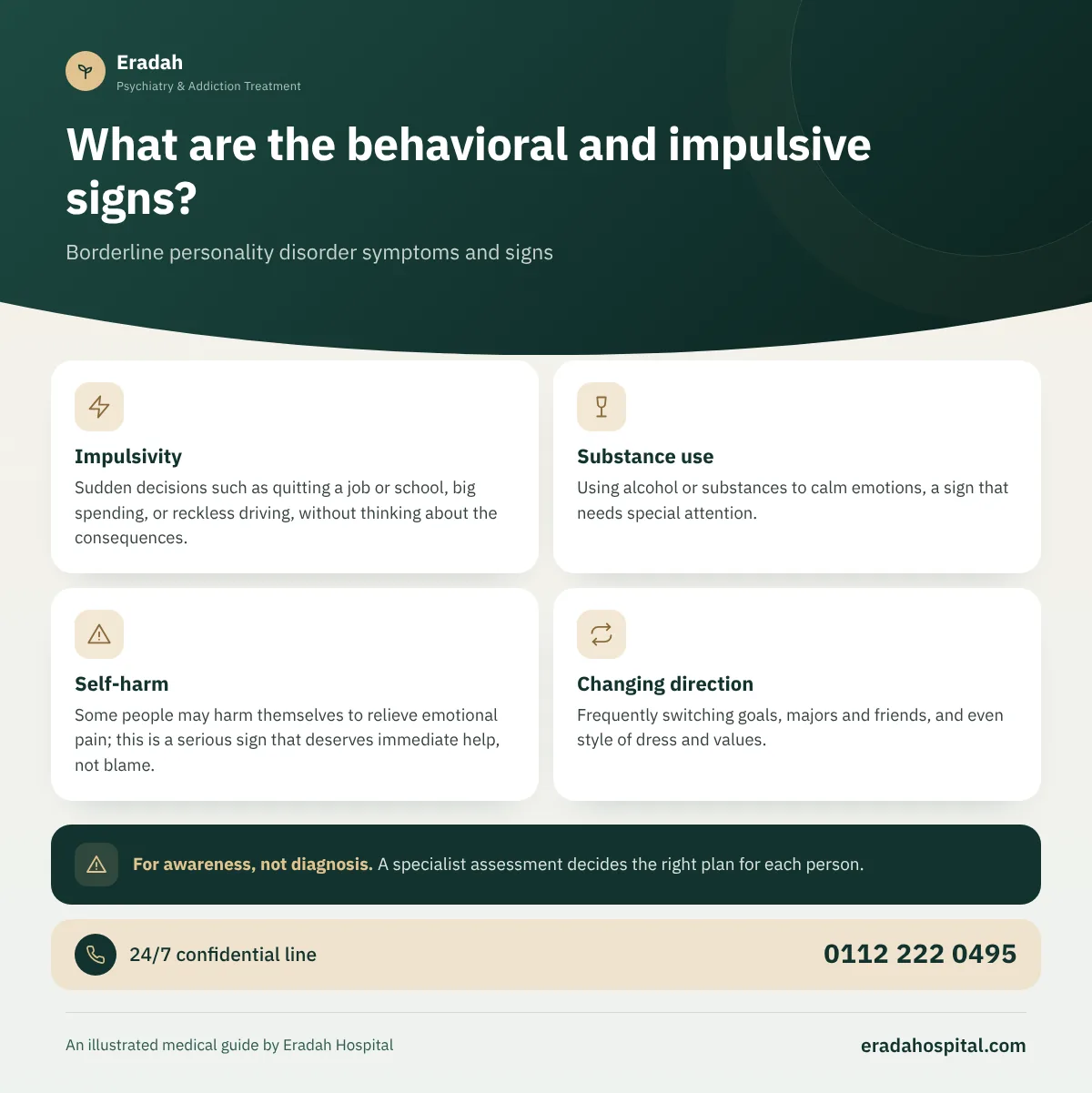
What are the behavioral and impulsive signs?
Sudden decisions such as quitting a job or school, big spending, or reckless driving, without thinking about the consequences.
Using alcohol or substances to calm emotions, a sign that needs special attention.
Some people may harm themselves to relieve emotional pain; this is a serious sign that deserves immediate help, not blame.
Frequently switching goals, majors and friends, and even style of dress and values.
Some people think self-harm in borderline personality disorder is "acting" or an attempt to get attention, but it is usually a desperate way to stop unbearable pain. Responding with blame or mockery makes it worse, while calm listening and seeking specialist help reduce it.
Are thinking and perception affected?
In moments of intense stress, a person may have temporary paranoid thoughts, such as feeling that everyone is against them, or a state of "dissociation" in which they feel they are watching themselves from outside or that what is around them is not real. These states are usually brief and pass when the stress passes, and they differ from the persistent psychosis seen in schizophrenia.
Catastrophic thinking ("they will definitely leave me") and reading negative intentions into other people's neutral actions are also common. These thinking patterns are among the main things that specialist psychological therapies work on.
Do symptoms differ in teenagers, men and women?
| Category | What others may notice | Note |
|---|---|---|
| Teenagers | Marked mood swings, conflicts with parents, self-harm, early experimentation with substances | Some mood swings are normal in adolescence; the difference is intensity, persistence and harm. |
| Women | Fear of abandonment, repeated sadness, sometimes co-occurring eating disorders | Women are diagnosed more often in clinics because they seek help more. |
| Men | Anger, impulsivity, substance use and work problems | Men may be given a different diagnosis or reach treatment through addiction. |
| Middle-aged adults | Less intensity, with emotional sensitivity and difficulty in relationships remaining | Many of the acute symptoms ease over the years. |
What do the symptoms look like from the family's point of view?
A family may see a son or daughter who is "very moody," who loves intensely and then gets intensely angry, feels insulted by the smallest things, and sometimes threatens to leave home or hurt themselves. This picture is exhausting and may push parents to respond with anger or by ignoring, which increases the feeling of rejection and traps everyone in a closed cycle.
When talking to the person, choose a calm time, not the time of a crisis, and talk about your own feelings ("I'm worried about you") rather than accusing ("you're crazy"). Offer help and ask for a specialist assessment, and see the treatment page for the available options.
Questions for self-reflection: do I need an assessment?
- Do I feel real panic when someone close to me goes away, even briefly?
- Do my important relationships often end in sharp, painful breakups?
- Do my feelings change intensely several times in the same day?
- Do I act impulsively and then regret it deeply?
- Do I carry a feeling of emptiness or of not knowing who I am?
- Have I thought about hurting myself, or done so, to relieve emotional pain?
Suicidal thoughts or risk of self-harm? Get help now
- Talking about wanting to die, that “nothing is worth it,” or that they are a burden on others
- Self-harm or hints of it, especially if it is becoming more frequent or more dangerous
- Severe emotional collapse after a breakup, a quarrel, or a feeling of rejection and abandonment
- Sudden withdrawal from people, saying goodbye to them, or getting rid of important belongings
- Heavy use of alcohol or substances in the middle of an emotional crisis, with intense agitation or a feeling of being detached from reality
Stay with the person and do not leave them alone. Listen calmly, without blame or lectures, and ask them directly about suicidal thoughts; asking does not plant the idea. Keep anything they could use to hurt themselves out of reach as far as you can, and call ambulance (123) or go to the nearest emergency department, or call the mental health support line 16328, available around the clock.
Ambulance 123 Mental health support line 16328