Does borderline personality disorder have a single cause?
No. The UK National Health Service says the causes are not fully clear and that the disorder appears to result from a combination of genetic and environmental factors. The most widely accepted model today is the "diathesis-stress" model: a child is born with a sensitive emotional temperament, then grows up in an environment that does not help them understand and regulate their feelings.
One of the best-known explanations is the "biosocial theory" formulated by Marsha Linehan, the founder of dialectical behavior therapy: a child who is highly sensitive to emotions, in an environment that "invalidates" those emotions, meaning it ignores them, mocks them or punishes them. Over time the child does not learn how to name their feelings or how to soothe them, and intense reactions grow with them.
Is borderline personality disorder hereditary?
Genetics plays an important role, but not a complete one. Twin studies estimate that about 40% of the variation in the likelihood of developing the disorder is due to genetic factors, and no single gene has been found responsible. What is usually inherited are traits such as emotional intensity, impulsivity and sensitivity to rejection, not the full disorder itself.
Having a relative with the disorder, or a relative with a mood disorder or addiction, raises the likelihood slightly, but most relatives of people with the disorder do not develop it. For this reason, family history should be less a cause for fear than a reason for early attention.
What is the role of the brain and neurotransmitters?
Research points to differences in the brain circuits responsible for emotional alarm and its control. The amygdala may be more reactive, while areas of the frontal cortex responsible for inhibition and planning work less efficiently under stress. The roles of serotonin in impulsivity and of the body's own opioid systems in pain and attachment are also being studied.
These findings explain part of the picture, but they do not mean the disorder is a "chemical imbalance" that can be fixed with a pill. The brain is also shaped by experience, early trauma can itself change the sensitivity of stress systems, and treatment can retrain them.
How is childhood trauma related to borderline personality disorder?
The UK National Health Service notes that many people with the disorder experienced trauma or neglect in childhood. These experiences include physical, emotional or sexual abuse, emotional neglect, early loss of a parent or separation from one, and living with a parent who has an addiction or an untreated mental illness.
Sometimes the influence is not a single traumatic event but a long climate of insecurity: unpredictable care, conditional love, constant shouting, or feelings that are met with phrases like "you're exaggerating" and "be quiet." In such a climate the child learns that their feelings are dangerous or unacceptable.
What are the psychological and personality factors?
Some children are born more emotionally reactive; they feel faster and more deeply and need longer to calm down.
An unstable relationship with a caregiver produces a constant fear of loss in later relationships.
A weak sense of self makes the person rely on others to define their worth.
Difficulty delaying a response, which is magnified during emotional arousal.
Proponents of mentalization-based therapy see the core of the problem as a weakened ability to "read" minds, that is, to understand what is going on in one's own mind and in others' minds, especially under stress. Schema therapy, on the other hand, holds that basic emotional needs unmet in childhood form negative "schemas" such as "everyone will leave me."
What is the difference between causes and triggers?
Causes are what build the predisposition to the disorder over years, while triggers are the situations that ignite symptoms in someone who already has the predisposition. Understanding this difference matters for families; the event that came right before a crisis is not the "cause of the illness."
| Causes (build the predisposition) | Triggers (ignite symptoms) |
|---|---|
| Genetic predisposition and sensitive temperament | Feeling rejected or ignored |
| Childhood trauma or neglect | Emotional separation or a heated argument |
| An environment that invalidates feelings | Public criticism or embarrassment |
| Insecure attachment to caregivers | Substance use, lack of sleep or severe stress |
What are the risk factors and protective factors?
| Risk factors | Protective factors |
|---|---|
| Family history of mood disorders, personality disorders or addiction | A safe, stable relationship with at least one adult |
| Abuse, neglect or loss in childhood | A family that acknowledges the child's feelings and helps them name them |
| Bullying or isolation at school | Supportive friendships and activities that build a sense of competence |
| Early substance use in adolescence | Early psychological intervention when signs appear |
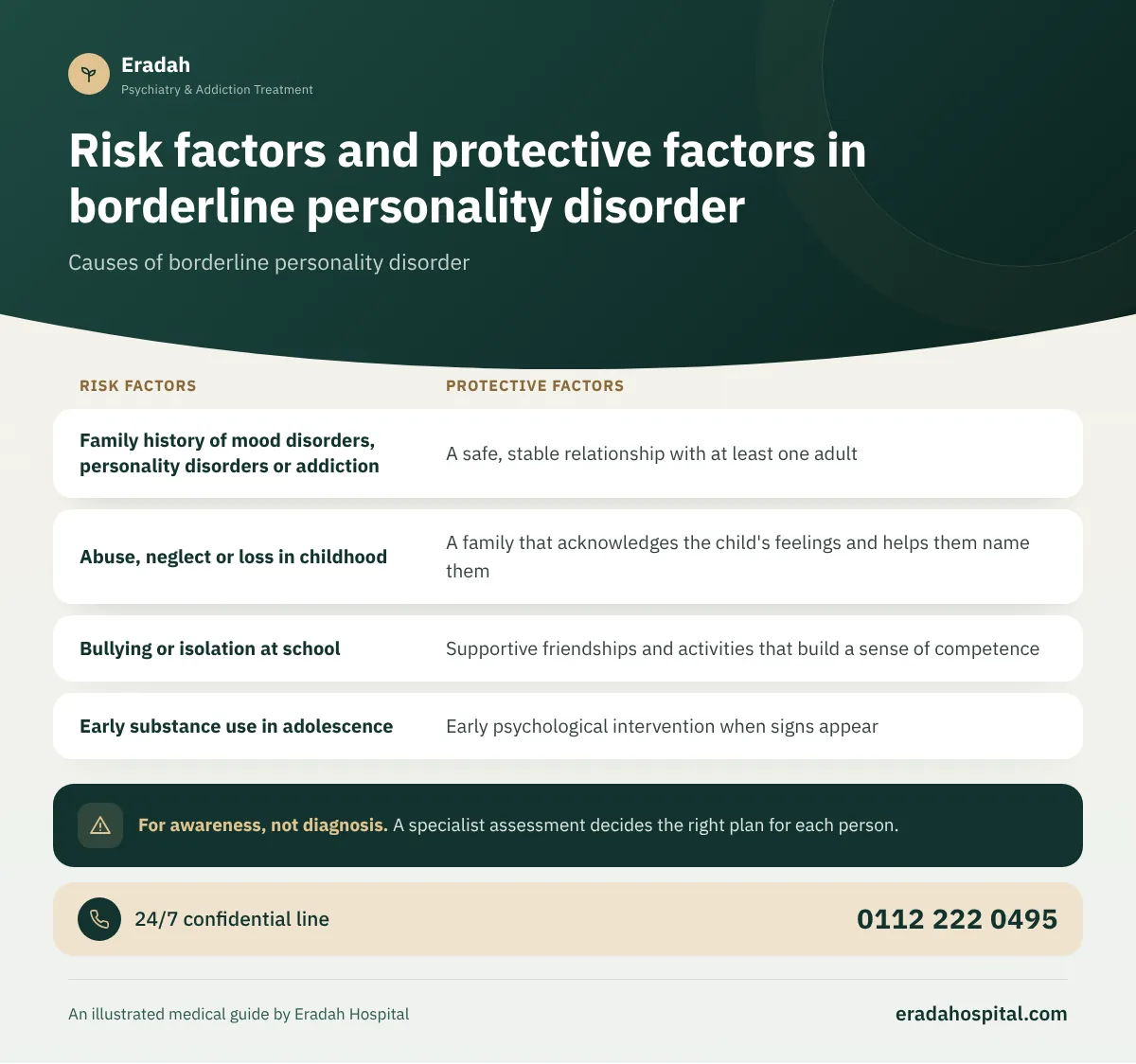
Protective factors are not a guarantee, but they make a real difference. Many of them can be built at any stage, even after symptoms have appeared.
Myths about the causes of borderline personality disorder
- "The mother is to blame": the disorder does not come from one party, and putting all the blame on parents obstructs treatment instead of helping it.
- "Weak faith or willpower": the disorder has a biological and psychological basis, and willpower alone is not enough without suitable tools.
- "Being spoiled is the cause": emotional sensitivity is an innate trait, not the result of pampering.
- "Possession or the evil eye": explanations like these delay effective treatment, while the disorder is scientifically understood and treatable.
The purpose of understanding causes is to guide treatment, not to assign blame: sensitivity needs regulation skills, trauma needs processing, and relationships need safety. Details are on the treatment page.