What are the foundations of borderline personality disorder treatment?
International guidelines, including those of the UK's National Institute for Health and Care Excellence (NICE), agree that the foundation is structured psychotherapy delivered by a trained team, within a clear theoretical framework, and for long enough. The guidelines advise against relying on brief psychological interventions of under three months as a treatment for the disorder.
Treatment focuses on learning emotion regulation skills, reducing harmful behaviors, and building more stable relationships and a meaningful life; it does not aim to "change the personality." It usually begins with a comprehensive assessment and shared goals in which the patient takes part personally, because a sense of control over the plan is part of recovery.
What is dialectical behavior therapy (DBT)?
It was developed by Marsha Linehan specifically for people with borderline personality disorder who repeatedly harm themselves, and it is among the most studied therapies. It combines "acceptance" (accepting feelings as they are) and "change" (learning new ways to act), and usually includes individual sessions, skills groups, and support between sessions during crises.
Noticing feelings and thoughts without being swept away by them or judging them.
Tools for getting through an acute crisis without acting in ways that make it worse.
Understanding and naming feelings and making them less likely to flare up.
Asking for what you need and saying no to what you don't want while keeping the relationship and your self-respect.
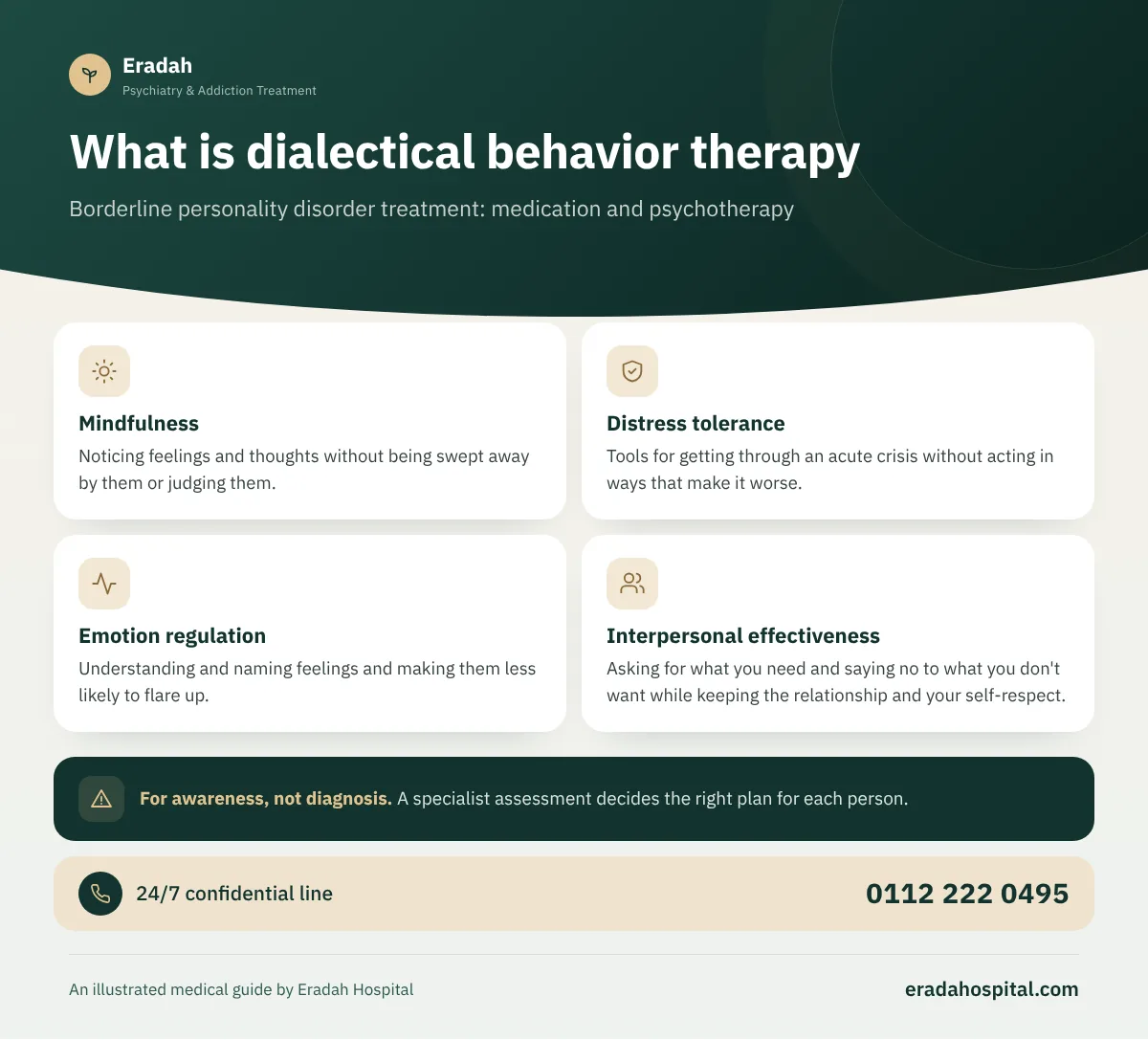
NICE guidelines recommend DBT particularly for women with the disorder whose priority is reducing repeated self-harm, and modified versions are used for teenagers and for people with co-occurring addiction.
What other psychotherapies are effective?
| Treatment | The core idea | What it suits |
|---|---|---|
| Mentalization-based therapy (MBT) | Strengthening the ability to understand what is going on in your own mind and in others' minds, especially when emotional | Relationship difficulties and misreading other people's intentions |
| Schema therapy | Changing deep patterns formed in childhood, such as "everyone will leave me" | People with childhood wounds and repeating patterns |
| Transference-focused psychotherapy (TFP) | A dynamic therapy that uses the relationship with the therapist to understand relationship patterns | People who can commit to intensive, long treatment |
| Good psychiatric management (GPM) | Structured care delivered by a trained psychiatrist, with education and practical goals | Where specialist therapies are not readily available |
No single treatment suits everyone; what matters most is a safe therapeutic relationship, a structured framework, a trained therapist, and enough commitment from both sides. The choice of treatment is made in consultation between doctor and patient according to the most prominent symptoms and the resources available.
Are there medications for treating borderline personality disorder?
No medication is approved by the US Food and Drug Administration to treat the disorder itself. NICE guidelines state that medication should not be used to treat the disorder or its individual symptoms such as mood swings or self-harm, and should be used only to treat a co-occurring disorder such as depression or anxiety, according to its own guidelines.
- Antidepressants: when there is a diagnosed co-occurring depression or anxiety, with special monitoring of young people at the start of treatment.
- Mood stabilizers or some antipsychotics: the doctor may turn to them in specific cases and weighs their benefits against their side effects.
- Short-term sedative: may be used during an acute crisis for a few days, no more than a week according to NICE, with a clear plan for stopping it.
How long does borderline personality disorder treatment take?
- The first weeksAssessment and building trust
A comprehensive assessment, agreement on goals, a written crisis plan, and education for the patient and family.
- The first monthsSafety phase
Focus on reducing self-harm, crises and substance use, and learning distress tolerance skills.
- Six months to a yearBuilding skills
Emotion regulation, improving relationships, and working through deep patterns or trauma.
- After the first yearBuilding a life
Study or work, more stable relationships, and less intensive follow-up with a plan for after treatment ends.
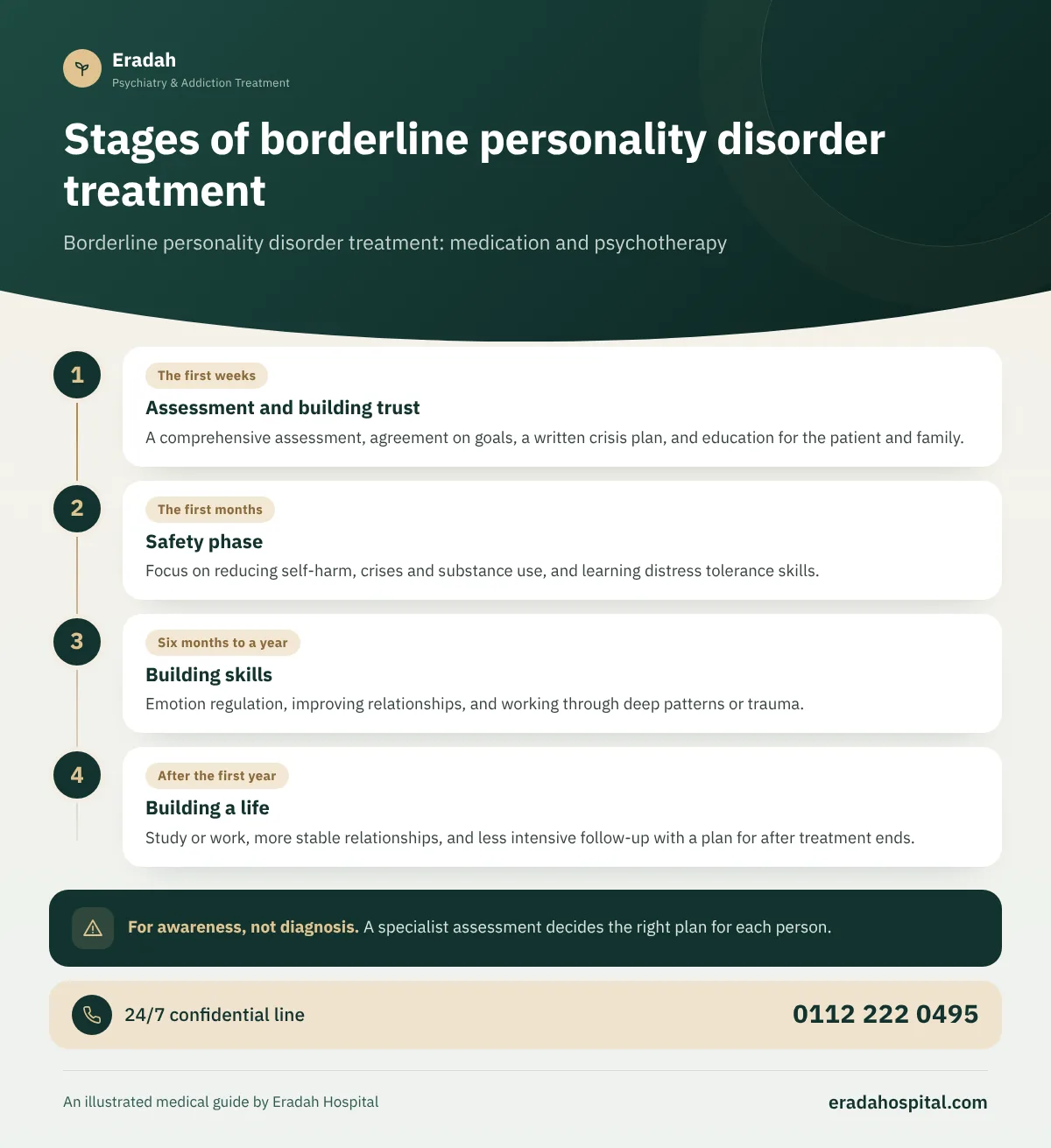
The UK National Health Service notes that effective treatment usually lasts more than a year. Improvement does not follow a straight line; temporary setbacks are expected and do not mean treatment has failed. NICE also warns that the end of treatment or a change of therapist can stir strong feelings, so it should be planned for gradually.
When does a patient need to be admitted to a hospital?
Most treatment takes place in outpatient clinics. NICE recommends that any inpatient stay be short and have a clear purpose, because a long stay may increase dependence on the hospital. Situations that may call for admission include: a high risk to life that cannot be managed at home, a co-occurring addiction that needs medically supervised detox, or a severe co-occurring disorder.
In crisis situations, the guidelines advise the team to stay calm, acknowledge the distress, and explore the person's point of view before considering admission. In Egypt, the Mental Patient Care Law No. 71 of 2009 regulates patients' rights and the rules for admission to psychiatric hospitals.
What is a crisis plan and why is it important?
- Your own early warning signs: what usually happens before a crisis?
- Calming skills you have tried that worked for you.
- People you can call, and the numbers 123 and 16328.
- Steps that make the environment safer at times of danger.
- What you want others to do, and not to do, during a crisis.
The plan is written with the therapist at a calm time and reviewed after every crisis. Having one reduces the feeling of helplessness for the patient and the family alike.
How can the family help with treatment?
NICE recommends asking the patient directly whether they want their family involved, respecting their decision, and introducing the family to support groups. Among the most important things families learn: acknowledging feelings before discussing the situation, calm and consistent boundaries, and not rewarding crises with attention alone while ignoring times of stability.
Family education programs, including skills inspired by dialectical behavior therapy, help parents communicate in ways that reduce escalation and protect them from burnout.
Choosing a hospital for borderline personality disorder treatment
Borderline personality disorder is treated mainly with long, regular psychotherapy that may last a year or more, so the most suitable place is not the one offering the longest stay, but the one with therapists who can stay with the patient during crises and afterward. The guidelines recommend that any inpatient stay be short and have a specific purpose, such as a high risk to life or a co-occurring addiction that needs detox. Before you decide, check for:
- Structured, evidence-based psychotherapy, such as DBT skills, rather than general supportive sessions.
- A written crisis plan drawn up with the patient at a calm time, with clear steps for when self-harm occurs.
- A psychiatrist who reviews medication and does not pile on sedatives, since no drug is approved for the disorder itself.
- The ability to treat alcohol, sedatives or other substances that many patients turn to in order to calm their feelings.
- Family counseling that teaches the family how to respond to angry outbursts and fear of abandonment without escalating.
At Eradah, assessment is carried out by psychiatrists, and treatment is built on individual and group sessions with psychologists, with the inpatient psychiatry unit used when needed for a short period of stabilization, along with the family program. If substance use is part of the picture, read Borderline Personality Disorder and Addiction.
Borderline personality disorder treatment at Eradah
At Eradah, treatment begins with a comprehensive psychiatric assessment that identifies the most prominent symptoms and any co-occurring conditions, especially depression and substance use. It is followed by an individual plan based on evidence-based therapies such as DBT skills, with medical follow-up of medication when needed for a co-occurring disorder, a family counseling program, and a clear crisis plan. Care is delivered in complete confidentiality and with respect for the patient's dignity.