What is the link between borderline personality disorder and addiction?
The US National Institute of Mental Health lists substance use disorders among the conditions that most often occur together with borderline personality disorder, and scientific reviews confirm this strong link. In addiction treatment centers in particular, a notable share of patients have features of this disorder without ever having been diagnosed.
This is what is called "dual diagnosis": having a mental health disorder and a substance use disorder at the same time, each feeding the other. That is why asking about one should always lead to asking about the other.
Why do people with borderline personality disorder turn to substances?
Intense emotions are painful, and a substance offers quick calm, even if only temporary.
Difficulty pausing before acting makes it quicker to try substances and easier to repeat.
A chronic feeling of emptiness drives a search for any strong sensation to fill it.
The wish to belong, or a relationship with a partner who uses substances, opens the door to use.
Specialists call this "self-medication": a person trying to treat their own pain with a substance. The idea is humanly understandable, but the result is the opposite of what is hoped for: what soothes tonight fuels tomorrow, and over time the substance becomes a new source of pain instead of a way out.
Which substances are misused most often with borderline personality disorder?
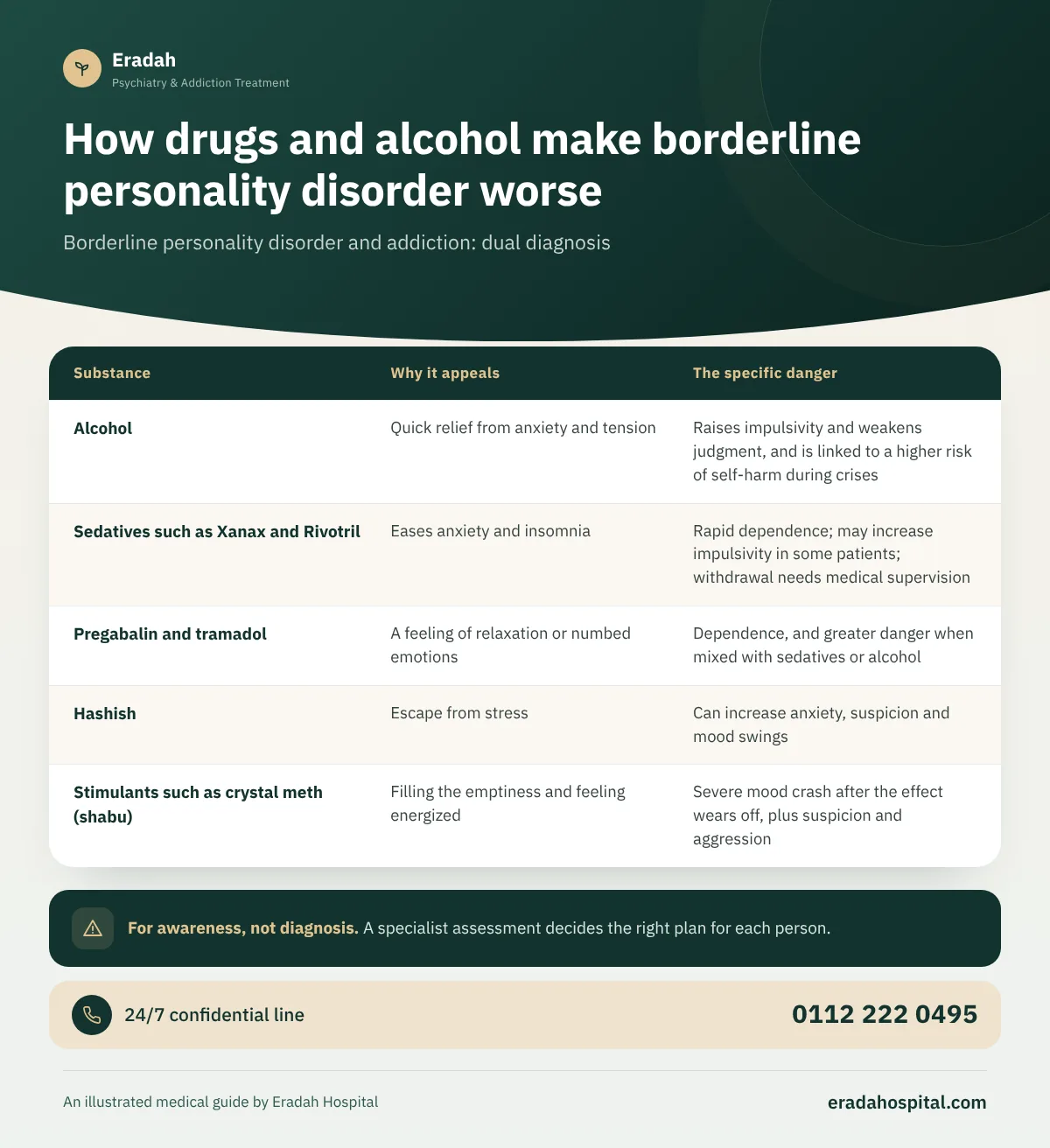
| Substance | Why it appeals | The specific danger |
|---|---|---|
| Alcohol | Quick relief from anxiety and tension | Raises impulsivity and weakens judgment, and is linked to a higher risk of self-harm during crises |
| Sedatives such as Xanax and Rivotril | Eases anxiety and insomnia | Rapid dependence; may increase impulsivity in some patients; withdrawal needs medical supervision |
| Pregabalin and tramadol | A feeling of relaxation or numbed emotions | Dependence, and greater danger when mixed with sedatives or alcohol |
| Hashish | Escape from stress | Can increase anxiety, suspicion and mood swings |
| Stimulants such as crystal meth (shabu) | Filling the emptiness and feeling energized | Severe mood crash after the effect wears off, plus suspicion and aggression |
Mixing substances, especially sedatives with alcohol or opioids, multiplies the danger to breathing and consciousness. Taking a large amount of medication or substances during an emotional crisis is an emergency that requires calling an ambulance (123) immediately.
How do substances worsen borderline personality disorder symptoms?
- Stronger mood swings: the effect followed by withdrawal creates mood waves on top of the original ones.
- Greater impulsivity: substances weaken inhibition, which leads to more reckless decisions and conflicts.
- Higher risk of self-harm: crises under the influence of substances are more dangerous and harder to calm.
- More turbulent relationships: lying, hiding and arguments about use feed the fear of abandonment.
- Slower treatment: it is hard to learn emotion regulation skills when the brain is under the influence of a substance.
The reverse is also true: addiction increases symptoms that resemble borderline personality disorder, such as mood swings and impulsivity. This is why the doctor takes care to assess the person after a period of abstinence before making a final diagnosis.
What are the warning signs in someone with borderline personality disorder who has started using substances?
- Drinking or using more, particularly after arguments or breakups.
- Asking for sedative medication from more than one doctor or pharmacy.
- Hiding medication or bottles, or lying about where time is spent.
- Emotional crises more intense than usual, with slurred speech or unexplained drowsiness.
- New friends connected to substance use, and distance from old friends.
If you notice these signs, speak calmly at a time when the person is not under the influence, express your concern without blame, and suggest a joint assessment of both mental health and substance use.
Why must both conditions be treated together?
Treating addiction alone, without attention to emotion regulation, leaves the person without tools to face the pain that drove them to use, so the chance of relapse rises. Treating borderline personality disorder while substance use continues makes learning difficult. That is why guidelines recommend integrated treatment, in which the addiction team and the mental health team work together within one plan.
NICE guidelines state that people with alcohol or substance dependence should be referred to specialist services, while the care coordinator continues to follow the borderline personality disorder treatment, so that the patient does not fall between two services.
How is DBT adapted for people with addiction?
A version of dialectical behavior therapy has been developed for people with borderline personality disorder and a substance use disorder. It is built around the goal of "dialectical abstinence": a clear commitment to stopping completely, while handling any slip without destructive blame, by analyzing it and returning quickly to the plan.
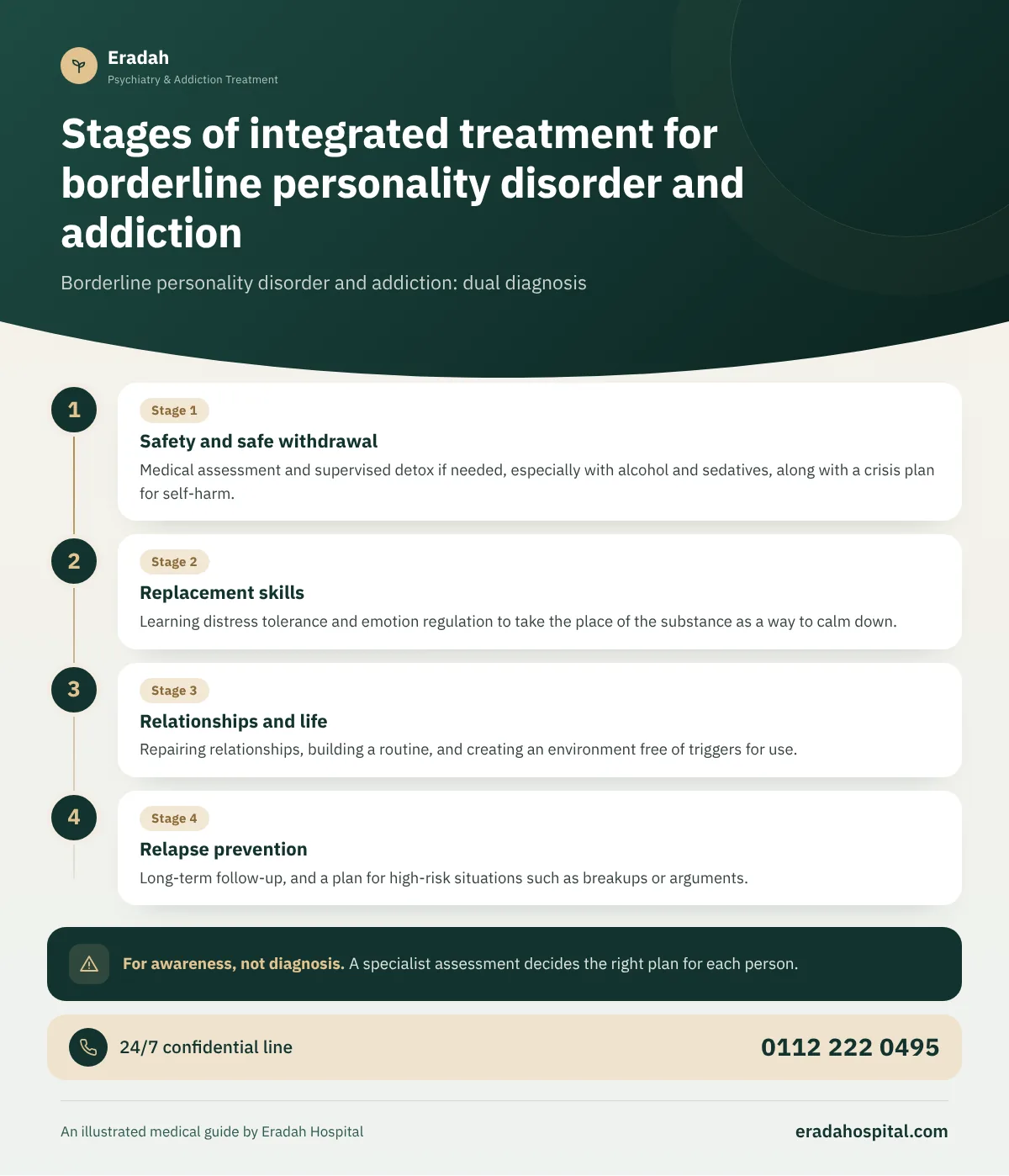
- Stage 1Safety and safe withdrawal
Medical assessment and supervised detox if needed, especially with alcohol and sedatives, along with a crisis plan for self-harm.
- Stage 2Replacement skills
Learning distress tolerance and emotion regulation to take the place of the substance as a way to calm down.
- Stage 3Relationships and life
Repairing relationships, building a routine, and creating an environment free of triggers for use.
- Stage 4Relapse prevention
Long-term follow-up, and a plan for high-risk situations such as breakups or arguments.
Are there special medication considerations in dual diagnosis?
Yes. Where possible, the doctor avoids medications that cause dependence, such as benzodiazepine sedatives, in people with a history of substance use, and prefers lower-risk options when a co-occurring disorder needs treatment. Medications approved for treating alcohol or opioid addiction may be used depending on the case and on a medical decision.
The team also keeps track of how much medication the patient has on hand during difficult periods as part of the safety plan, in cooperation with the family and with the patient's consent.
How can the family help with dual diagnosis?
A family facing borderline personality disorder and addiction together lives under double pressure. What helps here: understanding that substance use is often an attempt to soothe pain, not funding or covering up the use, and setting clear boundaries calmly, while continuing to show love and willingness to help.
At Eradah we offer an integrated dual diagnosis program that brings psychiatric assessment, addiction treatment, emotion regulation skills and family counseling together in one plan. You can also read our page on treating borderline personality disorder for the psychological treatments in detail.
Suicidal thoughts or risk of self-harm? Get help now
- Talking about wanting to die, that “nothing is worth it,” or that they are a burden on others
- Self-harm or hints of it, especially if it is becoming more frequent or more dangerous
- Severe emotional collapse after a breakup, a quarrel, or a feeling of rejection and abandonment
- Sudden withdrawal from people, saying goodbye to them, or getting rid of important belongings
- Heavy use of alcohol or substances in the middle of an emotional crisis, with intense agitation or a feeling of being detached from reality
Stay with the person and do not leave them alone. Listen calmly, without blame or lectures, and ask them directly about suicidal thoughts; asking does not plant the idea. Keep anything they could use to hurt themselves out of reach as far as you can, and call ambulance (123) or go to the nearest emergency department, or call the mental health support line 16328, available around the clock.
Ambulance 123 Mental health support line 16328