“The school says he’s become spaced out and doesn’t play with anyone, and we thought he was just shy.” Many families notice a change in their child and don’t know whether it is a phase that will pass or a mental health problem. This guide gathers what parents need to understand mental illness in children: the types, the warning signs, and when a child needs a doctor.
How common is mental illness in children and teens?
The World Health Organization estimates that 14.3% of adolescents aged 10 to 19 have a mental disorder, that these conditions account for 15% of the burden of disease in this age group, and that most go undetected and untreated. The organization presents these estimates:
| Disorder | Ages 10 to 14 | Ages 15 to 19 |
|---|---|---|
| Anxiety disorders | 4٫1% | 5٫3% |
| Depression | 1٫3% | 3٫4% |
| ADHD (attention-deficit/hyperactivity disorder) | 2٫7% | 2٫2% |
| Conduct disorder | 3٫3% | 1٫8% |
In a pooled analysis of 192 studies covering more than 700,000 people, 34.6% of mental disorders began before age 14 and 48.4% before age 18, with the peak of onset at 14.5 years. The US National Institute of Mental Health (NIMH) stresses that many affected adults had symptoms in childhood that nobody noticed.
Types of mental illness in children
The most common disorders at these ages, including separation anxiety, phobias, and social anxiety.
Persistent sadness or irritability and loss of enjoyment, increasing in adolescence.
Difficulty paying attention, or excessive movement and impulsivity, affecting schoolwork.
Differences in communication and social interaction with repeated patterns of behavior.
Oppositional defiant disorder and conduct disorder: anger and defiance, or violating the rights of others.
Obsessions and rituals, motor and vocal tics, or eating disorders that begin in adolescence.
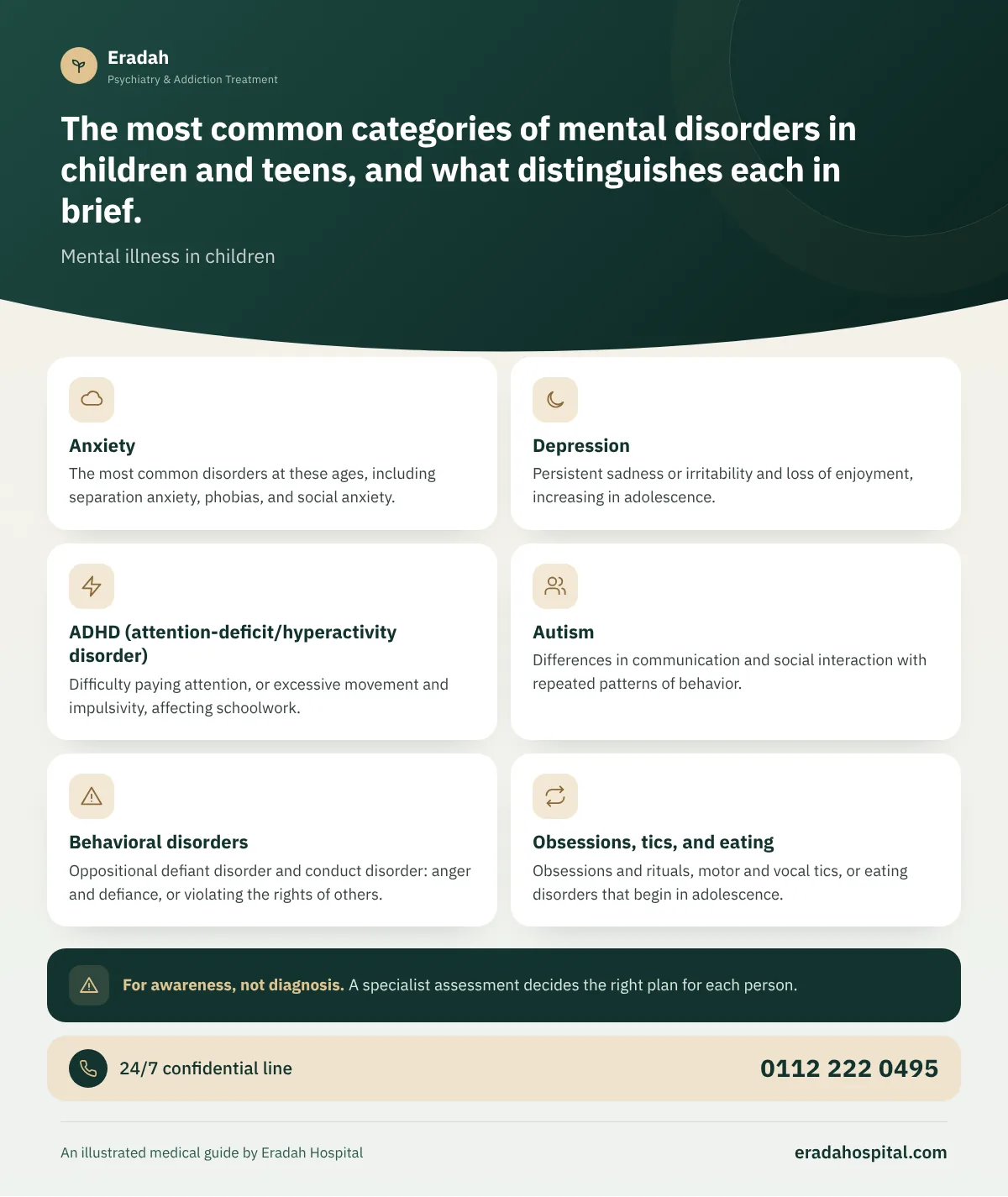
Each has its own detailed page, such as autism, ADHD, Tourette syndrome, and eating disorders. The World Health Organization classifies autism, ADHD, and intellectual disability among the neurodevelopmental disorders that appear during the developmental period.
Signs of mental illness in young children
NIMH notes that younger children may benefit from an evaluation if they:
- Have frequent tantrums or are extremely irritable most of the time.
- Seem very afraid or anxious.
- Often complain of stomach aches or headaches with no known medical cause.
- Are in constant motion and cannot sit still, except in front of screens.
- Sleep too much or too little, have recurring nightmares, or seem sleepy during the day.
- Show no interest in playing with other children or find it hard to make friends.
- Have had a recent drop in grades or are struggling at school.
- Repeat actions or check things many times for fear that something bad will happen.
Signs of mental disorder in older children and teens
- Loss of interest in things they used to enjoy, and low energy.
- Sleeping too much or too little, or being sleepy all day.
- Periods of very high energy and activity with a much lower need for sleep.
- Spending more and more time alone and avoiding friends and family.
- Dieting or exercising excessively, or fear of gaining weight.
- Self-harm, smoking, alcohol or drug use, or risky or destructive behavior.
- Thoughts of suicide, hearing voices that others do not hear, or believing that someone is controlling their thoughts.
Substance use at this age needs special attention because it often hides a mental disorder behind it, and you can find the early signs in the guide to teen addiction.
When is behavior part of development?
NIMH acknowledges that it can be hard to tell normal, troublesome behavior in developmental stages from a problem that deserves a doctor. The rule it suggests: if the signs last weeks or months and affect the child's daily life at home, at school, or with friends, contact a specialist. A tantrum in a three-year-old is normal, but violent daily outbursts in a ten-year-old deserve a question.
Why do children develop mental disorders?
Genetics and the child's temperament interact with the environment. The World Health Organization notes that among the biggest influences on adolescents' mental health are quality of life at home and relationships with peers, and that violence, especially bullying and sexual violence, harsh parenting, and severe socioeconomic problems are known risks. The more risk factors a teen is exposed to, the more likely their mental health is to be affected. In contrast, a safe and supportive environment at home and school, healthy sleep, exercise, and learning problem-solving and emotion-management skills are protective.
What should parents do if they suspect a mental health problem?
- Write down what you notice: when it started, how often it happens, where it shows up, and what came before it.
- Ask the school about his behavior there; the full picture helps the doctor.
- Start with the pediatrician to rule out a physical cause, then see a child psychiatrist.
- Talk to the child calmly and without accusing, and listen to what they say about their feelings.
- Do not hide the matter out of fear of “what people will say”; delay makes treatment harder.
Treating mental illness in children
NIMH stresses that the earlier treatment begins, the more effective it is, and that it may prevent more severe and longer-lasting problems as the child grows. Treatment in children relies mainly on psychotherapy with family involvement, such as cognitive behavioral therapy and parent training, along with school support, and the doctor may add medication in specific cases after assessment. Do not start or stop any medication for your child without a doctor.
Eradah sees children and adolescents for psychological assessment, treatment, and follow-up, coordinating with the pediatrician and the school when needed. The first consultation is free and confidential, and the family can attend it alone to understand what their child is going through and learn the next step, whether the worry is about a child's behavior or a teen who has started using substances. If a parent also needs treatment, a stable mother or father is among the strongest protections for a child. You can find more about mental disorders in general in the guide to mental illness.