What is Tourette syndrome?
“My son blinks and makes a sound from his throat all day, and his teachers think he’s being funny.” This sentence is heard again and again in pediatric and psychiatric clinics. What looks like stubbornness may be Tourette syndrome, a medically recognized neurological condition, and understanding it completely changes how home and school treat the child.
Tourette syndrome, or Gilles de la Tourette syndrome, named after the French physician who described it, is a disorder of nervous system development that causes tics: sudden, rapid, repeated movements or sounds that the person does not intend. The World Health Organization classifies it among diseases of the nervous system under the code 8A05.00 in the International Classification of Diseases, ICD-11.
According to the UK’s National Health Service (NHS), the diagnosis is considered when tics begin before age 18, last a year or more, and include both movement and sound. Many children go through passing tics that do not necessarily mean they have the syndrome.
What do tics look like in Tourette syndrome?
It often starts with simple tics of the face and head, such as blinking, grimacing and head jerking, and then vocal tics are added, such as throat clearing and repeated sniffing. Tics change and wax and wane, calming for weeks and then flaring. Many are preceded by an urgent inner sensation, similar to the need to sneeze. For the full details, including simple and complex types and what worsens and eases them, read Symptoms and Signs of Tourette Syndrome.
How common is Tourette syndrome?
These figures mean Tourette syndrome is not as rare as many think, but mild cases often go undiagnosed because the family regards it as a “habit” that will pass. There are no unified Egyptian figures, but delayed diagnosis is common when tics are interpreted as misbehavior.
How does Tourette syndrome change with age?
The MSD Manual describes a typical course in most children, with wide variation from child to child:
- Ages 4–6The start
Often simple motor tics, such as blinking or head jerking.
- LaterSounds appear
Vocal tics such as throat clearing and sniffing may be added, completing the picture.
- Ages 10–12The peak
The most severe period of tics for many children.
- AdolescenceEasing
Tics gradually ease in most.
- AdulthoodStabilization
They disappear or ease considerably, while related conditions may continue.
The StatPearls review confirms that tics usually recede with adulthood, but the accompanying psychiatric and neurological conditions may persist afterward, which is why “the blinking has gone” is not enough to be fully reassured.
Why does Tourette syndrome happen?
The exact cause is still unknown, but the MSD Manual explains that tic disorders tend to run in families, which is why the doctor asks about affected relatives. The problem is thought to lie in the brain circuits that regulate and inhibit movement. It is not the result of wrong parenting or spoiling, and has nothing to do with the evil eye or possession.
Doctors distinguish between primary tics and secondary tics, which can appear with excessive use of stimulants such as cocaine, or with other neurological conditions, which is why the doctor always asks about medications and substances before confirming the diagnosis.
What conditions accompany Tourette syndrome?
The most common according to the MSD Manual, and sometimes it affects schooling more than the tics do.
Intrusive thoughts and repeated rituals that may blur with complex tics.
Makes tics worse, and other people’s comments make it worse.
Problems with reading or writing that need school support.
Appears more in teenagers and adults with bullying and isolation.
Difficulty falling asleep or broken sleep increases fatigue and tics.
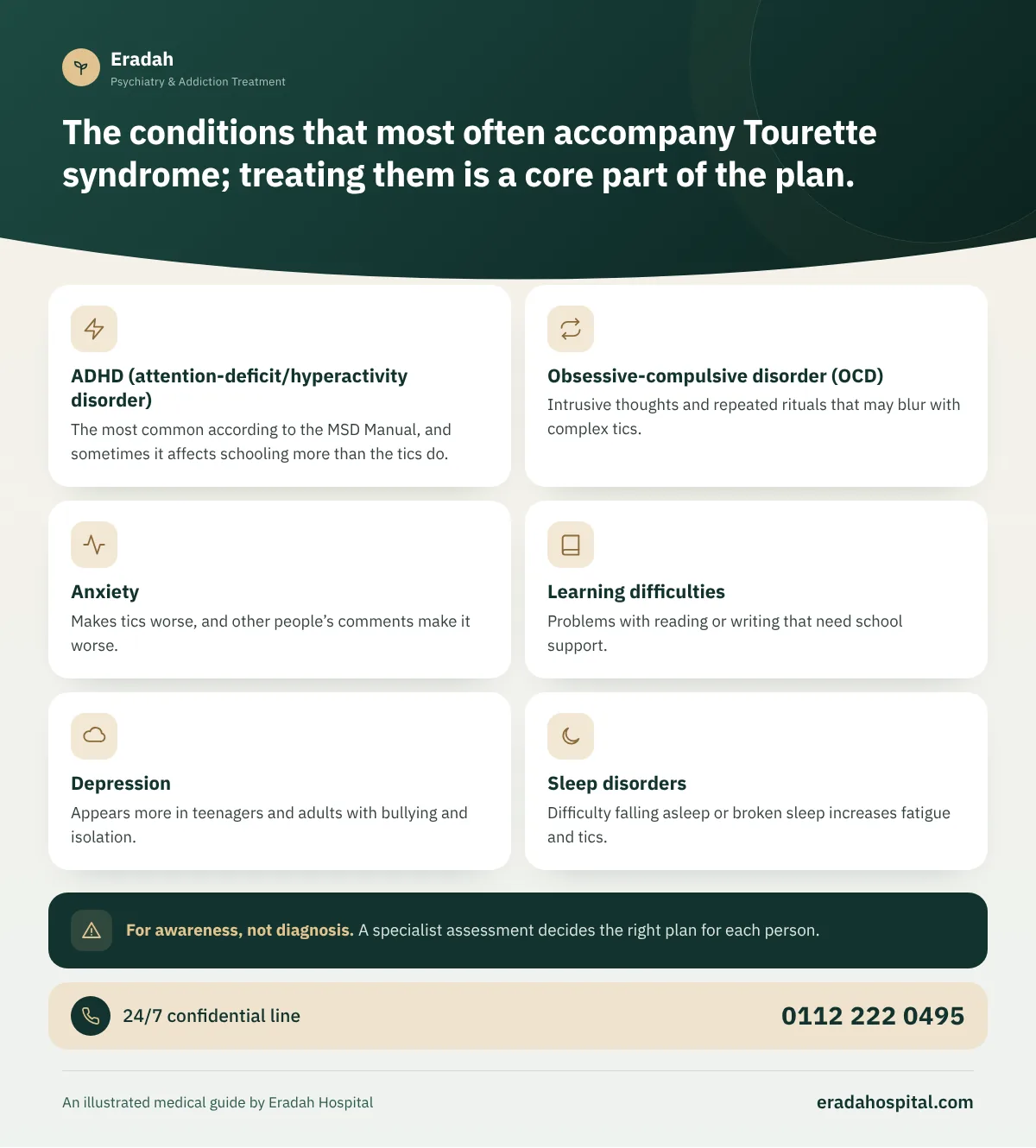
The MSD Manual notes that teenagers and adults with the condition may also suffer from depression, bipolar disorder or substance use disorder. That is why a good assessment looks for ADHD, obsessive-compulsive disorder and others, not for tics alone.
Common myths about Tourette syndrome and the truth
| The myth | The truth |
|---|---|
| Every person with Tourette swears and curses | Involuntarily blurting out obscene words occurs in fewer than 10% of people with the condition according to StatPearls, and the NHS describes it as rare. |
| They could stop it if they wanted to | They can suppress it only for seconds or minutes, and then it often returns stronger. |
| Punishment teaches them self-control | Punishment increases tension, and tension increases tics. |
| People with it are less intelligent | Intelligence is usually normal; difficulties at school come from accompanying conditions or bullying. |
| It will stay with them for life at the same intensity | It eases in many people in adolescence and adulthood. |
What is the difference between Tourette syndrome, transient tics and obsessive-compulsive disorder?
Not every repeated blink is Tourette. The American DSM-5-TR criteria, as presented in the MSD Manual, divide primary tic disorders into three levels on one spectrum: provisional tic disorder lasting less than a year, persistent (chronic) tic disorder with motor tics only or vocal tics only for more than a year, and then Tourette syndrome when movement and sound are both present for more than a year.
A compulsion in OCD, by contrast, comes in response to a worrying thought to ease anxiety, while a tic comes in response to an urgent physical sensation. The 2022 European guidelines also stress the need to distinguish tics from functional movement disorders in children and adults, a different condition we explain in our guide to conversion disorder.
How is Tourette syndrome treated?
There is no treatment that cures it completely, and many children do not need treatment for tics at all; the first step is always explanation and reassurance. When tics disrupt life, comprehensive behavioral intervention for tics comes next, then medication if that is not enough, along with treatment of accompanying conditions. The full details of the options and their side effects are in Treatment of Tourette Syndrome.
When should you see a doctor about tics?
- Tics lasting more than a few months, or combining movement and sound.
- Tics that cause pain or injury, such as violent neck jerking.
- Schooling, work or relationships being affected because of them.
- Obsessive thoughts, severe distractibility, anxiety or persistent sadness.
- Tics appearing after starting a medication or using a stimulant substance.
Assessment usually begins with a pediatrician or neurologist, and the psychiatrist takes part in treating accompanying conditions.
How can the family support a child with Tourette syndrome?
The most important thing a family can offer is a home where the child is not judged for a movement they do not control. Calmly ignore the tic, listen to what the child says rather than how they say it, and do not ask them to “stop it.” Tell their siblings about the condition so it does not become material for mockery at home. And watch for signs of bullying, sadness and withdrawal, which are more harmful to the child than the tic itself.
Tourette Syndrome Guide: Everything You Need to Know
We have gathered everything about Tourette syndrome into 2 pages, each answering one question in detail. Choose what you are looking for:
Tourette syndrome symptoms and signs
What are the symptoms of Tourette syndrome? Learn about simple and complex motor and vocal tics, the sensation that comes before them, what worsens and eases them, whether people with it swear, and when to see a doctor.
Tourette syndrome treatment: medication and behavioral therapy
Treatment of Tourette syndrome: when tics need treatment at all, comprehensive behavioral intervention for tics (CBIT), medication classes and their effects, treatment of accompanying conditions, and the role of family and school.
A harmful tic or severe despair? Ask for help now
- A violent tic of the neck or head causing severe pain, injury or sudden weakness in the arms or legs
- Severe tics appearing suddenly over a day or a few days, especially after an infection or a new medication
- Severe muscle stiffness, fever or confusion after starting a new medication
- Talk of death or self-harm because of bullying, isolation or constant embarrassment
- A teenager or adult turning to alcohol, sedatives or stimulants to calm tics
Stay calm, do not blame the person for their tics or ask them to suppress them, stay beside them and quietly ask how they feel. If a physical injury or sudden symptoms appear after a medication, call the treating doctor or go to the nearest emergency room. If they talk about harming themselves, do not leave them alone; call an ambulance (123) or the mental health support line 16328 (24 hours).
Ambulance 123 Mental health support line 16328