What is autism?
“My son is two and a half and doesn't talk, and when I call him he doesn't look, and everyone tells me he's still little.” Many families carry this question in silence. Knowing what autism is does not mean worrying about every delay, but it does mean not losing precious time in which early support could have made a real difference.
The World Health Organization describes autism as a diverse group of conditions related to brain development, shared by some difficulty with social interaction and communication, along with unusual patterns of activities and behaviors, such as difficulty moving from one activity to another, intense attention to detail, and unusual reactions to sounds, lights, and textures.
The UK's National Health Service (NHS) describes it as a difference in the way the brain develops, which a person is born with, and not a disease that suddenly strikes them or an “infection” they catch. For this reason, many autistic people prefer to talk about support and adaptation rather than “cure.” Medically it is called a neurodevelopmental disorder, like attention-deficit/hyperactivity disorder (ADHD), because it is linked to the development of the nervous system from early childhood.
It is called a “spectrum” because the picture differs greatly from one person to another. According to the World Health Organization, the intellectual level of autistic people ranges from severe disability to above-average abilities, and some live completely independently while others need lifelong care and support. Abilities and needs themselves also change with age.
This is why doctors abandoned the old separate labels such as Asperger syndrome, and now diagnose “autism spectrum disorder” and then specify the level of support the person needs. The full details of the labels and levels are on the types of autism page.
Is autism common? Autism in numbers
The gap between the global and US figures looks large because the global figure is an estimated average, and figures vary a great deal with the research method and the ability to detect cases. The World Health Organization notes that the prevalence of autism in many low- and middle-income countries is unknown, and no single published national figure exists for Egypt. The rise in figures over the years also reflects, to a large extent, better awareness and diagnosis.
Sources: World Health Organization, Autism fact sheet 2025; US Centers for Disease Control and Prevention (CDC), Autism and Developmental Disabilities Monitoring Network data 2022.
How does autism appear? A quick look at the signs
The signs revolve around two areas: communication and interaction, such as little response to their name and little pointing or sharing of interest, and repetitive behaviors and interests, such as hand flapping, lining up toys in rows, and intense distress at change, along with a different sensitivity to sounds, lights, and food. They may appear in the first year or may not become clear until school age, and some adults and girls may learn to hide them. Details for each age are on the autism symptoms and signs page.
How does an autistic person experience the world?
Imagine that an ordinary sound like a fan reaches you with an irritating sharpness, that bright light strains your eyes, that a shirt label bothers your skin all day, and then you are asked to smile and greet guests. This is a rough picture of what the difference in sensory processing described by the NHS in many autistic people can mean, and it explains behaviors that may look to others like “stubbornness” or “bad manners.”
The NHS explains that repetitive movements, known as stimming, can be soothing and enjoyable for a child, and that a fixed routine gives them a sense of security in an unpredictable world. Masking, meaning imitating other people's behavior and hiding the signs, can make a person look “typical” from the outside, but it makes daily activities and social interaction tiring and draining.
Why does autism happen?
There is no single cause. The World Health Organization points to multiple genetic and environmental factors that make autism more likely, with genetics playing the biggest part. The popular claim that a “cold” mother or a parenting style causes autism has no basis. The details are on the causes of autism page.
Autism or something else? Conditions that may look similar
Not every child with delayed speech is autistic, and not every very active child has ADHD. This is a simplified comparison that helps explain the differences, not to make a diagnosis:
| Autism | ADHD (attention-deficit/hyperactivity disorder) | Simple speech delay | |
|---|---|---|---|
| Core area | Communication and interaction, with repetitive behaviors | Attention, hyperactivity, and impulsivity | Delay in producing words only |
| Eye contact, pointing, and sharing interest | Reduced or different | Usually present | Present, and used to make up for the lack of speech |
| Play with others | Prefers to play alone or in a repetitive way | Plays with others but impulsively | Plays and interacts normally |
| Routine and change | Intense distress at change | Does not usually cling to routine | Not much affected |
| Sensory sensitivity | Common and clear | Not a core feature | Not a core feature |
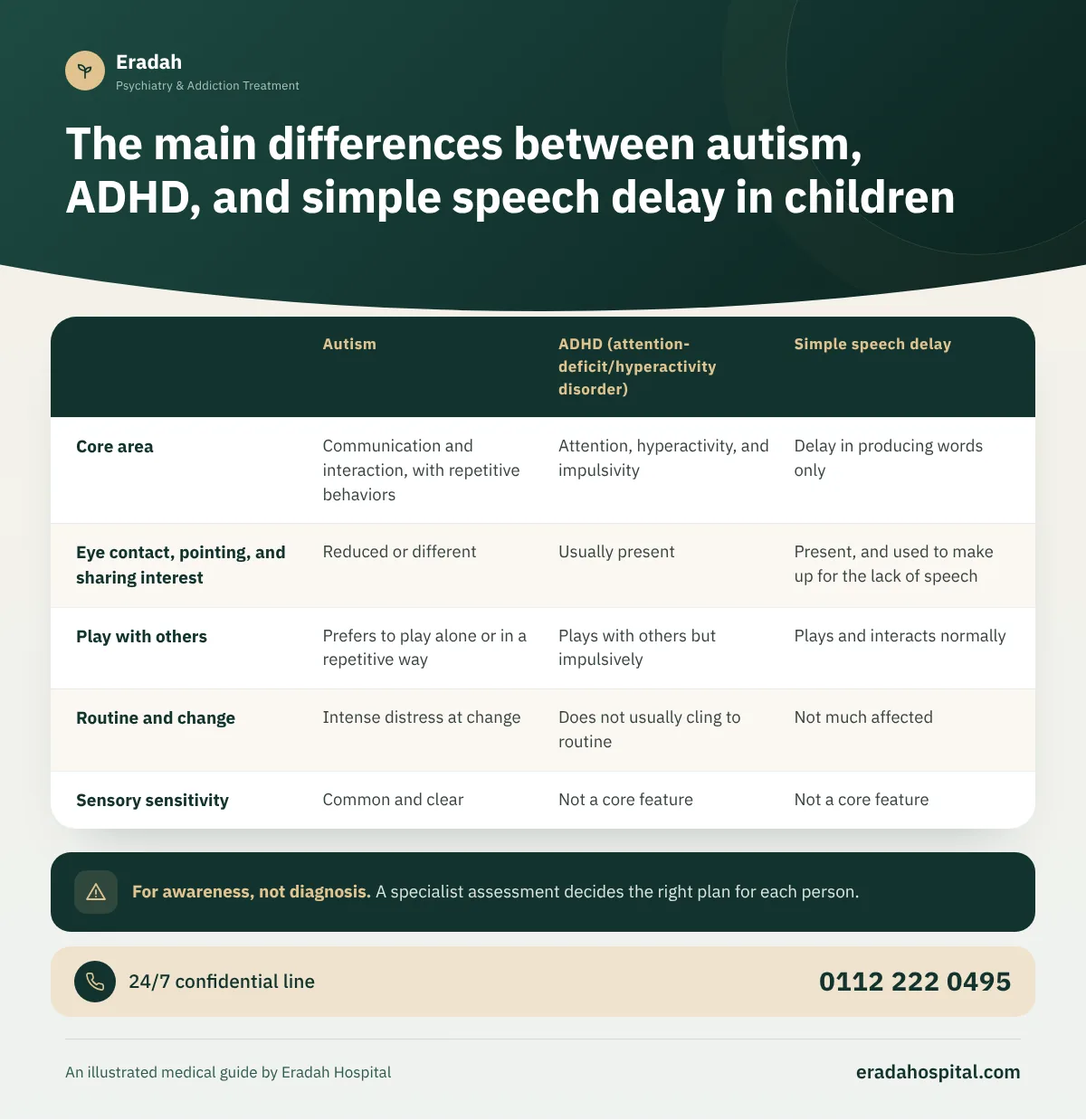
Every child with delayed speech needs a hearing test, because hearing loss can look like autism. Autism and ADHD can also occur in the same child. In adults, autism may be confused with social anxiety disorder or schizoid personality. The difference is that the communication difficulties in autism have been present since childhood and are not due to fear of judgment or a lack of interest in relationships.
Common myths about autism and the truth
| The myth | The truth |
|---|---|
| Autism is caused by maternal neglect or parenting | According to the NHS, autism is a difference a person is born with. Parenting does not create it, although support improves its course. |
| Every autistic person is a genius, or every autistic person has an intellectual disability | According to the World Health Organization, intellectual level varies widely, from severe disability to exceptional abilities. |
| An autistic person doesn't feel or love | They may find it hard to describe their own feelings or read other people's, but they feel, love, and hurt like everyone else. |
| Autism is a childhood condition that disappears with age | It lasts for life and its presentation changes, and many people are not diagnosed until adolescence or adulthood. |
| A particular diet, supplement, or session cures it | No treatment removes autism, and gluten-free and casein-free diets have not been shown to help, according to the MSD Manual. |
What conditions can accompany autism?
Often occurs together with autism, and needs its own assessment and treatment.
One of the things that most exhausts autistic people, especially with change and crowds.
Increases in adolescence and adulthood with isolation and difficulty in relationships.
More common in autistic people and needs neurological follow-up.
Difficulty falling asleep or frequent waking affects behavior and concentration.
The level of intellectual ability varies widely from person to person.
The World Health Organization and the NHS note that autistic people are more prone to conditions such as epilepsy, depression, anxiety, and eating disorders. Behind many “difficult behaviors” there is pain, sleeplessness, or anxiety that has not yet been discovered.
Is autism related to addiction?
It was widely believed that autistic people rarely use substances, but a Swedish population study that followed about 27,000 people diagnosed with autism found that autism alone, without ADHD or intellectual disability, was linked to roughly half the risk of substance use problems, and the risk was highest in those who have both autism and ADHD. Some adults may turn to alcohol or sedatives to bear social anxiety or sensory stress, and here they need a dual diagnosis assessment that takes their way of communicating into account.
When should you seek a specialist assessment?
- If the baby does not respond to their name or does not show clear facial expressions at about 9 months.
- If the child does not point to show you something that interests them at about 18 months.
- If the child loses words or social skills they had already gained, at any age.
- If the school notices clear difficulties with communication and making friends, along with repetitive behaviors.
- If an adult feels that difficulty communicating and social exhaustion have been with them since childhood and disrupt their work and relationships.
The ages above come from the list of signs published by the CDC. The absence of one sign does not mean autism, but it does mean that an assessment is better than waiting. The assessment steps and the M-CHAT screening questionnaire are explained on the autism diagnosis page.
Can autism be cured?
Autism is not an illness that is cured in the usual sense; it is part of how the brain works for life. But that does not mean nothing can be done: the World Health Organization confirms that evidence-based psychosocial interventions improve communication, social skills, and the quality of life of autistic people and their families, and that getting them early makes the biggest difference. Many children learn to speak and become independent to a degree beyond their families' expectations. Learn about the options on the autism treatment page, and about the day-to-day side in the guide Dealing with an autistic child.
Where does Eradah fit in?
Eradah receives children and adolescents for psychological assessment and follow-up of what accompanies autism, such as anxiety, hyperactivity, angry outbursts, or sleep disturbance, along with guidance for the family and coordination with the pediatrician and the speech and rehabilitation centers that run skill-development programs. Autistic adult men who have depression, anxiety, or substance use problems can receive a confidential assessment and follow-up in the outpatient clinics, taking their sensory needs and communication style into account.
Autism Guide: Everything You Need to Know
We have gathered everything about autism into 6 pages, each answering one question in detail. Choose what you are looking for:
Autism symptoms and signs in infants, children and adults
What are the symptoms of autism in children? Signs of autism by age from 9 months to 5 years, repetitive behaviors and sensory sensitivity, how it appears in girls and adults, and when to worry.
Causes of autism: genetics, brain development and the truth about vaccines
What causes autism in children? The role of heredity and the chance of it recurring among siblings, pregnancy and birth factors, and the truth about its link to vaccines, paracetamol, screens, and parenting.
Types of autism: the three support levels and Asperger syndrome
What are the types of autism? Why doctors abandoned the old classification such as Asperger syndrome, what the three levels of autism mean, so-called mild autism, and whether “virtual autism” is a real diagnosis.
Diagnosing autism: the M-CHAT test, assessment steps and who diagnoses it
How is autism diagnosed in children and adults? Who diagnoses it, when a diagnosis is reliable, what the M-CHAT autism screening questionnaire and the ADOS and CARS scales are, and whether there is a lab test or scan for autism.
Autism treatment: early intervention, speech therapy and the role of medication
Is there a treatment for autism? Early intervention, parent training, speech therapy, occupational therapy and behavior analysis, when medications are used, and commercial treatments that are not recommended because they have not been proven.
Living with an autistic child: a practical guide for families at home and at school
How do you deal with an autistic child? Practical steps for communication, routine, visual schedules, and making the home sensory-friendly, what to do during a meltdown, sleep, school, and parents looking after themselves.
A seizure, severe self-harm, or suicidal thoughts? Get help now
- A seizure that happens for the first time, lasts more than 5 minutes, or after which the person does not recover as usual
- Head-banging, biting, or severe self-harm to the point of injury or bleeding, with no way to calm them
- The child leaving home or getting lost without understanding the danger of roads or water
- An adolescent or adult talking about death or suicide, or about being a “burden” on their family
- A sudden, rapid decline in speech, walking, or awareness, or complete refusal to eat and drink
Stay calm, move dangerous objects and medications away from them, do not restrain them by force except to prevent clear injury, and reduce light and noise as much as you can. During a seizure, lay them on their side away from hard edges and do not put anything in their mouth. Call the ambulance on 123 or go to the nearest emergency department. If an adolescent or adult talks about suicide, do not leave them alone, ask them calmly and listen to them, and call the mental health support line 16328 (24 hours).
Ambulance 123 Mental health support line 16328