What is the main sign of Tourette syndrome?
The core symptom of Tourette syndrome is the tic: a sudden, rapid, repetitive movement or sound with an irregular rhythm, which the person does not choose and cannot control for long. What distinguishes the syndrome from other conditions is that motor and vocal tics occur together for more than a year.
According to the UK’s National Health Service (NHS), symptoms usually begin around age 6 and become more noticeable around age 10. The movement and the sound do not have to appear at the same time or last all day; it is enough that both have appeared during the course of the illness.
What are the motor tics in Tourette syndrome?
Repeated blinking, rolling the eyes, grimacing, or moving the nose and mouth.
Jerking or twisting the head in a quick, repeated movement.
Shrugging the shoulders, jerking the arm, or sudden hand movements.
Tensing the abdominal muscles or jerking of the body.
Jumping, touching, or repeating a particular movement in the same order.
Examples of motor tics the NHS lists include blinking and eye rolling, shoulder shrugging, jerking movements, tensing the abdominal muscles, and jumping. The picture often starts with a single facial tic that then moves or multiplies.
What are vocal tics?
- Repeated throat clearing, often mistaken for allergy or infection.
- Repeated sniffing or snorting.
- Whistling or sounds like animal noises.
- Repeating a sound, word or phrase, whether from the person’s own speech or someone else’s.
- Blurting out inappropriate words without intending to, which is the least common type.
A vocal tic is often explained at first as a “permanent cold” or a bad habit, so the child goes around ear, nose and throat clinics before anyone realizes it is part of a tic disorder.
What is the difference between simple and complex tics?
| Simple tics | Complex tics | |
|---|---|---|
| Duration | Very brief, fractions of a second | Longer, and may combine several simple tics |
| Motor examples | Blinking, grimacing, jerking the head or shoulder | Twisting the head while raising a shoulder, copying other people’s movements, inappropriate gestures |
| Vocal examples | Throat clearing, sniffing, snorting, short sounds | Repeating the person’s own words or others’ words, or blurting out inappropriate words |
| How they appear to others | Often without social meaning | May seem deliberate, but they are not |
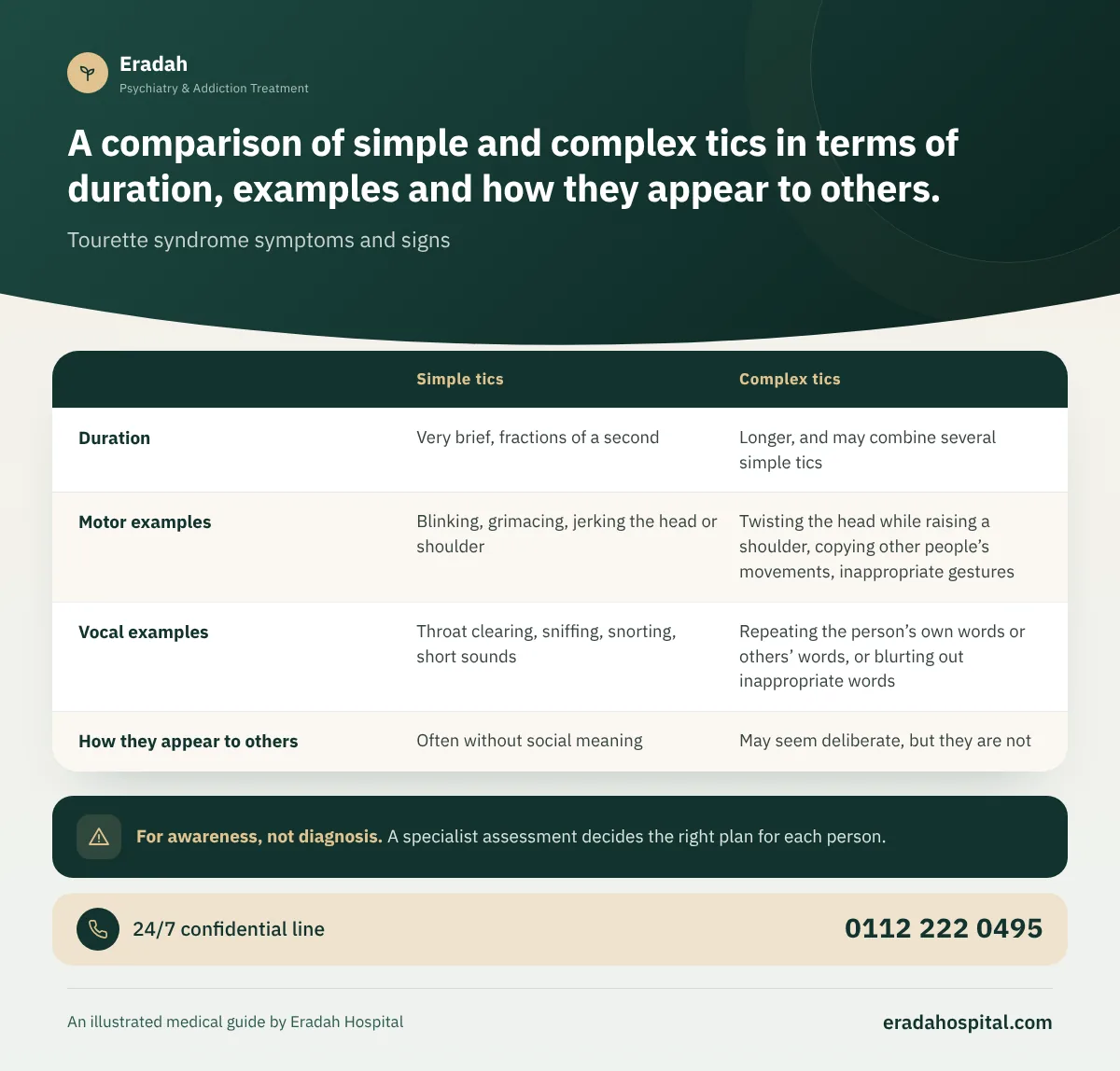
The MSD Manual explains that complex tics may seem to have social meaning, so others think they are deliberate, but they remain involuntary and do not reflect misbehavior.
What feeling comes before a tic, and can it be suppressed?
Some people, especially older ones, notice an urgent sensation before the tic: a tightening, tingling or pressure in part of the body, like the need to sneeze or scratch, which eases only when the tic is performed. The MSD Manual notes that some patients can suppress tics for a short time, from seconds to minutes.
But suppression is exhausting. A child who “holds it in” all through a class may come home and release the tics all at once. So the ability to suppress them in public does not mean the child does them on purpose at home. This premonitory sensation is also what behavioral therapy builds on later.
What makes Tourette syndrome symptoms worse or better?
| Often makes tics worse | Often eases them |
|---|---|
| Stress and anxiety | Being absorbed in an activity that needs concentration, such as studying or work |
| Tiredness and lack of sleep | Regular sleep and a steady daily routine |
| Excitement and strong emotion | Daily physical activity |
| Relaxing in front of the TV | Enjoyable hobbies that occupy the hands and mind |
The MSD Manual notes that tics are often more noticeable when the body is relaxed, such as while watching TV, and ease when busy with a task. The NHS adds that stress, excitement and tiredness are among the most common triggers.
Do people with Tourette syndrome really curse and swear?
How do symptoms differ between children and adults?
In children, tics are at their worst around ages 10 to 12 according to the MSD Manual, then decline during adolescence. In adulthood, tics usually decline as StatPearls explains, but those who still have them often carry a history of comments and ridicule. In teenagers and adults, symptoms of accompanying conditions appear, such as depression or social phobia, and some turn to substances to ease tension.
Is there a lab test or scan that detects Tourette syndrome?
No. Diagnosis is clinical, based on a description of the tics, how long they have lasted, and observation, according to the MSD Manual. The doctor may request an EEG, an MRI or blood tests, as the NHS notes, but their purpose is to rule out other causes, not to confirm the syndrome. The 2022 European guidelines consider the Yale Global Tic Severity Scale (YGTSS) the gold standard for assessing and tracking tic severity. It helps if the family films the tics on a phone, because they may disappear completely in the clinic.
When do Tourette syndrome symptoms call for a doctor’s visit?
- Tics that combine a movement and a sound, or that last more than a few months.
- A tic that causes neck or back pain or repeated injury.
- Declining school performance, withdrawal, or refusing to go to school.
- Obsessive thoughts, rituals, severe distraction, or persistent sadness.
- Sudden onset of severe tics, or onset after a medication or stimulant substance.
If tics interfere with life, the next step is Tourette syndrome treatment with behavioral training or medication, depending on the case.
A harmful tic or severe despair? Ask for help now
- A violent tic of the neck or head causing severe pain, injury or sudden weakness in the arms or legs
- Severe tics appearing suddenly over a day or a few days, especially after an infection or a new medication
- Severe muscle stiffness, fever or confusion after starting a new medication
- Talk of death or self-harm because of bullying, isolation or constant embarrassment
- A teenager or adult turning to alcohol, sedatives or stimulants to calm tics
Stay calm, do not blame the person for their tics or ask them to suppress them, stay beside them and quietly ask how they feel. If a physical injury or sudden symptoms appear after a medication, call the treating doctor or go to the nearest emergency room. If they talk about harming themselves, do not leave them alone; call an ambulance (123) or the mental health support line 16328 (24 hours).
Ambulance 123 Mental health support line 16328