Can depersonalization be treated? And what is the goal of treatment?
Yes. The MSD Manual states that full recovery is possible for many patients, especially if the symptoms are caused by temporary or treatable stress, or have not lasted long. In others, the symptoms may become chronic and harder to treat.
The manual adds a reassuring point: even persistent depersonalization may cause only mild disability if the person learns to occupy their mind with other thoughts and activities instead of focusing on their sense of self. So the goal of treatment is not limited to removing the feeling; it includes regaining daily life even before the feeling disappears completely.
Why does treatment start with stress and trauma?
The MSD Manual recommends that treatment address all the stressors tied to the onset of the disorder, as well as older ones such as childhood neglect or abuse that may have set the stage for it. Depersonalization is often the brain's way of "switching off" feelings when they become too much to bear, and the real treatment is to make those feelings bearable.
How does cognitive behavioral therapy help treat depersonalization?
In an open study published in 2005 in the journal Behaviour Research and Therapy, 21 patients were treated with individual cognitive behavioral therapy. The treatment focused on:
- Reinterpreting the symptoms in a non-threatening way: "an unpleasant sensation created by anxiety" instead of "I'm going crazy."
- Reducing avoidance: gradually returning to the places and situations the patient has come to avoid.
- Dropping safety behaviors: such as constantly touching things to make sure they are real.
- Stopping symptom monitoring: no longer checking yourself every minute.
Patients improved in the severity of depersonalization, depression, anxiety and overall functioning after treatment and at 6 months, and 29% of them no longer met the criteria for the disorder by the end of treatment. The researchers cautioned that these are preliminary results that need larger and more tightly controlled trials. The MSD Manual states that cognitive techniques help stop obsessive thinking about the feeling of unreality, and that behavioral techniques help a person engage in tasks that keep the mind occupied.
What are sensory grounding techniques?
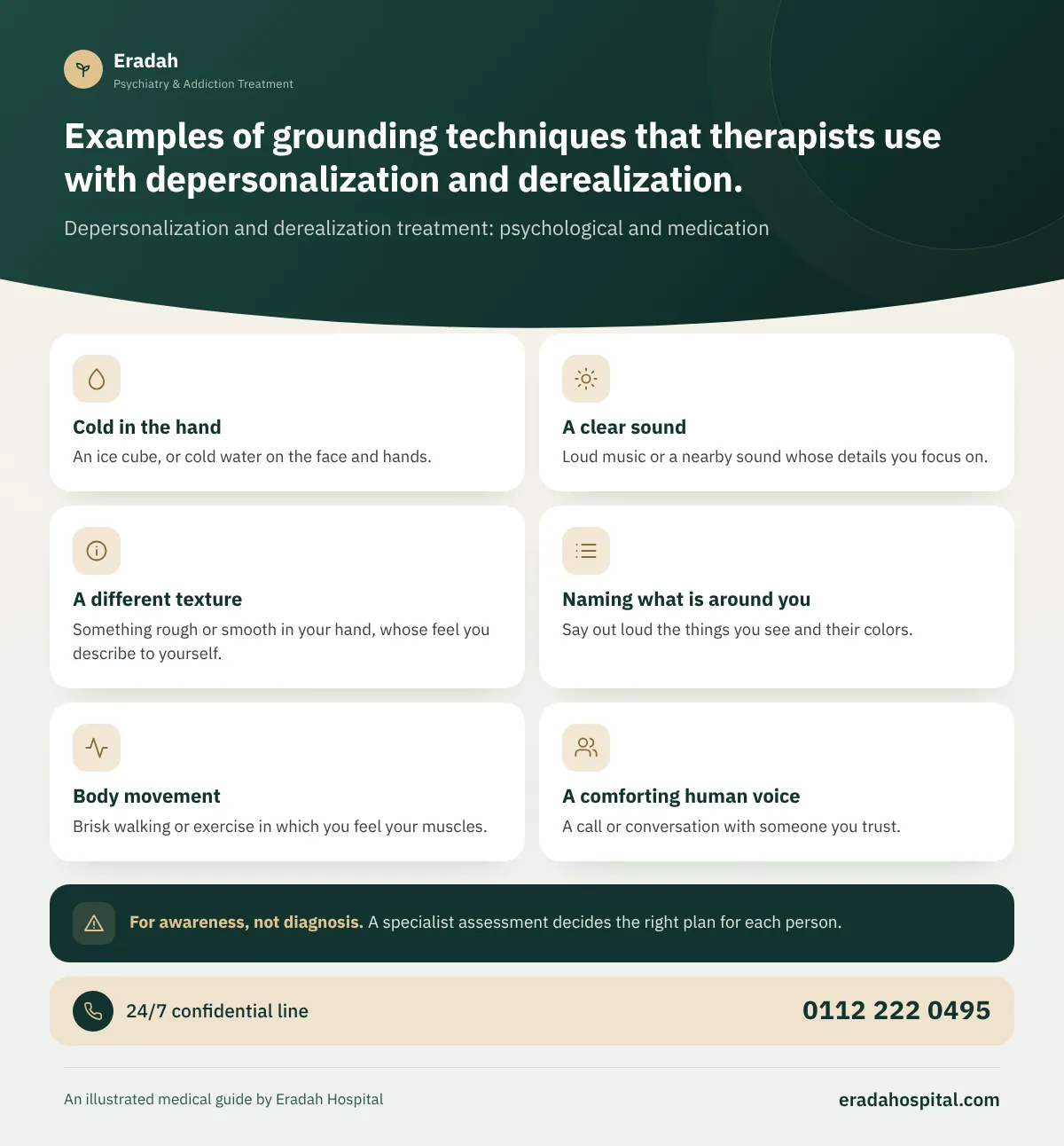
Grounding techniques use the five senses to help the patient feel connected to themselves and to the world in the present moment. Examples in the MSD Manual include playing loud music or holding an ice cube in the hand. They take forms such as:
An ice cube, or cold water on the face and hands.
Loud music or a nearby sound whose details you focus on.
Something rough or smooth in your hand, whose feel you describe to yourself.
Say out loud the things you see and their colors.
Brisk walking or exercise in which you feel your muscles.
A call or conversation with someone you trust.
These tools agree with what was observed in the 2003 study of 117 patients, which found that warm contact with other people, strong sensory or emotional stimulation, and relaxation tend to ease the severity of symptoms.
Do other types of psychotherapy help?
The MSD Manual states that psychodynamic psychotherapy helps the patient deal with negative feelings, inner conflicts, or experiences that made certain feelings unbearable so that they became "split off." Some patients also benefit from tracking feelings and detachment moment by moment within the session and naming them. The type is chosen according to the patient's history: someone whose depersonalization began after a panic attack is treated differently from someone with a long history of childhood neglect.
Are there medications for treating depersonalization?
According to the MSD Manual, many medications have been tried but none has been shown to have clear effectiveness for depersonalization itself. Some patients may benefit from classes such as selective serotonin reuptake inhibitors, lamotrigine, opioid antagonists or anti-anxiety drugs, but the manual considers it likely that they work mostly by treating co-occurring conditions such as anxiety and depression. In a small controlled trial in 2003 with 9 patients, lamotrigine alone did not outperform placebo.
Why is stopping hashish part of treatment?
Because hashish, ketamine and hallucinogens are among the best-known triggers of episodes according to the MSD Manual, and each use may bring the feeling back or deepen it. Some young people fear that stopping is "pointless" because the depersonalization continues despite abstinence, but abstinence is the condition for improvement to begin, not an immediate guarantee of it. If stopping is hard, that is a sign of the need for hashish addiction treatment alongside.
Daily tips that help recovery
- Remind yourself calmly: this feeling is unpleasant but not dangerous, and it will pass.
- Don't check yourself every minute to see whether the feeling is still there.
- Occupy your mind with an activity that needs concentration; staying busy eases the feeling.
- Spend time with comfortable people instead of isolating yourself.
- Sleep regularly and cut back on stimulants such as excess caffeine.
- Stay completely away from hashish, alcohol and hallucinogenic substances.
Depersonalization treatment at Eradah
At Eradah, treatment begins with a confidential psychiatric assessment that looks for anxiety, panic, depression, trauma and substance use, followed by an individual psychotherapy plan in most cases in outpatient clinics. When depersonalization is linked to hashish or other substance use, we treat both together as dual diagnosis, with care inside the psychiatric hospital for men when needed.
Severe detachment from reality or thoughts of self-harm? Get help now
- Talking about death, that life is meaningless, or a wish to harm themselves
- Losing the sense of reality so that the person believes the world has actually changed, or hears voices that others do not hear
- Sudden confusion, a seizure, or loss of consciousness
- Severe detachment after using hashish, hallucinogens, or ketamine, with panic or risky behavior
- Complete inability to eat, sleep, or look after themselves for days
Stay with the person, speak calmly in short sentences, and help them feel the present by focusing on your voice or the texture of something in their hand; do not argue with their feelings. If there is danger to their life, or confusion or a seizure, call ambulance (123) or go to the nearest emergency department, or call the mental health support line 16328 (24 hours), and do not leave them alone if they talk about harming themselves.
Ambulance 123 Mental health support line 16328