Does hashish addiction have a treatment?
Yes. Cannabis use disorder is a treatable illness, and many people recover from it and return to their lives, studies, and work. Hashish and bango are treated the same way because the active substance in both is the same.
The biggest challenge with this type of addiction is not physical withdrawal but the psychological and social habit: hashish is tied to staying up late, friends, sleep, and escaping pressure. So treatment focuses on changing these links and building new skills, not only on stopping the substance.
What are the stages of treating hashish and bango addiction?
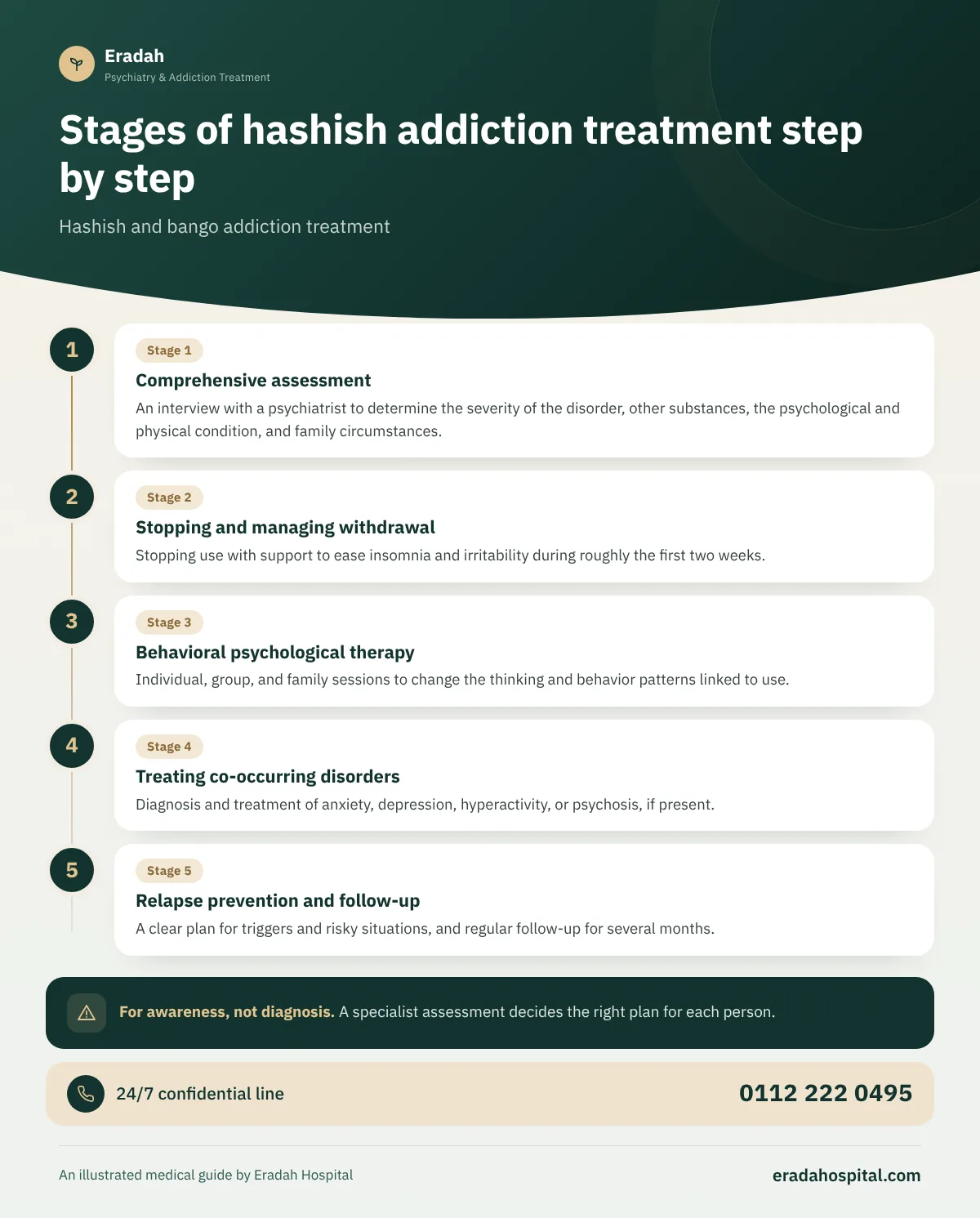
- Stage 1Comprehensive assessment
An interview with a psychiatrist to determine the severity of the disorder, other substances, the psychological and physical condition, and family circumstances.
- Stage 2Stopping and managing withdrawal
Stopping use with support to ease insomnia and irritability during roughly the first two weeks.
- Stage 3Behavioral psychological therapy
Individual, group, and family sessions to change the thinking and behavior patterns linked to use.
- Stage 4Treating co-occurring disorders
Diagnosis and treatment of anxiety, depression, hyperactivity, or psychosis, if present.
- Stage 5Relapse prevention and follow-up
A clear plan for triggers and risky situations, and regular follow-up for several months.
Details of the first days after stopping and their timeline are on the page about hashish and bango withdrawal symptoms.
Which psychological treatments are most effective?
Scientific references agree that the first-line treatment for cannabis use disorder is psychological therapy, and that combining them gives better results than any one alone:
Helps the patient recognize the situations and thoughts that lead to use, and learn alternative skills for handling pressure and craving.
Short sessions based on motivational interviewing that strengthen the person's own desire to change instead of imposing it on him.
Tangible rewards for commitment and negative tests, which raises rates of staying in treatment.
Especially for teenagers: improves communication, sets clear rules, and turns the family into a partner in recovery.
Is there a medication to treat cannabis addiction?
So far there is no approved medication from the major regulatory agencies for treating cannabis use disorder itself, unlike opioid or alcohol addiction. Various drugs such as N-acetylcysteine and gabapentin have been studied, but their results remain mixed and are not enough to approve them as a main treatment.
The doctor uses medications for two purposes: treating bothersome withdrawal symptoms such as insomnia for a short period, and treating accompanying psychiatric disorders such as depression, anxiety, and psychosis. The medication and its duration are set for each case, and no sleeping pill or sedative may be used without a prescription; some of them cause a new addiction. If you are taking a prescribed psychiatric medication, don't stop it or change it without your doctor.
Are there medications for treating hashish addiction?
So far there is no approved medication that treats hashish addiction itself; the 2025 Cochrane update concluded that all the medications studied are still experimental, despite promising results for some that have not been confirmed. That is why the doctor prescribes medication for what accompanies addiction: insomnia in the first days for a short time, or anxiety and depression, or hyperactivity and attention problems, or psychotic symptoms, and psychological treatment remains the foundation.
You can find what each trial found in detail, and the medications the doctor prescribes during treatment and why, on the page about hashish addiction medications, between research and “courses”.
What happens at the first visit?
- A confidential talk with the doctor about the pattern and duration of use and other substances, if any.
- An assessment of the psychological state: anxiety, depression, sleep, and any thoughts of self-harm.
- A physical exam and tests when needed, including tests to identify the substances used.
- A discussion of the patient's own goals and what he wants to change in his life.
- Agreeing on an initial plan: type of treatment, duration, and the family's role.
Outpatient treatment or inpatient stay?
| Point of comparison | Outpatient treatment | Inpatient stay |
|---|---|---|
| Who is it suited for? | Most cases of hashish and bango addiction | Complex cases, or those where outpatient treatment failed |
| Daily life | The patient continues his studies or work | Temporary distance from the environment and triggers |
| Follow-up | Regular weekly sessions | Medical and psychological care around the clock |
| Privacy | Higher, and those around him don't notice an absence | Full confidentiality inside the center |
An inpatient stay is advised when there is psychosis or hallucinations, thoughts of self-harm, use of other substances such as alcohol, sedatives, and tramadol, repeated failure of outpatient attempts, or an environment in which the patient cannot stay away from use.
How long does hashish addiction treatment take?
There is no single duration that suits everyone. The withdrawal stage usually ends within about two weeks, while behavioral psychological therapy usually continues for several weeks to months, and follow-up to prevent relapse extends for longer depending on the severity of the case and the presence of accompanying disorders. More important than the duration is sticking to the plan until the end.
How is treatment different for teenagers?
A teenager needs a plan that takes his age into account: the family has a bigger role, family therapy methods are used that involve the parents in setting rules and rewards, and there is coordination with the school or university when needed. Treating hyperactivity, anxiety, or depression, if present, also gets attention, since treating them reduces the drive to use.
How do you prevent relapse after hashish treatment?
Relapse is common in every type of addiction, and it doesn't mean treatment failed but is a signal to adjust the plan. Among the most important relapse prevention tools:
- Knowing personal triggers: people, places, times, and feelings linked to use.
- A written plan for what to do when craving intensifies.
- Changing the circle of friends linked to use.
- Filling time with meaningful activities: sports, work, study, a hobby.
- Continuing follow-up sessions even after improvement.
- Treating insomnia and anxiety in healthy ways instead of going back to hashish.
What is the family's role in hashish addiction treatment?
The family is a key partner, especially with teenagers and young adults. There are scientific family training programs, such as the Community Reinforcement and Family Training program, that teach parents how to encourage their son to accept treatment without harsh confrontation, how to reward positive behavior, and how to set clear limits. Parents themselves also need psychological support to get through the pressure and anxiety.
Why must anxiety and depression be treated along with hashish addiction?
A large proportion of people with cannabis use disorder have an accompanying psychiatric disorder, such as anxiety, depression, or hyperactivity, and sometimes psychotic episodes. If the addiction alone is treated, the original drive for use remains, so the chances of relapse go up. That is why modern treatment relies on the principle of dual diagnosis: treating both disorders together with one plan and one team.
Treating “hydro” addiction: why does it need special attention?
Hydro is a name used in Egypt for types of cannabis grown by intensive methods and marketed as high in THC. Research indicates that high-potency cannabis differs in its effect from weaker types:
- In a British study published in 2015, frequent use of high-potency cannabis was linked to more severe dependence, especially in younger people, while hashish and weaker types were not linked to it to the same degree.
- In a multi-center European study published in 2019, daily use of high-potency cannabis was linked to about 4.8 times the likelihood of a psychotic disorder compared with those who didn't use it.
- In the British study, high-potency cannabis was linked to clearer effects on memory and paranoia.
That is why it is not enough to treat hydro as a milder bango; it needs a careful psychiatric assessment from the start.
Handling paranoia and psychosis during hydro treatment
Some people who use hydro may arrive for treatment with severe suspicion of others, hearing voices, or strange thoughts. In this case treating the psychosis is the priority, and the psychiatrist decides whether antipsychotics are needed and what setting is suitable for treatment. The symptoms disappear in many people with stopping and treatment, while other cases need longer follow-up because drug-induced psychosis may reveal a predisposition to a persistent psychotic disorder.
How do you choose a center for hashish addiction treatment?
- An official license and a team that includes psychiatrists and qualified therapists.
- A comprehensive assessment before the plan, and a detailed written plan for each patient.
- Scientifically supported psychological treatment programs, not just admission or medications.
- Treatment of accompanying psychiatric disorders within the same program.
- A family program and follow-up after discharge.
- Respect for privacy and dignity, and a clear confidentiality policy.
Choosing a hospital for hashish and bango addiction treatment
Most people who use hashish or bango don't need inpatient care, and that is exactly what makes the choice sensitive: a place that pressures the family into a long stay in every case doesn't serve the patient, and a place that settles for an advice session doesn't serve him either. The important exception is hydro and high-potency types, because they may draw a young person into morbid suspicion or hallucinations that need a psychiatrist, not just a counselor. Ask any center:
- On what basis will it decide that your son needs inpatient care rather than outpatient follow-up?
- Is there a psychiatrist who assesses suspicion and hallucinations if they appear after hydro?
- How will insomnia and irritability be managed in the first weeks without replacing hashish with a sedative?
- Does a teenager have a plan that involves the parents and communicates with the school or university when needed?
- Is the anxiety or depression that the young man was escaping through smoking treated?
Eradah is licensed by the Ministry of Health and Population under number 1427 and has operated in Sheikh Zayed since 2015. Treatment can start through the outpatient program and intensive day care without interrupting studies, and an inpatient place is reserved for those whose condition requires it, and it is for men only. Cannabis-related psychosis is followed by the psychiatrist within the same plan; for more, read about paranoia after hashish. The first consultation is free and confidential, and the team answers at 01122220495 by call or WhatsApp around the clock, or book your first assessment appointment directly.
Hashish and bango addiction treatment at Eradah
At Eradah Psychiatry & Addiction Treatment we begin with a comprehensive confidential assessment, then build a plan that suits each patient: flexible outpatient treatment for students and workers, or inpatient care for cases that need it. A team of psychiatrists and therapists provides cognitive behavioral and motivational therapy and treats accompanying anxiety and depression, with a family program and regular follow-up to prevent relapse.