What are delusions of grandeur?
"All of a sudden he started saying he would solve all the country's problems, spent the household's money on a project with no basis, and anyone who objects is just jealous of him." This is how many families describe the start of what they call delusions of grandeur. In truth, this popular name covers different conditions: some are an irritating personality trait, and some are a psychotic symptom that needs immediate treatment.
Doctors use two related terms: grandiosity, meaning an exaggerated sense of importance and uniqueness, and grandiose delusions, which are fixed, unrealistic beliefs that the person is a unique genius, has made a great discovery, or holds wealth, power or a special mission, and which do not change in the face of clear evidence. A delusion is part of psychosis, a partial loss of contact with reality, whereas grandiosity can be part of a personality while judgment of reality stays intact.
A systematic review published in 2023 in the journal Clinical Psychology Review, covering more than 100 studies in 30 countries, found that grandiose delusions appear in about 28% of patients in psychiatric samples, after delusions of persecution and reference.
Symptoms and signs of delusions of grandeur
- Believing one has superhuman abilities or unmatched intelligence without evidence.
- Claiming a special connection to famous people or to higher authorities.
- Believing in a great mission or task to save people or the world.
- Huge, unrealistic plans and spending a lot of money on them.
- Rejecting all criticism and regarding those who object as envious or enemies.
- Rapid speech, little sleep and excess energy if the cause is a manic episode.
- Anger or aggression when someone questions their belief.
Causes of delusions of grandeur: which illnesses lie behind them?
A review published in Clinical Psychology Review in 2011 indicates that grandiose delusions appear in about two-thirds of people with bipolar disorder and half of people with schizophrenia, as well as in a large share of people with substance use disorders, and that more than 10% of healthy people have grandiose thoughts that fall short of a delusion.
In bipolar disorder, confidence swells along with reduced sleep, racing thoughts and impulsivity.
Grandiose delusions may appear alongside hallucinations and delusions of persecution.
A fixed delusion, such as having a great talent or having made an important discovery, without other psychotic symptoms.
Cocaine and crystal meth (known in Egypt as shabu) can cause a feeling of absolute power and then psychosis.
Persistent grandiosity and a need for admiration, but without losing contact with reality.
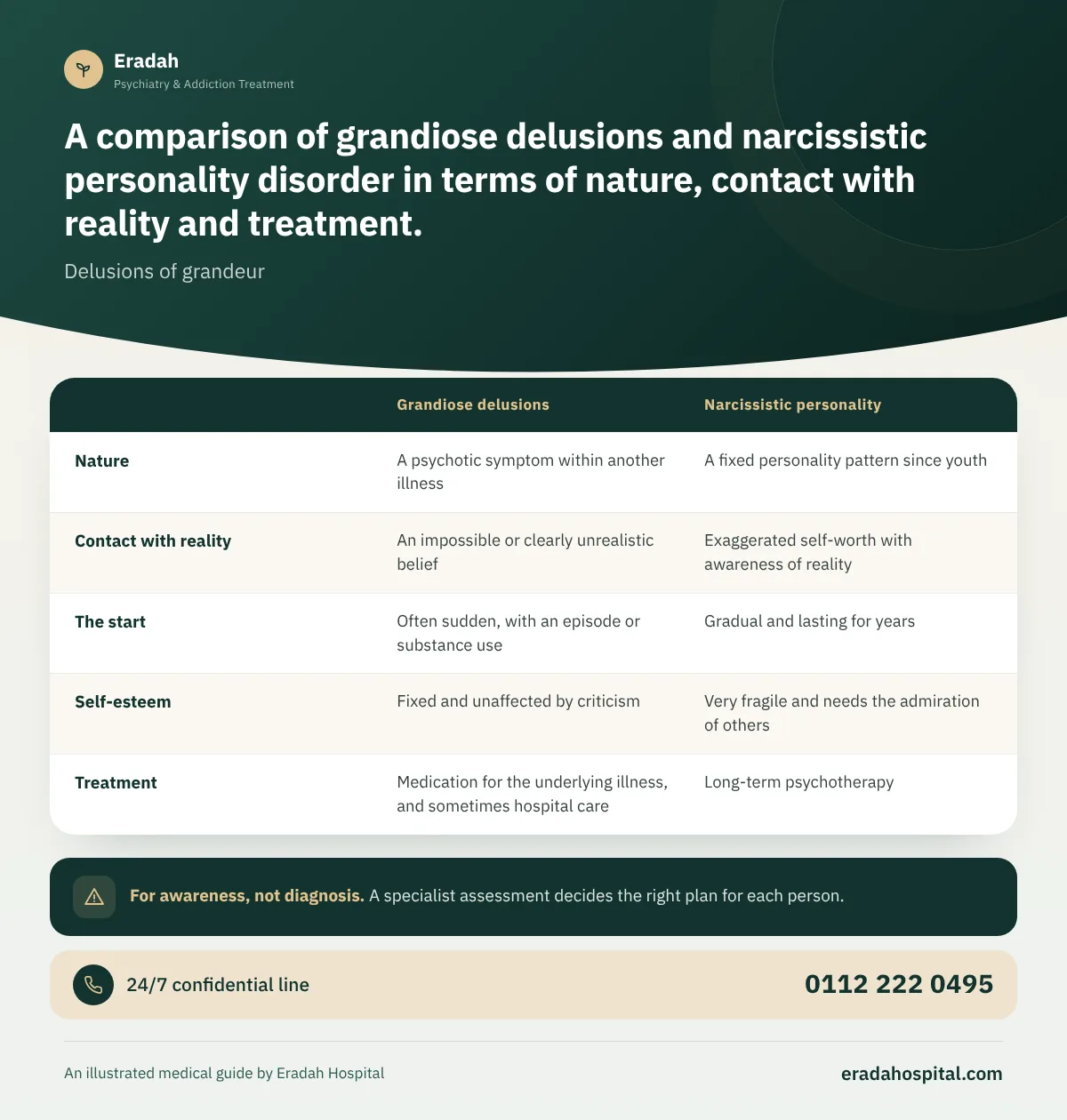
The difference between delusions of grandeur and narcissism
| Grandiose delusions | Narcissistic personality | |
|---|---|---|
| Nature | A psychotic symptom within another illness | A fixed personality pattern since youth |
| Contact with reality | An impossible or clearly unrealistic belief | Exaggerated self-worth with awareness of reality |
| The start | Often sudden, with an episode or substance use | Gradual and lasting for years |
| Self-esteem | Fixed and unaffected by criticism | Very fragile and needs the admiration of others |
| Treatment | Medication for the underlying illness, and sometimes hospital care | Long-term psychotherapy |
The MSD Manual describes narcissistic personality disorder as a fixed pattern of grandiosity, a need for admiration and a lack of empathy, in which the person exaggerates their achievements but has fragile self-esteem, and it estimates its prevalence at about 1.6% on average. Suspicion and expecting harm from others is paranoia, and the two can occur together in the same patient.
Drugs and delusions of grandeur
Stimulants such as cocaine and crystal meth sharply raise dopamine, so the person feels smarter and stronger than everyone else. With repeated use and lack of sleep, this feeling can turn into real delusions that need treatment, as in drug-induced psychosis. The MSD Manual notes that cocaine use is one of the most common disorders that accompany narcissistic personality.
Are delusions of grandeur dangerous?
The danger lies not in the idea itself but in what the person does because of it: spending savings or borrowing money for imaginary projects, quitting a job, getting into clashes with family or strangers, driving impulsively, and refusing treatment because "I don't need a doctor." In mania, this may be followed by a collapse in mood with deep regret over what happened.
How do you deal with a person who has delusions of grandeur?
- Do not argue with the details of their belief, but do not agree with it either.
- Talk about their feelings, exhaustion and lack of sleep rather than whether the idea is true.
- Quietly protect money and important papers without a humiliating confrontation.
- Suggest seeing a doctor because of exhaustion or sleeplessness; it is an easier way in.
- Watch for substance use, as many cases start or worsen with stimulants.
- Do not leave them alone if aggression or threats appear, and call for help.
Treatment of delusions of grandeur
Treatment targets the cause: mood stabilizers and antipsychotics for mania, schizophrenia and delusional disorder, as decided by the doctor who determines the medication and dose; stopping drug use with supervised detox if substance use is the driver; and long-term psychotherapy for narcissistic personality. The MSD Manual points out that poor insight is the biggest challenge, so the plan begins with building a relationship of trust with the patient and supporting the family through a family program.
Mania, aggression or hallucinations? Get help now
- Going without sleep for days with excess energy and nonstop rapid speech
- Aggression, or threats to themselves or others, when their belief is questioned
- Hallucinations or delusions of persecution alongside grandiose ideas
- Using large amounts of stimulants such as cocaine or crystal meth
- Sudden dangerous decisions, such as spending all savings or driving impulsively
Do not argue with the details of their belief, and do not leave them alone if aggression or threats appear. Speak calmly about their exhaustion and lack of sleep, and protect money and keys without a humiliating confrontation. Call the ambulance on 123 or go to the nearest emergency room; they may need a short stay in a psychiatric hospital to keep them safe. The mental health support line 16328 (24 hours) is available for advice.
Ambulance 123 Mental health support line 16328