What are the symptoms of hysteria (conversion disorder)?
The MSD Manual describes the symptoms of hysteria as neurological symptoms or deficits that arise unconsciously and involuntarily, usually affecting movement or sensation, but that do not fit the known mechanisms of neurological diseases or the nerve pathways of the body. That is, the symptom is real, but its “map” differs from the map of nerve damage.
What are the main groups of conversion disorder symptoms?
Weakness or paralysis in an arm or leg, or difficulty walking and balancing.
Seizure-like episodes or fainting without epileptic electrical activity.
Tremor, spasms, jerks, or unusual postures of the limbs.
Numbness or loss of sensation, or blurred or double vision.
Loss of voice, or whispering only, or a lump in the throat and difficulty swallowing.
Persistent dizziness, or difficulties with memory and concentration.
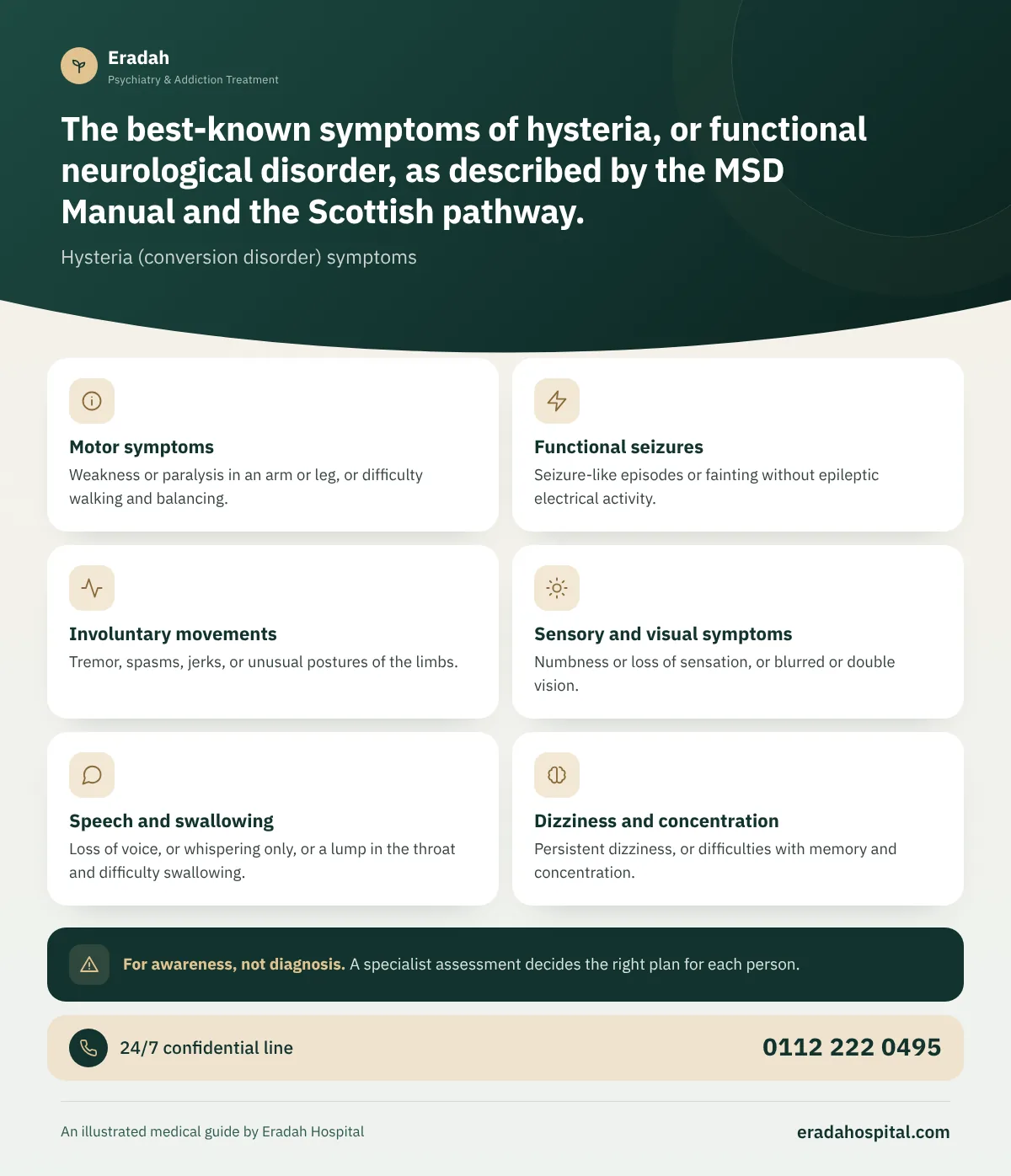
The Scottish pathway for functional neurological disorder adds to this list persistent postural dizziness, functional cognitive symptoms, and functional hearing and vision problems. More than one group can occur in the same patient.
Non-epileptic seizures: how do they differ from an epileptic seizure?
Functional, or “dissociative,” seizures are among the most common symptoms of the disorder. neurosymptoms.org, an educational platform run by a neurologist who specializes in this field, explains that they are of two types: seizures with violent movements resembling a major epileptic seizure, and seizures in which the person falls and lies still and unresponsive, often for several minutes.
| Non-epileptic (functional) seizure | Epileptic seizure | |
|---|---|---|
| What happens in the brain | A dissociation-like process, without abnormal electrical discharge | A sudden abnormal electrical discharge |
| EEG during the seizure | Does not show the epileptic pattern | Shows abnormal electrical activity |
| Epilepsy medication | Does not treat it | Often the main treatment |
| Most accurate method of diagnosis | A video of the seizure, with video-EEG when needed | EEG and neurological assessment |
The same platform notes that specialists diagnose seizures more accurately, in 9 out of 10 cases, if they see a video of one filmed on a phone. Many patients were wrongly diagnosed with epilepsy at some point and took its medication. The MSD Manual points to signs such as resistance to eye opening during a seizure. The distinction is not made at home, but by a neurologist experienced in epilepsy.
Functional weakness, paralysis, and difficulty walking
The patient may feel heaviness or weakness in an arm, leg, or half of the body, drop what they are holding, or walk in an unusual way. The MSD Manual explains one example doctors use: a patient who cannot bend their foot while lying in bed but can walk on tiptoe. Another example is “Hoover’s sign”: when the patient lifts their healthy leg against resistance, the doctor feels clear pressure from the “paralyzed” leg.
Tremor and involuntary movements
These include functional tremor, muscle spasms, sudden jerks, and abnormal gait. According to the MSD Manual, one of their distinguishing features is that the tremor changes or disappears when the patient’s attention is distracted, for example when they are asked to copy a rhythmic movement with the other hand. This does not mean they are controlling it; it is simply that the circuits producing it work differently from the tremor of neurological diseases.
Sensory symptoms and loss of vision or hearing
- Numbness or loss of sensation in part of the body, which does not follow the known distribution of the nerves.
- Poor vision or temporary loss of vision, or double vision.
- A “tunnel-like” narrowing of the visual field that is inconsistent with the laws of optics.
- Hearing loss or temporary deafness.
Loss of voice, difficulty swallowing, and other symptoms
Symptoms the MSD Manual mentions include loss of voice or the ability to speak except in a whisper, difficulty swallowing, the sensation of a lump in the throat, and urinary retention. The disorder is often accompanied by other symptoms that are not part of its definition, such as fatigue, pain, sleep disturbance, anxiety, and low mood, and each needs attention.
How do hysteria symptoms begin, and how long do they last?
Symptoms often begin suddenly and may follow a stressful event, according to the MSD Manual. It may be a single episode, or scattered recurrent episodes, and the symptoms may become chronic. The Scottish pathway points out that relapse is common, such as a period when walking gets worse or seizures or speech problems return, and that new symptoms must be assessed openly, because people with the disorder may also have other neurological diseases that should not automatically be attributed to “hysteria.”
When are the symptoms an emergency?
In non-emergencies, see a neurologist if the symptoms recur or interfere with your work or studies, and then comes the next step: treatment of hysteria with a rehabilitation and psychological plan.
Sudden weakness or a seizure? Do not assume it is “hysteria” and ask for help
- Sudden weakness or numbness on one side of the body, a drooping mouth, or sudden difficulty speaking for the first time
- A first-time convulsive seizure, or a long or repeated seizure without the person regaining consciousness in between
- A head injury or difficulty breathing during or after the episode
- Taking a large amount of medication or any substance during distress
- Talk about death or a wish to harm oneself
New sudden neurological symptoms cannot be judged at home, since some strokes and epileptic seizures look just like them. Stay with the person, move hard objects away from them, put nothing in their mouth, and call an ambulance (123) or go to the nearest emergency room. If they talk about harming themselves, do not leave them alone, and call the mental health support line 16328 (24 hours).
Ambulance 123 Mental health support line 16328