Is hysteria treatable?
Yes. A 2018 review in JAMA Neurology describes functional neurological disorder as a cause of disability that is treatable, and points to encouraging evidence for the benefit of specialized physical rehabilitation and psychotherapy, alone or together, while acknowledging that clinical trials are still limited.
The aim of treatment is to restore movement or speech or control of seizures, reduce disability, treat the anxiety or depression that accompany the condition, and prevent years of going from clinic to clinic, not to “prove” that the patient is healthy.
Why is explaining the diagnosis a treatment step?
The MSD Manual stresses that explaining the diagnosis is itself a decisive therapeutic intervention: the patient hears that their symptoms are real, that the diagnosis rests on positive signs on examination and not on “ruling everything else out,” and that there is a clear plan. This requires a stable relationship of trust and support between patient and doctor.
It helps for the patient to see for themselves the sign the doctor relied on, for example noticing that the strength of their leg improves when they are busy with the other leg; this turns the idea from “I’m imagining it” into “my nervous system is working in the wrong way and can be retrained.”
Who treats conversion disorder?
The MSD Manual describes treatment as multimodal, often requiring cooperation among neurologists, psychiatrists, primary care physicians, and rehabilitation specialists. The Scottish pathway stresses that treatment must be tailored to the functional disorder: physiotherapy that uses distraction during exercise, occupational therapy, speech and swallowing therapy, and psychotherapy that teaches techniques for controlling seizures or dizziness, not merely coping with them. Some patients need one treatment, and others need several in coordination.
What is the role of specialized physiotherapy?
For motor symptoms such as weakness, gait disturbance, and tremor, specialized physiotherapy retrains automatic movement instead of tense focus on the affected limb. In a randomized pilot study published in 2017 on 57 patients, 72% of those who received this treatment rated their symptoms as improved after 6 months, compared with 18% in the usual care group.
But the picture is not complete: in the large Physio4FMD trial published in 2024 in The Lancet Neurology, the specialized physiotherapy program was not superior to community neurophysiotherapy on a measure of physical functioning after 12 months, although more of its patients rated their motor symptoms as improved, and their psychological state was better. The researchers concluded that both types are safe and useful for selected patients.
Does psychotherapy help with non-epileptic seizures?
Seizure-focused CBT helps the patient recognize early warning signs before a seizure, learn techniques to stop or lessen it, and modify the fears and avoidance that feed it. In the UK CODES trial on 368 patients, published in 2020, the monthly number of seizures did not fall by a statistically significant margin when this therapy was added to structured medical care, but patients had longer seizure-free periods, found the seizures less bothersome, and their quality of life, ability to work, relationships, and psychological distress improved.
The MSD Manual notes that hypnosis is a short-term treatment that may help some patients, and that psychotherapy is effective for some. The type is chosen according to the symptoms and what accompanies them, and may include treatment of trauma when it is part of the picture.
Are there medications to treat hysteria?
According to the MSD Manual, there is currently no evidence supporting the use of medication to treat the disorder itself in people who do not have a co-occurring psychiatric disorder. But if depression, anxiety, or PTSD is present, it should be treated. The neurosymptoms.org platform explains that functional seizures are not treated with pills but by learning techniques to control them, which is why the doctor may review epilepsy medication in those who were wrongly diagnosed with epilepsy.
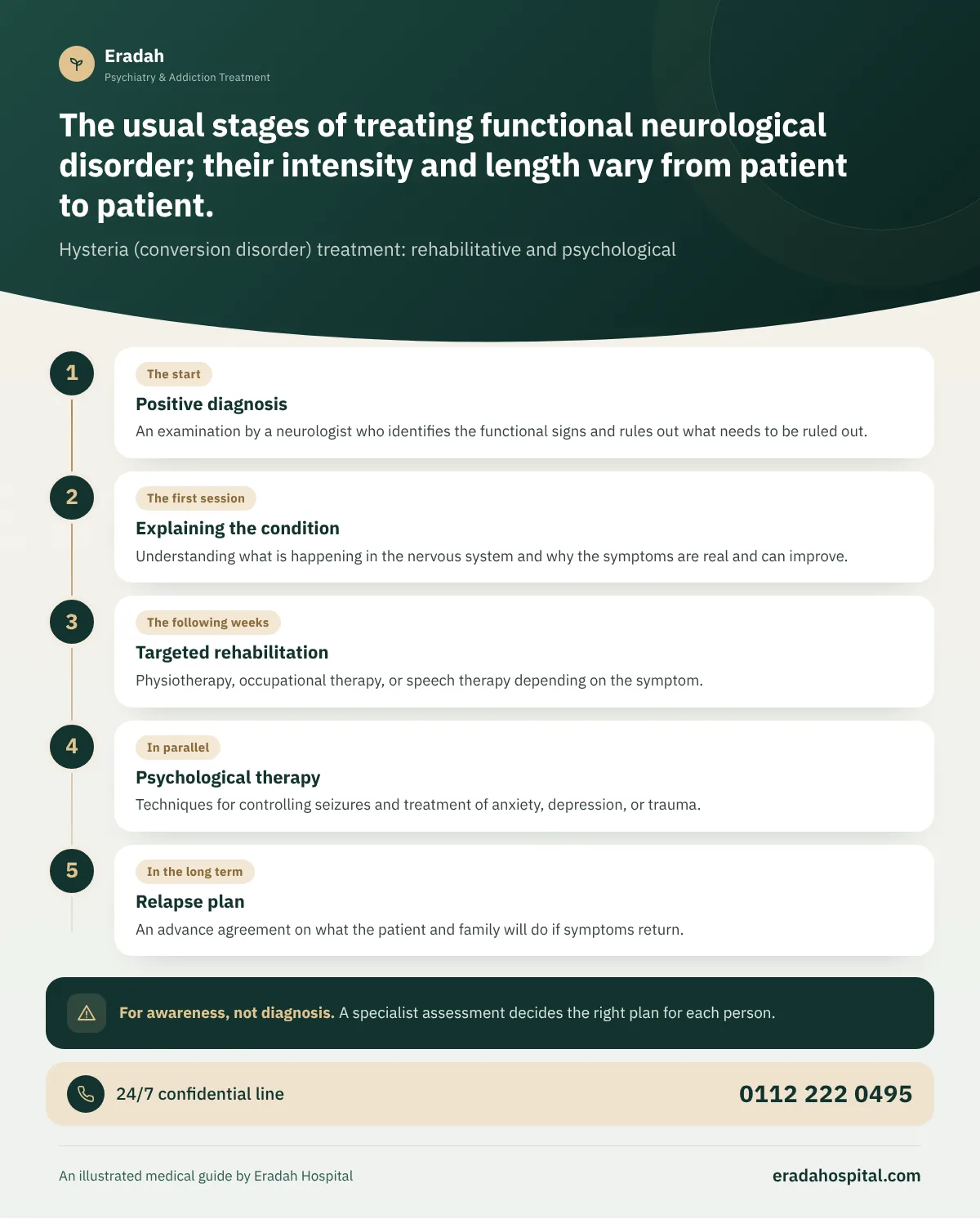
What are the stages of treatment?
- The startPositive diagnosis
An examination by a neurologist who identifies the functional signs and rules out what needs to be ruled out.
- The first sessionExplaining the condition
Understanding what is happening in the nervous system and why the symptoms are real and can improve.
- The following weeksTargeted rehabilitation
Physiotherapy, occupational therapy, or speech therapy depending on the symptom.
- In parallelPsychological therapy
Techniques for controlling seizures and treatment of anxiety, depression, or trauma.
- In the long termRelapse plan
An advance agreement on what the patient and family will do if symptoms return.
Why should repeated testing be approached with caution?
The JAMA Neurology review notes that many patients experience long delays in diagnosis, unnecessary costly tests, and harm from wrong treatments. After a clear diagnosis, repeating scans and tests increases anxiety and reinforces the idea of “an illness not yet discovered.” At the same time, the Scottish pathway cautions against automatically attributing every new symptom to the functional disorder, so balance is needed: an open assessment of what is new, without repeated testing of what is old.
How do you deal with relapse?
The Scottish pathway explains that relapse is common, and recommends discussing the possibility in advance and making a plan for it. A good plan includes recognizing triggers such as exhaustion, stress, and passing illness, returning to rehabilitation exercises as soon as symptoms appear, and contacting the treating team instead of starting from scratch at a new clinic. A relapse is a signal to adjust the plan, and does not mean that treatment has failed.
Conversion disorder treatment at Eradah
Diagnosis usually starts with a neurologist, and then comes the role of psychiatry in treating functional seizures and the accompanying anxiety, depression, and trauma. At Eradah we offer a confidential psychiatric assessment and cognitive behavioral therapy sessions in the outpatient clinics, and care inside the psychiatric hospital for men when the accompanying psychological symptoms become severe, in coordination with the treating neurologist.
Sudden weakness or a seizure? Do not assume it is “hysteria” and ask for help
- Sudden weakness or numbness on one side of the body, a drooping mouth, or sudden difficulty speaking for the first time
- A first-time convulsive seizure, or a long or repeated seizure without the person regaining consciousness in between
- A head injury or difficulty breathing during or after the episode
- Taking a large amount of medication or any substance during distress
- Talk about death or a wish to harm oneself
New sudden neurological symptoms cannot be judged at home, since some strokes and epileptic seizures look just like them. Stay with the person, move hard objects away from them, put nothing in their mouth, and call an ambulance (123) or go to the nearest emergency room. If they talk about harming themselves, do not leave them alone, and call the mental health support line 16328 (24 hours).
Ambulance 123 Mental health support line 16328