What happens during a panic attack?
The diagnostic criteria describe a panic attack as an abrupt surge of intense fear or acute discomfort that peaks within minutes and is accompanied by four or more symptoms from a list of 13 physical and psychological symptoms.
An attack can come when a person is completely calm, in front of the TV or in the car, or it can wake them from sleep. This sudden nature is what makes it frightening: the person finds no reason to explain it and thinks their body is breaking down.
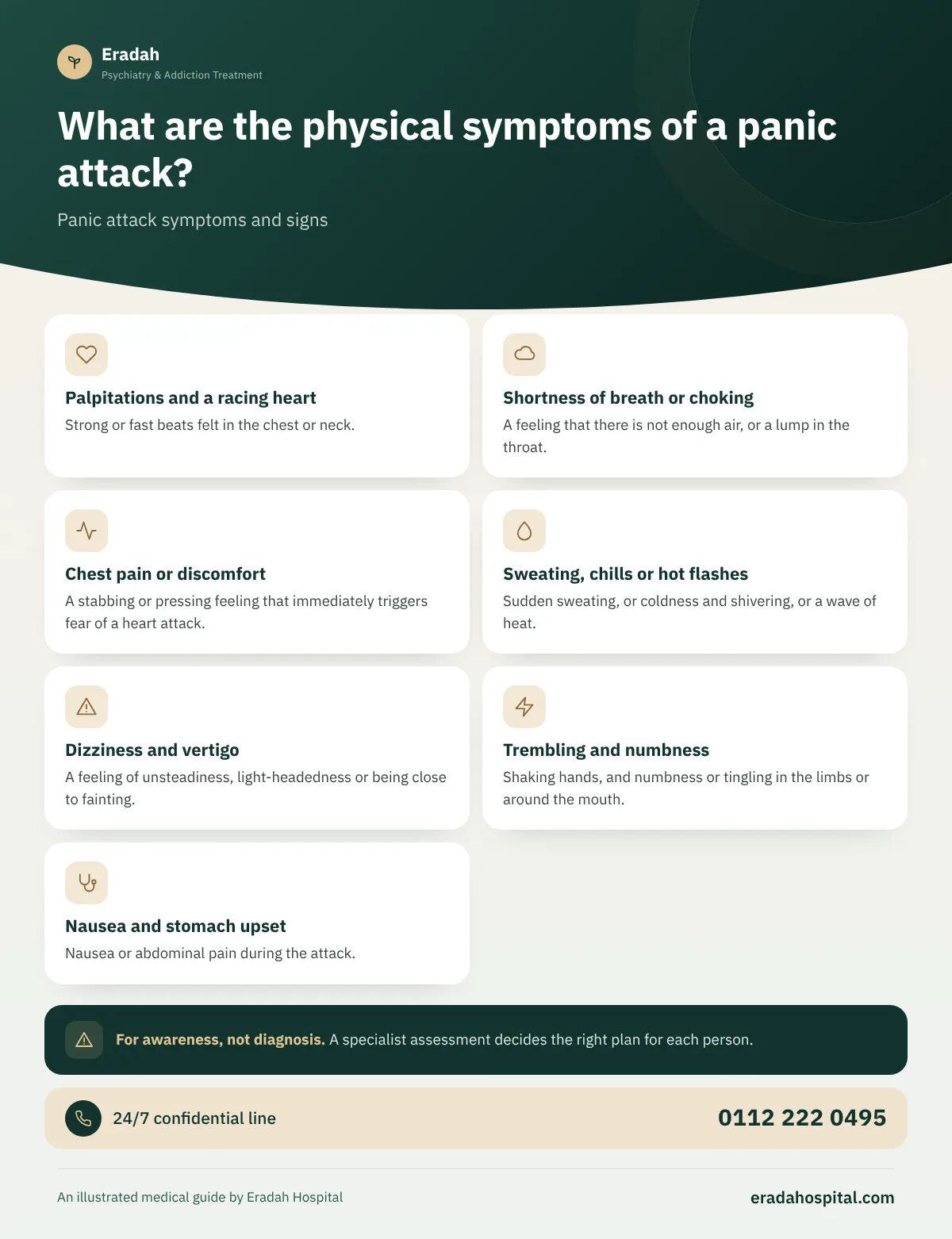
What are the physical symptoms of a panic attack?
Strong or fast beats felt in the chest or neck.
A feeling that there is not enough air, or a lump in the throat.
A stabbing or pressing feeling that immediately triggers fear of a heart attack.
Sudden sweating, or coldness and shivering, or a wave of heat.
A feeling of unsteadiness, light-headedness or being close to fainting.
Shaking hands, and numbness or tingling in the limbs or around the mouth.
Nausea or abdominal pain during the attack.
What are the psychological symptoms during an attack?
- Fear of dying: a momentary certainty that the heart will stop or that breathing will cut off.
- Fear of losing control or “going crazy”: a feeling that you will do something reckless or lose your mind.
- Derealization (feeling detached from reality): the world seems distant or strange, as if in a dream.
- Depersonalization: a sense of being detached from your body or watching yourself from the outside.
- An urgent urge to escape from the place at once, to somewhere “safe.”
After the attack ends, many people feel intense exhaustion lasting for hours, with lingering anxiety and the question: “What just happened to me?”
The order and intensity of symptoms vary from one attack to another, even in the same person. Heart symptoms may dominate in one attack, and dizziness and unreality in another. This variety adds to the patient’s confusion and pushes them to look for a new physical illness each time, when the common thread is a sudden wave of fear that peaks quickly and then recedes.
Are there different types of panic attacks?
| Type | Description |
|---|---|
| Sudden (unexpected) attack | Comes without an obvious trigger, and its recurrence is the basis for diagnosing panic disorder |
| Expected attack | Comes in situations the person fears, such as crowds, flying or enclosed spaces |
| Night-time attack | The person wakes suddenly from sleep with palpitations, shortness of breath and intense fear |
| Limited-symptom attack | Fewer than four symptoms, often appearing with improvement or between full attacks |
What are the signs of panic disorder between attacks?
What distinguishes the disorder is not limited to what happens during the attack, but extends to what happens between attacks:
- Constant worry about “when will the next attack come?”
- Constant monitoring of the heartbeat, breathing and any bodily sensation.
- Avoiding exertion, coffee or strong emotion for fear of a racing heart.
- Always carrying a bottle of water or “backup” medication as a safety measure.
- Refusing to go out alone or to stray far from hospitals.
- Repeated emergency visits and requests for an ECG.
How do signs of agoraphobia appear with panic?
Signs of agoraphobia begin with avoiding one place where an attack happened, then gradually spread. The best-known signs include:
- Avoiding public transport or driving on highways and bridges.
- Fear of markets, malls, queues and crowded places.
- Always sitting near the door or exit.
- Depending on a companion every time they go out.
- In severe cases: staying at home most of the time.
Do panic symptoms differ by age and gender?
| Category | What sets it apart |
|---|---|
| Teenagers | A common starting point at this stage, and it may be wrongly put down to allergy or a breathing problem, or coincide with trying stimulants or cannabis |
| Women | More than twice as likely to be affected as men, and symptoms may be influenced by hormonal changes, pregnancy and the postpartum period |
| Men | They may delay seeking help and focus only on heart symptoms, and may turn to alcohol or sedatives more often |
| Older adults | Panic starting for the first time later in life is less common, and calls for careful heart and medical examination before any psychological explanation |
How can a family tell that their son is having panic attacks?
A family may notice sudden calls for help, repeated emergency visits without a clear diagnosis, their son refusing to go out or ride public transport, or refusing to stay alone at home. They may also notice that he always carries sedative pills. A calm conversation matters more here than doubt: “We believe that what you are going through is terrifying; let’s look for real treatment together.”
Self-assessment questions: are the things happening to me panic attacks?
These questions are for awareness only, not a diagnosis:
- Have you had sudden waves of intense fear that peaked within minutes?
- Were they accompanied by palpitations, shortness of breath, dizziness, trembling or a sense of dying?
- Have they recurred without an obvious reason?
- Do you worry all the time about having a new attack?
- Have you started avoiding places or activities because of them?
Chest pain: panic attack or heart attack? When in doubt, call an ambulance on 123
- Pain, pressure or squeezing in the chest that spreads to the arm, jaw or back, especially with exertion
- The first attack of your life, or an attack different from your usual ones in form or duration
- Heart risk factors: older age, diabetes, high blood pressure, smoking, or family history
- Fainting, or shortness of breath that doesn't improve, bluish lips, or sudden weakness on one side of the body
- Talk of wanting to die, or severe hopelessness because of recurring attacks
No one can tell with certainty at home between a panic attack and a heart attack; if there is chest pain and you suspect it, treat it as an emergency: call an ambulance on 123, do not drive yourself, and stay with the person until help arrives. If a doctor has previously diagnosed panic attacks and the attack comes in the same usual pattern, help them breathe slowly and remind them that it will pass. If there are thoughts of self-harm, call the mental health support line 16328.
Ambulance 123 Mental health support line 16328