“I stopped the medication a week ago. Is it out of my body now? So why am I still dizzy?” These are two related questions, and the answers are not the same. A drug can leave the blood within days, while the brain needs longer to get used to its absence. It also varies a great deal between one drug and another, and between one person and another.
What is half-life, and how do we work out when a drug is cleared?
The StatPearls reference defines half-life as the time needed for a drug's concentration in the body to fall to half its value, and explains that half of the remaining amount is cleared after each half-life. So if a drug's half-life is one day, half is left after one day, a quarter after two days, and an eighth after three days. By the same arithmetic, only about 3% is left after five half-lives, which is why doctors generally treat a drug as practically cleared after about that long.
Examples of how long psychiatric medications stay in the body
These figures come from official labels approved by the US Food and Drug Administration (FDA), and they are averages in healthy adults:
| Medicine | Half-life | What does this mean in practice? |
|---|---|---|
| Fluoxetine (Prozac) | 4 to 6 days with continued use, and its active by-product 4 to 16 days | Its effect may last for weeks after stopping |
| Paroxetine (Seroxat) | About 21 hours | Levels fall quickly, so discontinuation symptoms appear if it is stopped suddenly |
| Venlafaxine (Efexor) | About 5 hours, and its active by-product about 11 hours | Among the shortest; stopping suddenly causes clear symptoms |
| Aripiprazole (Abilify) | About 75 hours, and its active by-product about 94 hours | It takes about two weeks for its level in the blood to stabilize |
Sedatives have separate guides that explain how long they stay in the body and how long they show up on tests, such as the guide to how long benzodiazepines stay in the body and the guide to how long Xanax stays in the body.
Why does the time a psychiatric drug takes to leave the body differ from person to person?
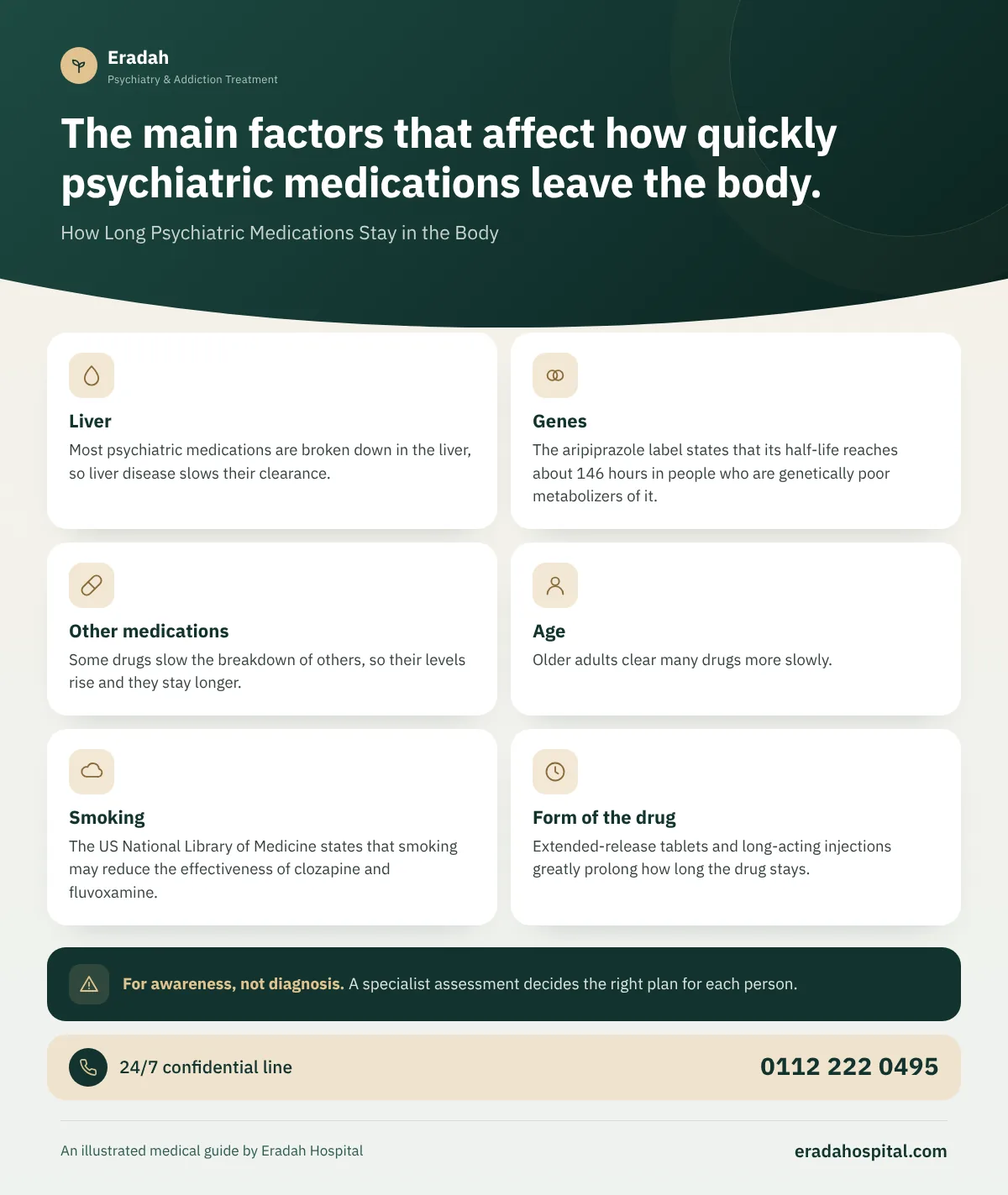
Most psychiatric medications are broken down in the liver, so liver disease slows their clearance.
The aripiprazole label states that its half-life reaches about 146 hours in people who are genetically poor metabolizers of it.
Some drugs slow the breakdown of others, so their levels rise and they stay longer.
Older adults clear many drugs more slowly.
The US National Library of Medicine states that smoking may reduce the effectiveness of clozapine and fluvoxamine.
Extended-release tablets and long-acting injections greatly prolong how long the drug stays.
A drug leaving the body does not mean its effects are over
With long-term use, the brain adapts to the presence of the drug. If its level drops suddenly, discontinuation symptoms appear. The paroxetine label describes these as possibly including dizziness, nausea, irritability, insomnia, and electric-shock-like sensations. This is why a person may feel symptoms days after the last tablet, just when the drug has actually started to leave. The UK's National Health Service (NHS) advises reducing antidepressants gradually over weeks or months, following a plan agreed with your doctor.
Why does the time a drug stays matter when switching medications?
Some drugs should not be combined with others because of the risk of serotonin syndrome, the most serious being with the monoamine oxidase inhibitor (MAOI) group. For this reason labels specify waiting periods before switching to them: the Prozac label requires at least 5 weeks after stopping it because of how long it stays, while the US National Library of Medicine mentions at least one week after venlafaxine. These decisions are for the doctor alone.
Do psychiatric medications show up on a drug test?
Standard drug tests look for specific substances, such as opiates, cannabis, stimulants, and benzodiazepines, and they do not target most antidepressants or antipsychotics. However, some psychiatric medications can be chemically similar to substances the test looks for and give a false positive result. You will find the details, and what to do before a test, in the guide to medications that show up on a drug test.
When should you see the doctor?
See a doctor if you have severe symptoms after stopping a medication, if your symptoms come back, or if you are planning a pregnancy and want to know your options. And if the medication in question is a sedative and you feel you have become dependent on it, Eradah's detox program allows you to reduce it under medical supervision, and the first consultation is free and confidential.