“The doctor wrote me a medication, and the pharmacist gave me a different name and said it's the same thing.” This situation comes up often with psychiatric medications, and it leaves fair questions: are they really the same drug? Which class does it belong to? This guide gathers the psychiatric medication names most commonly used in Egypt and links each brand name to its active ingredient and main use, with links to detailed guides on each drug.
Brand name and active ingredient: what is the difference?
The active ingredient is the component that works in the body, and it has a single scientific name worldwide. The brand name is what each company chooses for its product. That is why you may find several boxes of one ingredient in the pharmacy with different names and prices. According to the US Food and Drug Administration, a generic medication must contain the same active ingredient in the same strength and form of administration, and must work in the body in the same way, even if inactive ingredients such as color and shape differ.
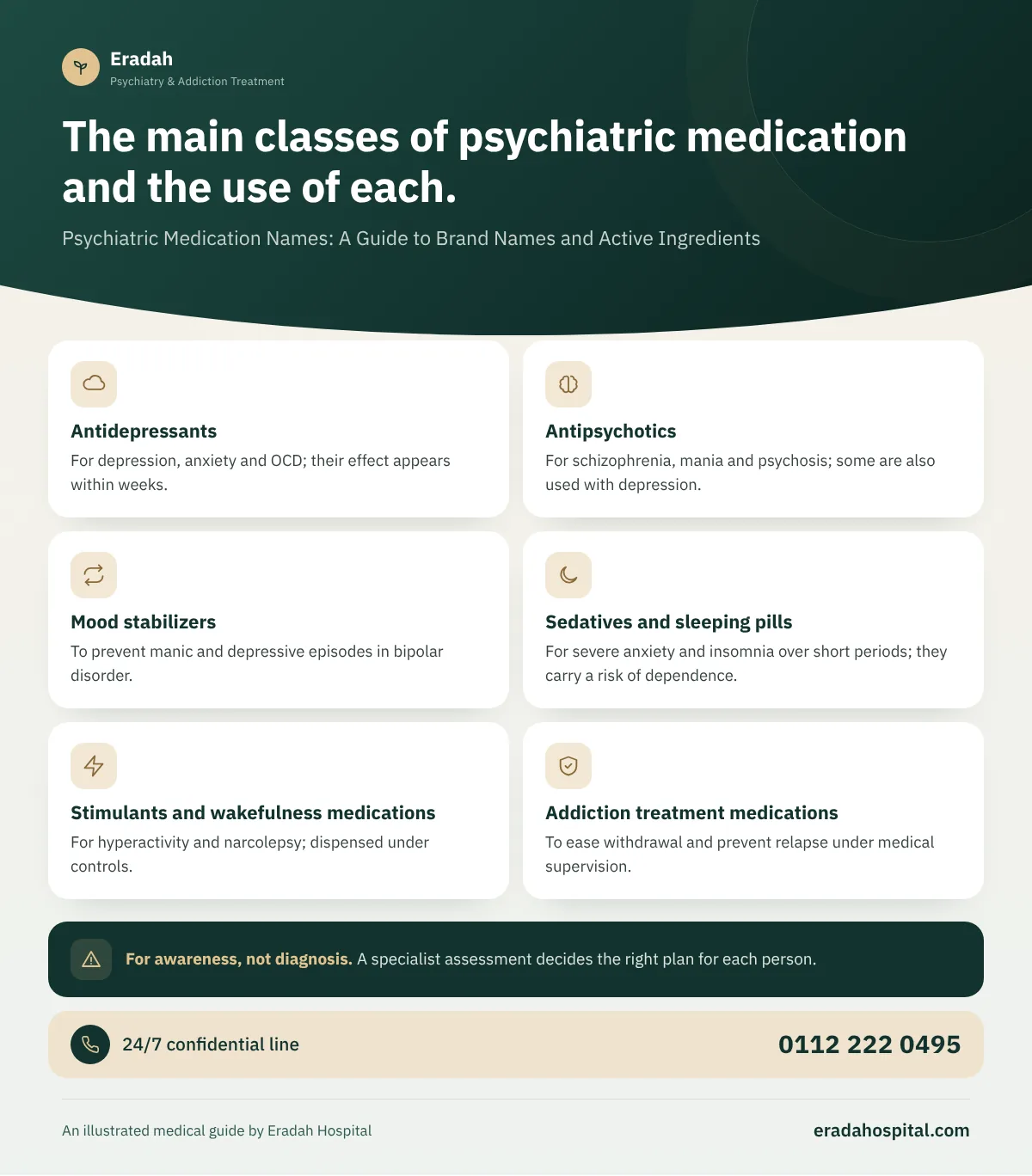
The major classes of psychiatric medication
For depression, anxiety and OCD; their effect appears within weeks.
For schizophrenia, mania and psychosis; some are also used with depression.
To prevent manic and depressive episodes in bipolar disorder.
For severe anxiety and insomnia over short periods; they carry a risk of dependence.
For hyperactivity and narcolepsy; dispensed under controls.
To ease withdrawal and prevent relapse under medical supervision.
Common antidepressant names
Antidepressants work mainly on serotonin and norepinephrine, and you will find an explanation of their types and when they start working in the antidepressants guide. These are the best-known names:
| Brand name | Active ingredient | Group |
|---|---|---|
| Cipralex | Escitalopram | Selective serotonin reuptake inhibitors (SSRIs) |
| Prozac | Fluoxetine | Selective serotonin reuptake inhibitors (SSRIs) |
| Lustral | Sertraline | Selective serotonin reuptake inhibitors (SSRIs) |
| Cymbalta | Duloxetine | Serotonin-norepinephrine reuptake inhibitors (SNRIs) |
| Remeron | Mirtazapine | Atypical antidepressant |
| Anafranil | Clomipramine | Tricyclic antidepressants |
| Tryptizol | Amitriptyline | Tricyclic antidepressants |
Antipsychotic and mood stabilizer names
Antipsychotics are used in schizophrenia and manic episodes, and some are used in treatment-resistant depression. Mood stabilizers are the core medications in treating bipolar disorder, and many of them were originally epilepsy medications.
| Brand name | Active ingredient | Group |
|---|---|---|
| Seroquel, Quetapex | Quetiapine | Second-generation antipsychotic |
| Risperdal, Apexidone | Risperidone | Second-generation antipsychotic |
| Zyprexa, Olapex | Olanzapine | Second-generation antipsychotic |
| Dogmatil | Sulpiride | Antipsychotic from the benzamide class |
| Lamictal, Lamotrin | Lamotrigine | Mood stabilizer and antiepileptic |
| Tegretol | Carbamazepine | Mood stabilizer and antiepileptic |
Sedatives, sleeping pills and anxiety medications
This group is the most associated with a risk of dependence, especially the benzodiazepines, which is why they are prescribed for short periods and with follow-up. Buspirone is an exception, as it does not act on the same receptors.
| Brand name | Active ingredient | Note |
|---|---|---|
| Xanax | Alprazolam | Short-acting benzodiazepine |
| Rivotril | Clonazepam | Long-acting benzodiazepine |
| Valium | Diazepam | A very long-acting benzodiazepine |
| Ativan (international name) | Lorazepam | Intermediate-acting benzodiazepine |
| Librax | Chlordiazepoxide with clidinium | A sedative combined with an antispasmodic |
| Buspar | Buspirone | For anxiety, without any significant risk of dependence |
| Stilnox | Zolpidem | Z-drug sleeping pill |
| Night Calm | Eszopiclone | Z-drug sleeping pill |
Stimulants and other medications a psychiatrist may prescribe
| Brand name | Active ingredient | Use |
|---|---|---|
| Ritalin | Methylphenidate | ADHD (attention-deficit/hyperactivity disorder) |
| Modazomel, Pravamax | Modafinil | Excessive sleepiness and narcolepsy |
| Lyrica | Pregabalin | Nerve pain, and anxiety in some countries |
| Neurontin | Gabapentin | Nerve pain and epilepsy |
| Parkinol | Trihexyphenidyl | Movement effects of antipsychotics |
| — | Naltrexone | Relapse prevention in alcohol and opioid use disorders |
Methadone and buprenorphine are also used to treat opioid dependence within organized medical programs, and they must not be used outside them.
Do psychiatric medicines cause addiction?
The answer differs from one class to another. Antidepressants, antipsychotics and mood stabilizers do not cause addiction in the medical sense, although stopping them suddenly can cause discontinuation symptoms or a relapse. Sedatives, sleeping pills and stimulants, however, may cause dependence with long-term or uncontrolled use. You will find the details for each type in the guide Do Psychiatric Medications Cause Addiction?.
A detailed guide to each psychiatric medication
Each of the medications mentioned here has its own page explaining its uses, side effects, and how to stop it safely:
Do Psychiatric Medications Cause Addiction? The Truth for Each Type
Do antidepressants and psychiatric medications cause addiction? The difference between addiction, dependence and discontinuation symptoms, and which psychiatric medications carry an addiction risk…
Details General guideAntidepressants: Types, When They Start Working and Side Effects
A guide to antidepressants: the main types and best-known names, when they start working, common side effects and how to handle them, length of treatment…
Details MedicationAnafranil (Clomipramine): For OCD and Depression, and Its Side Effects
Anafranil (clomipramine) is a tricyclic antidepressant and the strongest in its class on serotonin. When it is prescribed for OCD, its side effects…
Details General guideAntipsychotics: Types, Uses and Side Effects
What are antipsychotics? The difference between first and second generation, the best-known names, their uses in schizophrenia and bipolar disorder, their movement-related side effects…
Details MedicationBuspar: Anxiety Treatment Without Addiction? When It Starts Working and Side Effects
Buspar (buspirone) is a medication for generalized anxiety that does not belong to the sedatives. Does it cause addiction? When does it start working, why it does not work as needed, its side effects…
Details MedicationCipralex (Escitalopram): When It Starts Working, Side Effects and How to Stop It
Cipralex (escitalopram) is an SSRI antidepressant for depression and anxiety. When it starts working, its side effects, its interactions, and whether it causes…
Details MedicationDogmatil (Sulpiride): Why It Is Prescribed, Its Harms and Discontinuation Symptoms
Dogmatil, whose active ingredient is sulpiride, is an antipsychotic that is also prescribed in Egypt for anxiety and stomach and colon symptoms. Its indications, its harms such as raised…
Details MedicationDuloxetine (Cymbalta and Duloxprin): For Depression, Nerve Pain and Discontinuation Symptoms
Duloxetine (Cymbalta, Duloxprin) is an SNRI antidepressant for depression, anxiety, nerve pain and fibromyalgia. When it starts working, its symptoms…
Details MedicationLamictal (Lamotrigine): A Mood Stabilizer and the Rash Warning
Lamictal is a mood stabilizer and antiepileptic whose active ingredient is lamotrigine, and it protects against depressive episodes in bipolar disorder. Why it starts with a small dose, the rash warning…
Details MedicationLibrax: Is It a Sedative? Its Uses, Dependence Risk and Withdrawal Symptoms
Librax is a colon and stomach medication that contains a benzodiazepine sedative. Does it cause addiction? Its uses and harms, the danger of mixing it with opioids…
Details MedicationModafinil: The Wakefulness Drug and Its Misuse for Studying and Staying Up
Modafinil is a medication for excessive sleepiness and narcolepsy, and it is misused for studying and staying up late. How it works on dopamine, its side effects, and whether it causes…
Details MedicationNaltrexone: How Does It Prevent Relapse in Opioid and Alcohol Addiction?
What is naltrexone (Revia)? How it blocks the effect of opioids and reduces the desire for alcohol, why opioids must be stopped for days before it, its side effects…
Details MedicationOlanzapine (Zyprexa): Uses, Weight Gain and Symptoms
Olanzapine is an antipsychotic sold as Zyprexa and Olapex for schizophrenia and bipolar disorder. Why it raises weight and blood sugar more than others, its side effects…
Details MedicationProzac (Fluoxetine): Its Uses for Depression and OCD and Its Side Effects
Prozac (fluoxetine) is one of the oldest SSRIs. Its uses in depression, OCD, bulimia and panic, when it starts working, its side effects…
Details MedicationRemeron (Mirtazapine): An Antidepressant for Sleep and Appetite and Its Side Effects
Remeron (mirtazapine) is an antidepressant that improves sleep and appetite. How it differs from SSRIs, when it starts working, its side effects such as drowsiness and weight gain…
Details MedicationRisperdal (Risperidone): Its Uses and Side Effects
Risperdal is an antipsychotic whose active ingredient is risperidone, for schizophrenia and mania in bipolar disorder. How it works, its side effects such as raised prolactin and movement symptoms…
Details MedicationSeroquel (Quetiapine): Indications, Side Effects and Addiction
Seroquel is an antipsychotic whose active ingredient is quetiapine, prescribed for schizophrenia, bipolar disorder and depression. Its indications, the difference between regular and XR, its side effects…
Details MedicationSertraline (Lustral): Indications, Side Effects and How It Differs from Cipralex
Sertraline (Lustral) is an SSRI antidepressant for depression, OCD, panic and post-traumatic stress. Its indications, its side effects, and its safety in…
Details MedicationTegretol (Carbamazepine): A Mood Stabilizer and Epilepsy Medication and Its Side Effects
Tegretol, whose active ingredient is carbamazepine, is for epilepsy, trigeminal neuralgia, and as a mood stabilizer in bipolar disorder. Its side effects, skin and blood warnings, and tests…
Details MedicationTryptizol (Amitriptyline): Its Uses for Depression, Headache and Insomnia, and Its Harms
Tryptizol (amitriptyline) is a tricyclic antidepressant for depression, nerve pain, migraine prevention and sometimes insomnia. Its side effects and the danger of…
Details General guideThe Best Medication for Depression and Anxiety: The Available Options and How the Doctor Chooses
Is there a best medication for depression and anxiety? Learn about the approved medication options, what medical guidelines say, and the factors by which the doctor chooses…
Details General guideHow Long Psychiatric Medications Stay in the Body: Half-Life and What Prolongs It
How long do psychiatric medications take to leave the body? What half-life means, examples from official leaflets for common medications, and why it differs from person to person…
Details General guideAntidepressant Withdrawal Symptoms: How Long They Last and How They Differ from Relapse
What are antidepressant withdrawal symptoms? Dizziness, “electric shocks” in the head and insomnia, when they start and how long they last, which medications cause them most, and how…
Details General guideAntidepressants and Sex: Low Desire, Delayed Orgasm and What to Do
Antidepressants and sex: why desire drops or ejaculation is delayed with some medications, which have the least effect according to studies, and what the doctor does…
Details MedicationParoxetine (Xerox): Indications, Side Effects and How to Stop It
Paroxetine (Seroxat or Xerox) is an SSRI antidepressant for depression, panic, social phobia and OCD. Its uses and side effects…
Details MedicationVenlafaxine (Effexor): Its Uses, Symptoms, Blood Pressure and Discontinuation Symptoms
Venlafaxine (Effexor or Effexor XR) is an SNRI antidepressant for depression, anxiety and panic. Its indications, its side effects, and why it is monitored…
Details MedicationFaverin (Fluvoxamine): For OCD and Its Important Drug Interactions
Faverin (fluvoxamine) is an SSRI antidepressant used mainly for OCD and social phobia. Its uses, side effects and interactions…
Details MedicationTrazodone (Trittico): For Depression, Sleep and Important Side Effects
Trazodone (Trittico) is an antidepressant sometimes prescribed for insomnia. What it is used for, what the evidence says about sleep, and its side effects including erection…
Details MedicationInderal (Propranolol): Does It Treat Anxiety? Its Uses, Symptoms and Risks
Inderal (propranolol) is a heart medication that doctors sometimes prescribe for physical anxiety symptoms such as trembling and palpitations. Does it really treat anxiety? Who should not…
Details MedicationAripiprazole (Abilify): Uses, Symptoms, Impulsivity and Warnings
Aripiprazole (Abilify) is an antipsychotic for schizophrenia and bipolar disorder and an add-on in depression. Its uses, when it starts working, its symptoms such as restlessness…
Details MedicationClozapine (Leponex): For Treatment-Resistant Schizophrenia, Blood Tests and Warnings
Clozapine (Leponex) is an antipsychotic for schizophrenia that has not responded to other medications and for reducing suicidal behavior. Why it needs regular blood tests, and what…
Details MedicationHaloperidol (Haldol): Its Uses, Movement Effects and the Decanoate Injection
Haloperidol (Haldol) is a first-generation antipsychotic for schizophrenia, psychosis and tics. Its uses, its movement effects such as stiffness…
Details MedicationClonidine: For Opioid Withdrawal and Hyperactivity, and the Danger of Stopping It Suddenly
Clonidine is a blood pressure medication that doctors use to ease opioid withdrawal symptoms, for hyperactivity and for Tourette's. How it works in detox, and what…
Details MedicationDisulfiram (Antabuse): How It Deters Alcohol Use and Why It Must Not Be Given in Secret
Disulfiram (Antabuse) is a medication that causes an unpleasant reaction if the patient drinks alcohol. How it works, how effective it is according to studies, hidden sources of alcohol…
DetailsSafe rules for using any psychiatric medication
- Keep a written list of all your medications by their generic names, and show it to every doctor and pharmacist.
- Do not start or stop any psychiatric medication without a doctor, even if you have improved.
- Do not take a medication prescribed by a doctor for someone else, however similar the symptoms.
- Avoid alcohol and any additional sedative without consultation.
- Tell the doctor about any pregnancy, breastfeeding or chronic illness before starting.
- See the doctor if a troublesome side effect appears, instead of stopping on your own.
When do you need to see a psychiatrist right away?
If suicidal thoughts or a desire to harm yourself appear, or a sudden change in behavior such as unusual impulsiveness or agitation, or a skin rash with fever, or fever with severe muscle stiffness and confusion, these symptoms do not wait for the next appointment. And if you find yourself raising the dose of a sedative or stimulant on your own, that is a sign worth a calm assessment.
At Eradah Psychiatric Hospital, the doctor reviews your full list of medications and adjusts them within a treatment plan that includes psychotherapy, whether in the outpatient clinics or through residential stay when needed, with a dual diagnosis program for people who have both a mental illness and substance use. The first consultation is free and confidential.