What is the basic principle in treating overthinking?
The first principle is simple and counterintuitive: you will not beat overthinking with more thinking. The aim is to learn to notice when the circling begins, then to step out of it gently into an action or another focus of attention, not to look for an argument that silences the thought for good.
This is supported by the thought-suppression experiments carried out by Daniel Wegner and colleagues: trying to push a thought away made it return more later, while preoccupation with it fell when participants had a specific alternative to direct their attention to. That is why the following exercises rely on redirecting, not blocking.
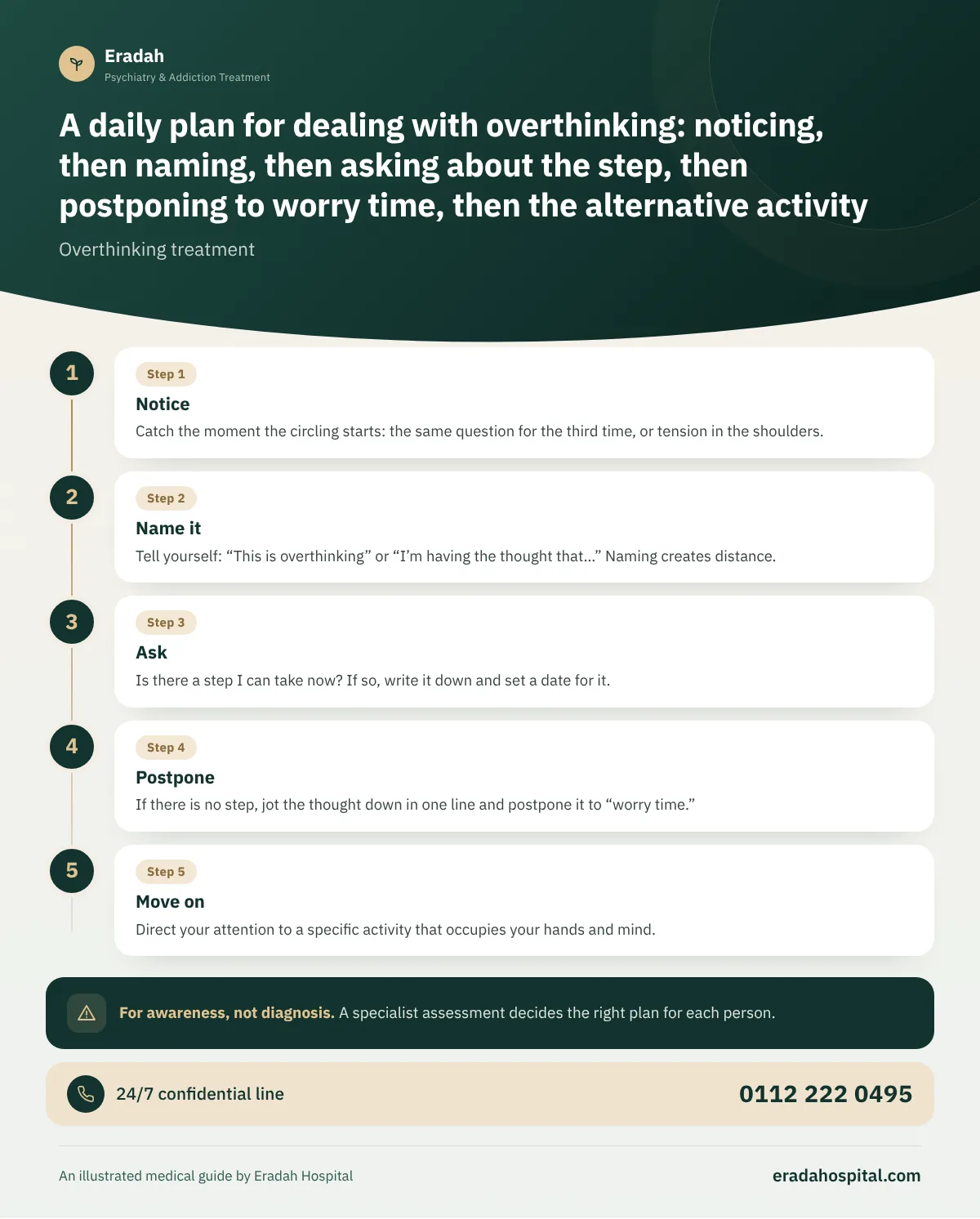
A daily plan for getting out of overthinking
- Step 1Notice
Catch the moment the circling starts: the same question for the third time, or tension in the shoulders.
- Step 2Name it
Tell yourself: “This is overthinking” or “I’m having the thought that…” Naming creates distance.
- Step 3Ask
Is there a step I can take now? If so, write it down and set a date for it.
- Step 4Postpone
If there is no step, jot the thought down in one line and postpone it to “worry time.”
- Step 5Move on
Direct your attention to a specific activity that occupies your hands and mind.
Practical exercises to stop overthinking
- From “why?” to “how?”: instead of “Why am I a failure at this?” ask “How do I deal with this particular situation?” Edward Watkins’s review indicates that the level of thinking, abstract and general versus specific and concrete, is among the factors that determine whether repetitive thinking is helpful or harmful.
- Writing: move the thoughts onto paper instead of letting them circle in your head; writing slows them and shows how repetitive they are.
- Verbal distance: say “I’m having the thought that I will fail” instead of “I will fail.” This small distance loosens the thought’s grip.
- An activity that occupies the hands and attention: a brisk walk, tidying something, a phone call, or a task that needs concentration.
- Cut back on reassurance-seeking: every extra question to others or online search brings a few minutes of relief and then strengthens the doubt.
- Set a limit for small decisions: give a simple decision a set amount of time, then choose and accept that perfection is not required.
What is “worry time” and does it work?
“Worry time” is an exercise based on postponing thoughts, not fighting them: each day you set aside a fixed period in a fixed place to sit with your worries and write them down, and when a worrying thought comes at any other time you jot it in one line and postpone it to its appointment.
A study by McGowan and Behar tested this method on 53 people with high levels of worry: one group trained for two weeks to confine worry to a 30-minute daily period at a set time and place, and outperformed the comparison group in reducing worry, tension, negative feelings and insomnia symptoms. It is a small pilot study, but it supports using this exercise as part of a broader plan.
How do you get rid of overthinking before sleep?
- Empty your mind before bed: an hour or two before sleep, write down tomorrow’s tasks and what is on your mind, so you do not try to “remember” them in the dark.
- Keep screens away: the World Health Organization advises limiting electronic devices before sleep, and avoiding caffeine and large meals.
- Breathe slowly: breathing out longer than you breathe in for a few minutes calms the body’s arousal.
- Don’t wrestle with the bed: if you stay awake for a long time, get up and go somewhere else and do a quiet activity in dim light, then come back when you feel sleepy.
- Keep regular times: sleep and wake at the same time every day, even on holidays, as the World Health Organization recommends.
If insomnia continues for weeks despite these steps, insomnia treatment explains cognitive behavioral therapy for insomnia and other options.
What is the psychological treatment for overthinking?
When overthinking is severe or chronic, working with a specialist therapist helps. In a systematic review by Querstret and Cropley covering 19 studies, mindfulness-based interventions and cognitive behavioral therapy appeared to be effective in reducing rumination and worry together, whether delivered face to face or online. The main approaches include:
| Approach | What it teaches |
|---|---|
| Cognitive behavioral therapy | Tracking and testing repeated thoughts, and replacing circling with problem-solving and action |
| Rumination-focused cognitive behavioral therapy | Shifting the thinking style from abstract “why?” to concrete “how?” |
| Mindfulness | Observing thoughts as passing events without arguing with them |
| Structured problem-solving | Defining the problem and its alternatives, trying one solution and then evaluating it |
You can learn more about cognitive behavioral therapy and how its sessions go.
Is there a medication for overthinking?
There is no medication that treats overthinking by itself. But if it is part of generalized anxiety disorder, depression or OCD, the psychiatrist may prescribe treatment for that condition after assessment, such as some antidepressants that are also used for anxiety and OCD. The doctor decides the type of medication, its duration and follow-up, so never start or stop any medication without a doctor.
When do you need specialist help?
Ask for a consultation if the exercises do not work after several weeks of sticking with them, if overthinking eats up hours of your day and your sleep, if it comes with persistent sadness, panic attacks or compulsive rituals, or if you have begun to rely on any substance to calm your mind. Help at Eradah begins with a confidential consultation in the outpatient clinics, followed by a treatment plan that suits the cause. If thoughts about death or self-harm appear, call an ambulance (123) or the mental health support line (16328) immediately.
When thinking turns into thoughts about death: ask for help now
- Repeated thoughts about death, that life is not worth living, or that the person is a “burden” on those around them
- Severe hopelessness and a feeling that the thoughts will never stop and there is no way out
- Almost completely stopping sleeping or eating for several days
- Overusing sleeping pills or sedatives, or mixing them with alcohol, to “quiet the brain”
- Strange thoughts, intense suspicion or hearing voices that others do not hear
Do not leave the person alone. Ask them calmly and directly how they feel and what they are thinking, and listen without blame or lectures; asking directly does not plant the idea, it opens the door to help. Call an ambulance on 123 or take them to the nearest emergency room, or call the mental health support line 16328 (24 hours), and keep medications and anything they could use to harm themselves out of reach.
Ambulance 123 Mental health support line 16328