Why do some people fall into the overthinking trap?
No one is born an “overthinker,” and no one chooses to spend their nights on the same questions. Overthinking forms where a personal predisposition meets stressful circumstances and mental habits that strengthen over time, and it persists because it gives the person the illusion that they are doing something useful.
When the mind faces a problem, it tries to solve it by thinking, and that is natural. But some problems cannot be solved by thinking: an unknown future, a past that cannot change, or other people’s feelings, which we do not control. When the mind insists on solving them mentally, it goes around in circles.
What are the main causes of overthinking?
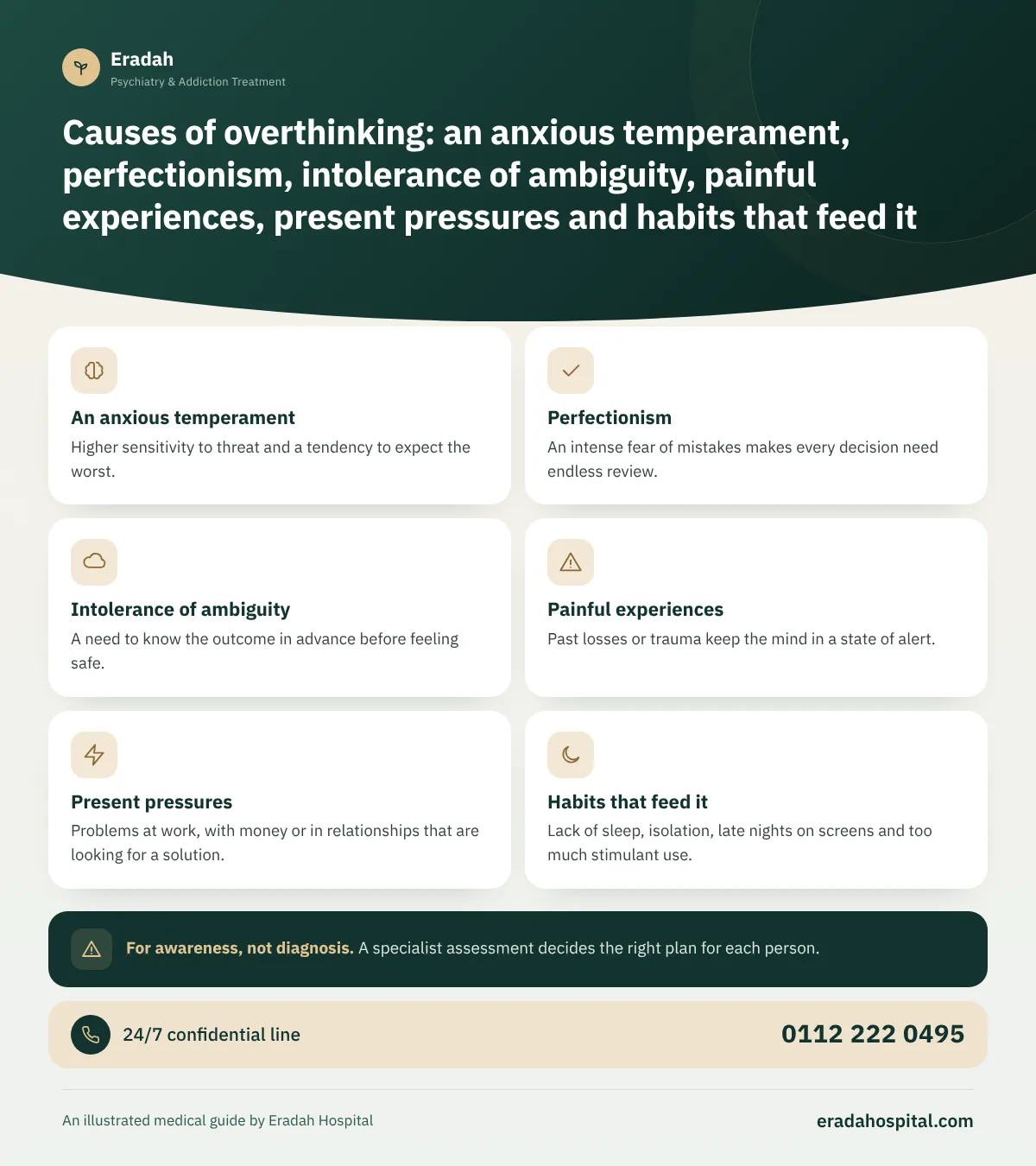
Higher sensitivity to threat and a tendency to expect the worst.
An intense fear of mistakes makes every decision need endless review.
A need to know the outcome in advance before feeling safe.
Past losses or trauma keep the mind in a state of alert.
Problems at work, with money or in relationships that are looking for a solution.
Lack of sleep, isolation, late nights on screens and too much stimulant use.
How do personality traits contribute to overthinking?
Some traits do not cause overthinking on their own, but they make the road to it shorter:
- Difficulty tolerating uncertainty: someone who cannot stand “I don’t know” tries to fill the gap with scenarios, and each scenario needs another one to reassure it.
- Perfectionism: someone who sees a mistake as a catastrophe reviews their decisions and words again and again.
- Beliefs about thinking itself: such as thinking that worry “protects” them from surprises, or that stopping thinking means negligence, so overthinking seems a responsibility rather than a burden.
- High sensitivity: some people pick up details and feelings more deeply, which we explain in the sensitive personality.
Are women more prone to overthinking than men?
In a statistical analysis published by Johnson and Whisman in 2013 covering 59 studies and 14,321 adults, women scored higher than men on rumination, but the two researchers described the difference as small in size despite its statistical significance. In other words, overthinking affects both sexes, and men are not immune to it.
What is the role of pressures and past experiences?
Present pressure gives overthinking its subject: a threatened job, a strained relationship or illness in the family, as we explain in causes of stress. Past experiences give it its intensity; someone who has suffered a sudden loss, a betrayal or a trauma may have a mind constantly scanning for any sign of danger, interpreting small things as the prelude to disaster. In some cases this is part of the effects of trauma, where memories and thoughts intrude on the mind against the person’s will.
Do daily habits increase overthinking?
Yes, and some of them work like fuel:
| Habit | Why they feed it |
|---|---|
| Lack of sleep | A tired brain is less able to regulate emotions and more inclined to negative interpretation |
| Screens at night | Constantly refreshed content keeps the mind active and delays sleep |
| Isolation and idle time | A lack of activity and people leaves more room for mental circling |
| Repeated reassurance-seeking | Brings a few minutes of relief and then teaches the mind that every doubt needs a new check |
| Stimulants and substances | Too much caffeine increases tension, and withdrawal from hashish and sedatives may increase anxiety and insomnia |
It is noticeable that hashish withdrawal is often accompanied by insomnia and tension, so the person thinks their mind “only calms down with hashish,” when in fact they are going through withdrawal symptoms that ease with time and treatment.
Can overthinking be a symptom of a mental disorder?
Yes, and this is one of the most important things to rule out. In her study published in 2000, Susan Nolen-Hoeksema found that rumination predicts the onset of new depressive episodes and anxiety symptoms, and that it may especially distinguish people with a mix of anxiety and depression. The relationship runs both ways: depression and anxiety feed overthinking, and overthinking feeds them.
| The situation | How thinking looks in it |
|---|---|
| Depression | Rumination, self-blame and a sense of worthlessness |
| Generalized anxiety disorder | Excessive anxiety that moves between many subjects for months and is hard to control |
| Obsessive-compulsive disorder (OCD) | Unwanted intrusive thoughts followed by rituals to neutralize them |
| Post-traumatic stress disorder (PTSD) | Intrusive memories and thoughts about the traumatic event |
| Chronic insomnia | Night-time mental activity that prevents sleep, fed by worry about not sleeping |
Why do I think so much about a particular person?
One of the most painful forms of overthinking is preoccupation with a person after a breakup, a dispute or being ignored. Often the mind here is searching for a certainty that cannot be had: “Why did he do that?”, “Did he love me?”, “What if he comes back?” Or it is trying to process a pain that has not yet been acknowledged, such as rejection, grief or anger. That is why naming the feeling itself helps more than analyzing the other person’s behavior again and again. If it turns into an attachment that drains your life, read about love addiction.
When thinking turns into thoughts about death: ask for help now
- Repeated thoughts about death, that life is not worth living, or that the person is a “burden” on those around them
- Severe hopelessness and a feeling that the thoughts will never stop and there is no way out
- Almost completely stopping sleeping or eating for several days
- Overusing sleeping pills or sedatives, or mixing them with alcohol, to “quiet the brain”
- Strange thoughts, intense suspicion or hearing voices that others do not hear
Do not leave the person alone. Ask them calmly and directly how they feel and what they are thinking, and listen without blame or lectures; asking directly does not plant the idea, it opens the door to help. Call an ambulance on 123 or take them to the nearest emergency room, or call the mental health support line 16328 (24 hours), and keep medications and anything they could use to harm themselves out of reach.
Ambulance 123 Mental health support line 16328