What is the main sign of overthinking?
Thinking a lot is not enough to judge; the main sign is repetition without result. The person asks the same question in different forms and feels they “must” reach an answer before they can relax, but the answer does not come, or comes and is not believed, so they start again.
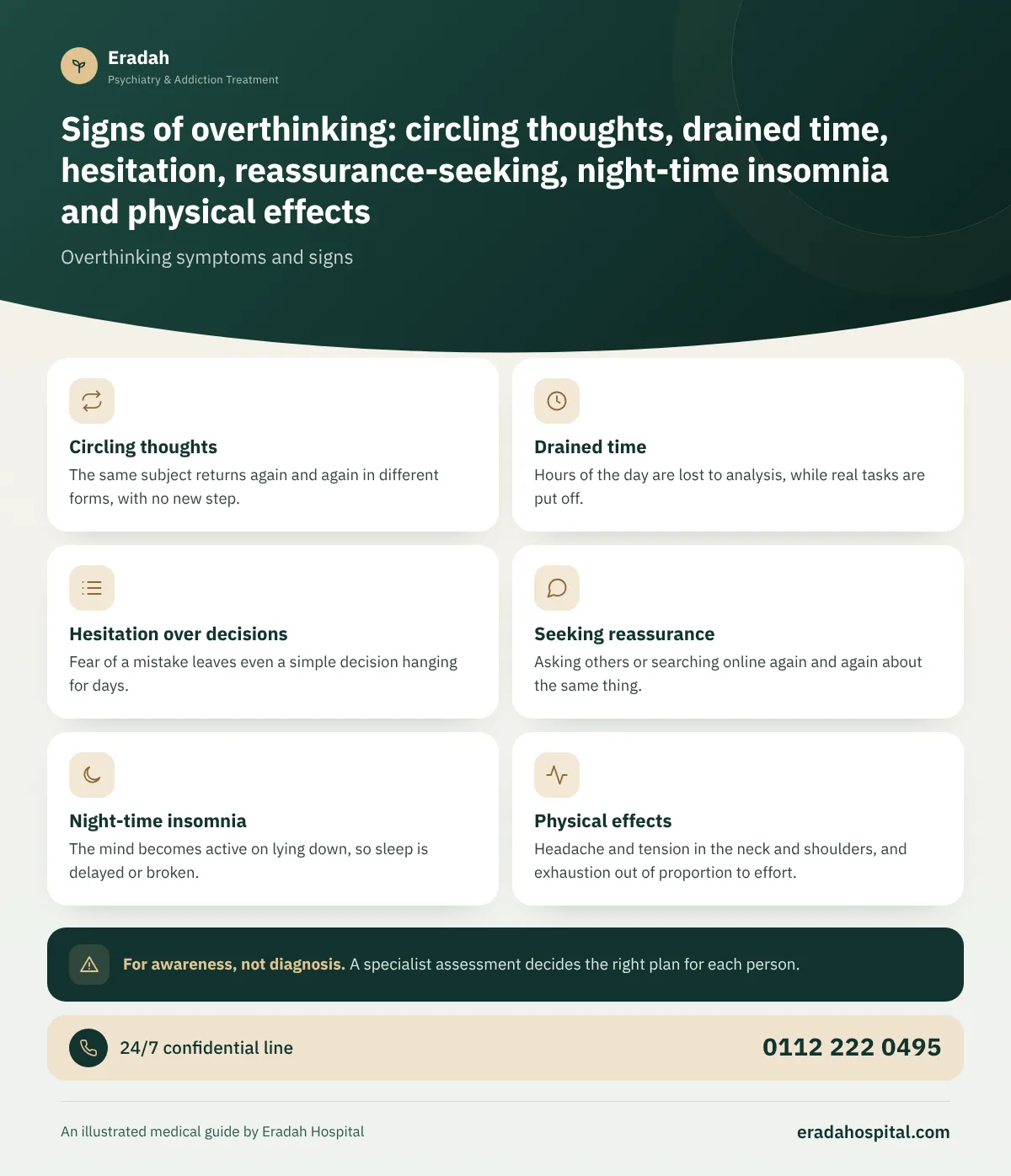
Many people describe the feeling as a “radio that never switches off” in the background: you may work, talk and eat, but part of your mind is still there, in yesterday’s conversation or in what might happen tomorrow. The signs usually appear in six forms:
The same subject returns again and again in different forms, with no new step.
Hours of the day are lost to analysis, while real tasks are put off.
Fear of a mistake leaves even a simple decision hanging for days.
Asking others or searching online again and again about the same thing.
The mind becomes active on lying down, so sleep is delayed or broken.
Headache and tension in the neck and shoulders, and exhaustion out of proportion to effort.
What are the mental and emotional signs of overthinking?
- Replaying situations: going over a conversation or a small mistake dozens of times and imagining what you should have said.
- The “what if?” chain: every bad possibility leads to one worse.
- Self-blame: questions like “Why am I like this?” and “Why does this always happen to me?”, which are features of rumination.
- Mind reading: analyzing the tone of a message or an expression on a face for a hidden meaning.
- Difficulty being present: mental preoccupation stops you enjoying a moment or a conversation.
- A sense of helplessness: the longer the thinking goes on, the weaker the confidence in your ability to act.
The review by Susan Nolen-Hoeksema and her colleagues notes that rumination strengthens negative thinking, weakens problem-solving and blocks action, which explains why the person feels they “think a lot and do nothing.”
How does overthinking affect sleep?
Night is overthinking’s favorite time: no work to occupy you, no one to talk to, and the dark magnifies worries. The person lies down tired but with a mind at peak activity. A study published in the journal Behavior Modification notes that excessive worry is linked to generalized anxiety, low mood and sleep difficulties. Sleep-related signs include:
- Difficulty falling asleep despite tiredness.
- Waking in the night and the thoughts returning immediately.
- Going over the day’s events or tomorrow’s tasks in detail in bed.
- Looking at the clock again and again and calculating the remaining hours of sleep.
- Waking up exhausted as if you hadn’t slept.
If this continues most nights for weeks, read about chronic insomnia, which may need treatment of its own.
Does overthinking have physical symptoms?
Yes. Repeatedly thinking about threat keeps the body on standby, and a review by Brosschot and colleagues suggests that worry and rumination are linked to extra activity in the heart, endocrine and immune systems, because they prolong the effect of stress before and after the situation. In daily life this may show up as:
| Area | What you may notice |
|---|---|
| Head | Tension headache and a feeling of heaviness or “crowding” in the brain |
| Muscles | Tension in the neck, shoulders and jaw |
| Stomach | Cramping or disturbed digestion at times of anxiety |
| Energy | Mental and physical exhaustion despite little effort |
| Heart and breathing | Palpitations or fast breathing when scenarios escalate |
These symptoms are real but nonspecific, and may have other physical causes, so it is best to see a doctor if they recur.
What are the common forms of overthinking?
| Format | What it looks like |
|---|---|
| Rumination | Going back to past mistakes and their causes and blaming oneself |
| Worry about the future | “What if?” scenarios about work, health and children |
| Thinking about a particular person | Analyzing a person’s words, messages and actions after a dispute or breakup |
| Thinking about decisions | Endlessly weighing options for fear of choosing wrong |
| Thinking about the body | Monitoring physical symptoms and interpreting them as the worst possibility |
The last form may overlap with health anxiety, while insistent thinking about a life partner may come close to pathological jealousy when it reaches constant suspicion, searching and accusing.
Self-assessment questions: do I think too much?
The following questions are for awareness and are not a diagnostic tool:
- Do you replay the same situation more than once a day without reaching anything new?
- Do you put off simple decisions for days for fear of making a mistake?
- Do you need repeated reassurance from others about the same matter?
- Is your sleep delayed most nights because of your mind’s activity?
- Do you come out of thinking more tense, not clearer?
When are overthinking symptoms a sign of another condition?
Pay attention if overthinking comes with persistent sadness and loss of pleasure, since it may be part of depression; if it is worry that moves between subjects most days for months, it may be generalized anxiety disorder; or if disturbing unwanted thoughts intrude on your mind followed by compulsive acts, it may be OCD. If thoughts about death or self-harm appear, seek help immediately through an ambulance (123) or the mental health support line (16328).
When thinking turns into thoughts about death: ask for help now
- Repeated thoughts about death, that life is not worth living, or that the person is a “burden” on those around them
- Severe hopelessness and a feeling that the thoughts will never stop and there is no way out
- Almost completely stopping sleeping or eating for several days
- Overusing sleeping pills or sedatives, or mixing them with alcohol, to “quiet the brain”
- Strange thoughts, intense suspicion or hearing voices that others do not hear
Do not leave the person alone. Ask them calmly and directly how they feel and what they are thinking, and listen without blame or lectures; asking directly does not plant the idea, it opens the door to help. Call an ambulance on 123 or take them to the nearest emergency room, or call the mental health support line 16328 (24 hours), and keep medications and anything they could use to harm themselves out of reach.
Ambulance 123 Mental health support line 16328