“Nothing happened, everything in my life is going fine, but I feel a weight on my heart and I don't know why.” This is one of the questions most often asked in psychiatric clinics. The reassuring answer is that sadness that seems to have no reason usually has an explanation; the important answer is that it shouldn't be ignored if it continues.
Is there really sadness for no reason?
Mood is not affected by big events alone, but also by sleep, hormones, relationships, small accumulated stresses and brain chemistry. So you may feel sad without a clear event, because the cause is slow, internal, or one you don't link to your mood. The NHS describes low mood as something that can make you feel sad, anxious or angry or less confident, with tiredness and sleep problems, and says it usually improves within days or weeks and can be helped by small changes, such as solving a problem that is on your mind or getting more sleep.
Causes of sadness for no reason
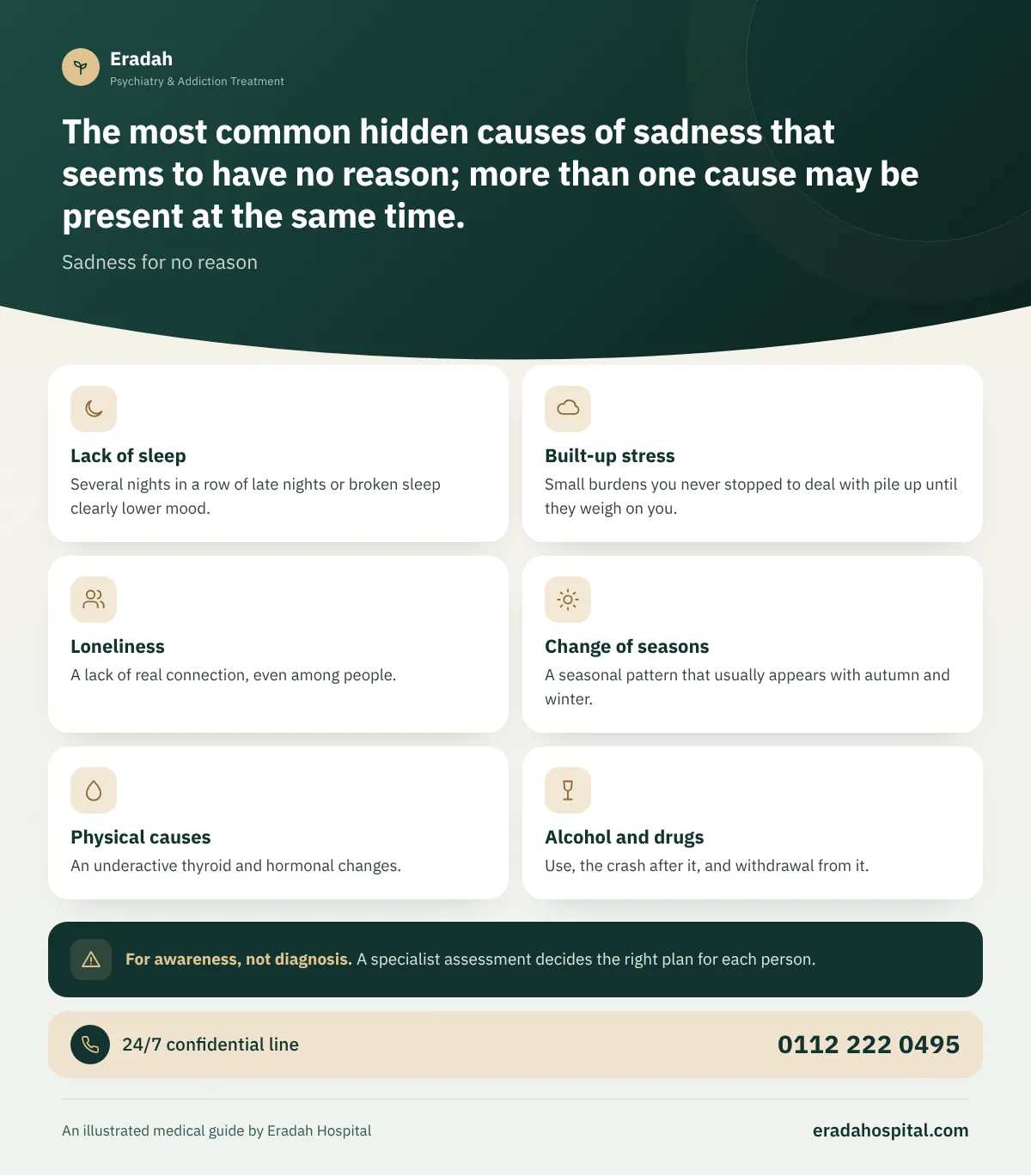
Several nights in a row of late nights or broken sleep clearly lower mood.
Small burdens you never stopped to deal with pile up until they weigh on you.
A lack of real connection, even among people.
A seasonal pattern that usually appears with autumn and winter.
An underactive thyroid and hormonal changes.
Use, the crash after it, and withdrawal from it.
Seasonal sadness: when it comes with winter
The U.S. National Institute of Mental Health (NIMH) describes seasonal affective disorder as a type of depression with a recurring seasonal pattern, with symptoms lasting about 4 to 5 months of the year. In most cases it starts in late fall or early winter and goes away in spring and summer, while in a few people it appears in spring and summer. So if you notice that your “reasonless” sadness returns at the same time every year, that is important information to tell your doctor.
When sadness is a constant companion
Some people can't remember the last time they felt truly light, and regard sadness as part of their personality. MedlinePlus explains that persistent depressive disorder, formerly called dysthymia, is a chronic type of depression whose main symptom is a low or sad mood on most days for at least two years (one year in children and adolescents, in whom it may show up as irritability), with at least two of the following: hopelessness, disturbed sleep, low energy, low self-esteem, appetite changes and poor concentration. It says it may run in families, and that most people with it have a major depressive episode at some point.
The page on symptoms of depression explains the signs in detail. And if sadness alternates with periods of heightened activity, excitement and little need for sleep, it may be part of bipolar disorder, which needs a specialized assessment.
What should you do when you feel sad for no reason?
- Don't fight the feeling or blame yourself for it; name it and acknowledge it.
- Review the last two weeks: sleep, eating, stress, and contact with people.
- Write down your mood every day for two weeks; the pattern shows what the moment doesn't.
- Get out into the light and fresh air, and move a little every day.
- Talk to someone you trust instead of waiting until you “know the reason.”
- Stay away from alcohol, drugs and sedatives taken without a prescription.
- Ask for a medical check-up and a psychological assessment if the sadness continues.
When should you ask for help?
Ask for help if the sadness lasts two weeks or more, affects your work and relationships, comes with loss of pleasure, insomnia or a change in appetite, or if you begin to turn to a substance to lift your mood. The doctor may order tests to rule out a physical cause before a psychological diagnosis. Psychological therapy is effective for most forms of persistent sadness, and a medication may be added depending on the diagnosis, which only the doctor decides. You can start in Eradah's outpatient clinics, and the first consultation is free and confidential.