What is Night Calm?
“I figured I’d take a pill to sleep for a week until the pressure eased, and six months later I was scared of the night if the box ran out.” This is how many Night Calm stories begin: an effective, legitimate sleeping medicine whose long use without a plan turns it from a temporary fix into a habit that is hard to break.
Night Calm is one of the brand names in use in Egypt for eszopiclone, known in the United States as “Lunesta.” Its official label describes it as the left-handed (S) half of the older molecule zopiclone, that is, a purified version of a sleeping medicine known for decades. It belongs to the group doctors call “Z-drugs,” which also includes zolpidem and zaleplon.
Although its chemical structure does not resemble benzodiazepines, the drug label states that it shares some of their pharmacological properties, which is why it is classified in the United States as a Schedule IV controlled substance alongside medicines such as Xanax and Valium. On our site it falls within the sedatives and sleeping pills family.
When does a doctor prescribe Night Calm?
Night Calm is prescribed to treat insomnia, whether difficulty falling asleep or repeated waking during the night. In its 2017 guidelines, the American Academy of Sleep Medicine suggested eszopiclone for both types of insomnia with a “weak” recommendation, meaning it is an acceptable option for some patients and not a solution for everyone. The drug label says that if insomnia persists after 7 to 10 days of use, the patient should be reassessed for another cause, such as depression, anxiety or a breathing disorder during sleep.
How does Night Calm affect the brain?
The drug label explains that its exact mechanism of action is not fully known, but it is thought to bind to GABA receptors at a site close to where benzodiazepines bind, strengthening the effect of this calming neurotransmitter and lowering brain activity enough to allow sleep. It reaches its peak blood concentration in about an hour, and its half-life is about 6 hours in adults. The result is:
- Drowsiness and falling asleep quickly, which is the medically intended effect.
- Poor recall of what happens after taking the tablet, especially if the person does not go straight to sleep.
- Slowed reactions and poor coordination, which raises the risk of falls at night.
- An effect that extends into the morning: in a study of 91 healthy adults described in the official label, impairment of memory and motor skills was greatest 7.5 hours after the tablet and was still present at 11.5 hours at the highest dose, while many participants did not feel affected.
Forms and names of Night Calm
Night Calm comes as film-coated tablets that are swallowed, and it is available in more than one strength, from which the doctor chooses. Another worldwide name for the same substance is “Lunesta,” while zopiclone, the parent drug, is sold under other brand names and differs from it in structure and duration. Night Calm has no well-known street names like traditional drugs, but tablets bought without a prescription or from an unreliable source cannot be verified for content or strength.
Why is Night Calm misused?
Most people who struggle with Night Calm were not looking for a “high” but for sleep. Yet the path to dependence repeats in similar ways:
- Staying on it for months after the crisis it was prescribed for has passed, without going back to the doctor.
- Raising the dose on their own when the effect weakens, or adding a second tablet in the middle of the night.
- Using it to calm anxiety during the day rather than for sleep.
- Mixing it with alcohol or other sedatives to strengthen its effect.
- Getting it from more than one doctor or pharmacy without the treating doctor’s knowledge.
The drug label notes that a study in people with a history of benzodiazepine misuse found that doses of eszopiclone far above therapeutic ones produced a feeling of euphoria similar to that produced by diazepam, with more memory loss and hallucinations as the dose rose. For this reason the risk is greater in people with a history of alcohol or drug use or a psychiatric disorder, as explained in the guide to insomnia and addiction.
Night Calm compared with zolpidem and Xanax
| Night Calm (eszopiclone) | Zolpidem | Xanax | |
|---|---|---|---|
| Family | Z-drug sleeping pills | Z-drug sleeping pills | Benzodiazepine |
| Main use | Insomnia: falling asleep and staying asleep | Short-term insomnia | Anxiety and panic attacks |
| Approximate half-life | About 6 hours | About 2.5 hours | Short-acting |
| Main official warning | Complex behaviors during sleep | Complex behaviors during sleep | Addiction, dependence and risk with opioids |
| Dependence risk | Present with long-term use | Present with long-term use | High and appears quickly |
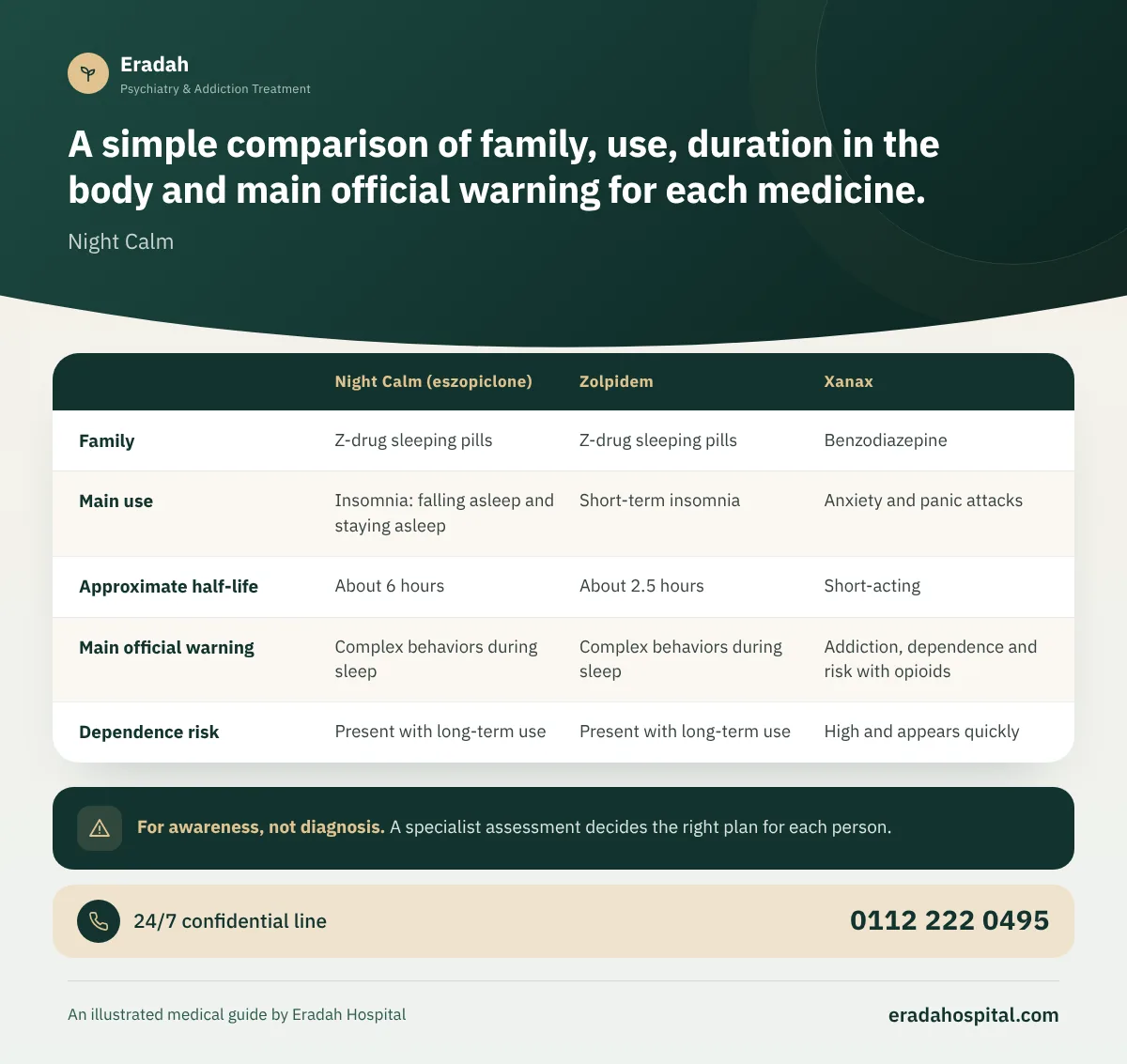
The longer time Night Calm stays in the body compared with zolpidem makes it better suited to people who wake during the night, but it also raises the chance of a morning effect. On the other hand, belonging to a family other than benzodiazepines does not mean it carries no risk; the difference is one of degree, not of kind.
The legal status of Night Calm in Egypt
Night Calm is a medicine dispensed from pharmacies by prescription only, and dispensing, circulating or selling it outside a medical setting is an offense. In the United States, its official label classifies it as a Schedule IV controlled substance. Anyone who needs help can also contact the Fund for Drug Control and Treatment of Addiction through hotline 16023 for a free, confidential consultation.
This is general educational information and not legal advice.
Night Calm in numbers
Sources: the official US label for eszopiclone (Lunesta), and a 2018 Cochrane review that pooled 14 trials with 4,732 participants.
These figures make an important point: the average benefit of a sleeping pill is real but modest, while the cost builds up with long-term use. That is why guidelines treat a sleeping pill as a temporary tool within a plan to treat insomnia, not as a permanent substitute for one.
Night Calm in brief: harms, symptoms, withdrawal and treatment
Morning drowsiness, a bitter taste and poor concentration, complex behaviors during sleep, and a major risk with alcohol and opioids.
Raising the dose on your own, running out of the box early, using it during the day, and severe anxiety when it runs low.
Rebound insomnia, anxiety, disturbing dreams and nausea on sudden stopping, and rarely seizures.
Gradual reduction under medical supervision, with behavioral therapy for insomnia and treatment of any accompanying anxiety or depression.
Each topic has a detailed page: harms of Night Calm, symptoms of Night Calm addiction, symptoms of Night Calm withdrawal, treatment of Night Calm addiction, and how long Night Calm stays in the body.
Night Calm guide: everything you need to know
We have gathered everything about Night Calm into 5 pages, each answering one question in detail. Choose what you are looking for:
Harms of Night Calm to the body and mind
Learn about the harms of Night Calm: morning drowsiness and the risk of driving, complex behaviors during sleep, the bitter taste, its effect on older adults, and the danger of mixing it with alcohol and opioids.
Night Calm addiction symptoms and signs of misuse
What are the symptoms of Night Calm addiction? The physical and behavioral signs families notice, the difference between prescribed use and dependence, and when the signs call for a medical assessment.
Night Calm withdrawal symptoms and how long they last
Night Calm withdrawal symptoms, when they start and how long they last: rebound insomnia, anxiety, disturbing dreams and nausea, when withdrawal can be dangerous, and why gradual reduction is needed.
Night Calm addiction treatment: stages and duration
How is Night Calm addiction treated? Assessment, safe gradual reduction, behavioral therapy for insomnia, treatment of accompanying anxiety and depression, and when the patient needs residential care.
How long Night Calm stays in the body
How long does Night Calm stay in the body? Its half-life and how the body clears it, whether a rapid test detects it or a laboratory test is needed, and the factors that prolong its stay.
Do you suspect a family member is dependent on Night Calm?
- Start by asking, not accusing: many people began the medicine with a prescription and did not notice that they had gone past its purpose.
- Notice the pattern: does he ask for more boxes? Does he take it during the day? Does he do things at night that he does not remember?
- Do not take the medicine away suddenly and do not hide it; stopping suddenly after long use can cause uncomfortable withdrawal symptoms.
- Encourage him to see a psychiatrist to assess the insomnia and what lies behind it, because a sleeping pill treats the symptom, not the cause.
- Learn the emergency signs and the ambulance number, 123, especially if he mixes it with alcohol or painkillers.
Danger signs after using Night Calm: call an ambulance (123) immediately
- Deep drowsiness from which the person cannot be woken by calling or shaking.
- Slow or weak breathing or unusual snoring, or blue lips.
- Severe confusion, agitation or hallucinations after taking a large number of tablets.
- Taking it with alcohol or an opioid painkiller such as tramadol, or with another sedative.
- An injury, fall or accident during sleep behavior the person does not remember.
Call ambulance (123) immediately and do not wait for them to “sleep it off.” If the person is unconscious but breathing, place them on their side in the recovery position, stay with them and watch their breathing until the paramedics arrive, and do not give them any sedative, stimulant or food. Tell the paramedics what they took, the approximate amount and the time, bring the medicine box if you find it, and tell them if the person also drank alcohol or took an opioid painkiller.
Call the ambulance 123