“My mom always says: why are you talking to yourself? Have you lost your mind?” The truth is that most people talk to themselves: while looking for their keys, rehearsing what to say before an interview, or encouraging themselves before an exam. So when is this habit normal, even helpful, and when is it a sign of something that needs attention?
What is talking to yourself?
Self-talk takes two forms: silent inner speech that you hear in your head while thinking or reading, and audible speech that you say quietly or loudly. A scientific review published in the journal Psychological Bulletin in 2015 describes inner speech, or “verbal thinking,” as a phenomenon linked to cognitive development, speech monitoring and executive functions such as planning and control, which serves important functions in human thought even though it differs from person to person.
Why do we talk to ourselves?
- To organize: “keys, wallet, phone” is a list you say so you don’t forget.
- To focus on a complex task or a sequence of steps.
- To plan and rehearse a conversation before it happens.
- To calm emotions and encourage yourself before a difficult situation.
- To think out loud and solve a problem more clearly.
- To break the silence for people who live alone for long periods.
The same review points out that children go through a stage of “private speech,” talking to themselves out loud while playing and solving problems, and this speech gradually turns into silent inner speech as they grow.
Benefits of talking to yourself: what do the studies say?
In research published in the Journal of Personality and Social Psychology in 2014, researchers from the University of Michigan carried out 7 studies on 585 participants. They found that people who addressed themselves by name or in the second person (“You can do it, Ahmed”) instead of the first person (“I can’t do it”) while thinking about a stressful situation showed less stress and better performance in tasks such as giving a speech in public, and viewed upcoming situations as a challenge rather than a threat. This effect did not differ between people with social anxiety and those without.
When the inner dialogue turns against you
Not all inner speech is helpful. A voice that keeps repeating “I’m a failure” and “everything will fall apart” feeds anxiety and depression, and replaying situations in the mind again and again is what is called overthinking. The problem here is not talking to yourself, but its harsh tone and negative content, which cognitive behavioral therapy addresses by teaching you to notice these thoughts and review them.
The difference between talking to yourself and talking to voices
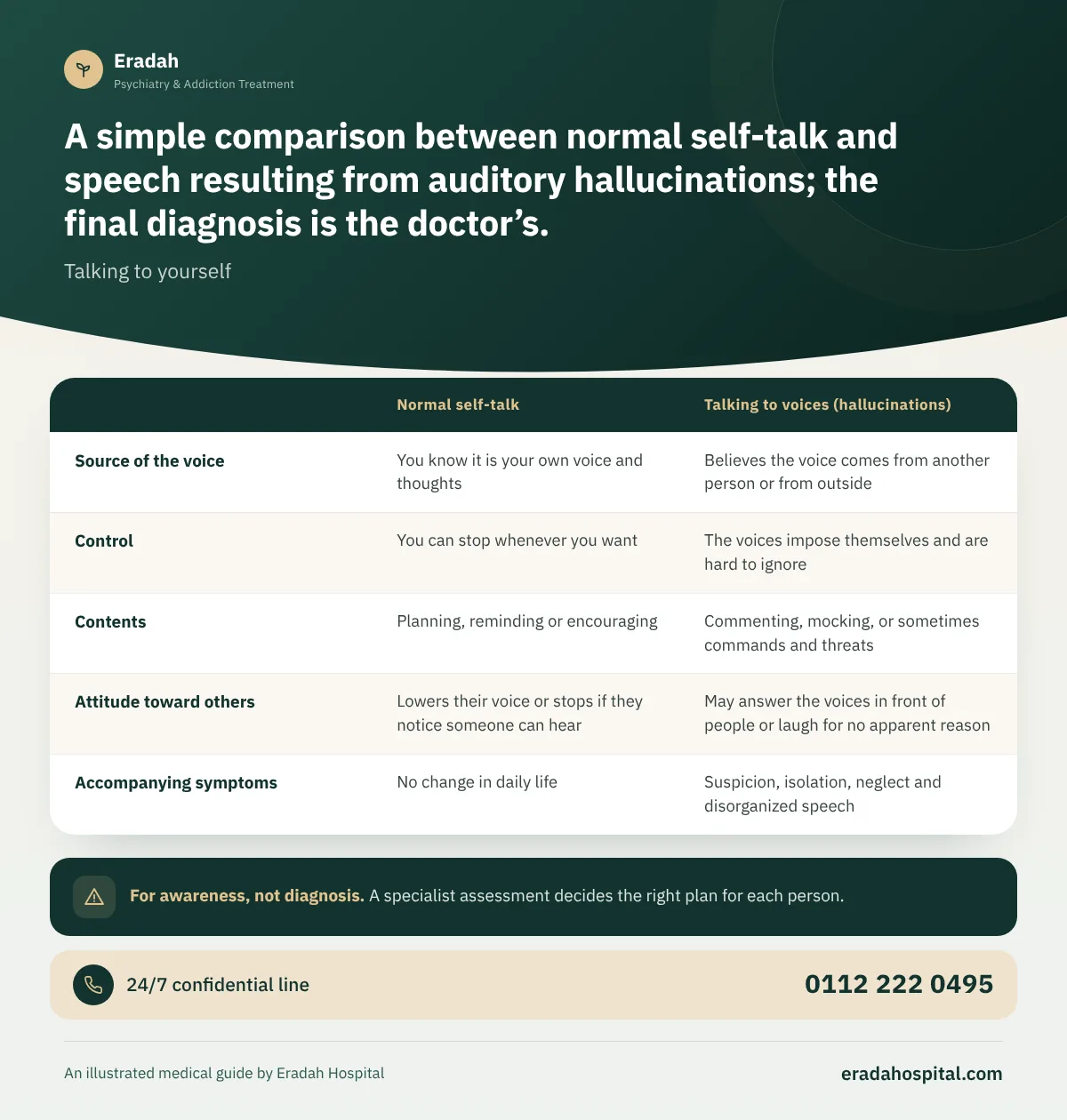
The UK’s National Health Service (NHS) notes that the most common hallucinations in schizophrenia are hearing voices, and that these voices seem completely real to the person even though those around them cannot hear them. From here comes the essential difference:
| Normal self-talk | Talking to voices (hallucinations) | |
|---|---|---|
| Source of the voice | You know it is your own voice and thoughts | Believes the voice comes from another person or from outside |
| Control | You can stop whenever you want | The voices impose themselves and are hard to ignore |
| Contents | Planning, reminding or encouraging | Commenting, mocking, or sometimes commands and threats |
| Attitude toward others | Lowers their voice or stops if they notice someone can hear | May answer the voices in front of people or laugh for no apparent reason |
| Accompanying symptoms | No change in daily life | Suspicion, isolation, neglect and disorganized speech |
When is talking to yourself a sign of mental illness?
An assessment by a psychiatrist is needed if you or your family notice, along with the self-talk, signs such as: answering voices that no one else hears, laughing or getting angry for no apparent reason, disorganized speech that is hard to understand, suspicion of people and a feeling of being watched, or isolation and neglect of hygiene and work. These may be signs of psychosis or schizophrenia, or drug-induced psychosis from substances such as crystal meth (shabu), hashish and Captagon. Confused self-talk in older adults may also be a sign of a memory problem worth checking.
What should you do?
If talking to yourself is a quiet habit that helps you organize and think, there is no need to worry or feel embarrassed about it. If the inner dialogue is harsh and wears you out, psychotherapy can help you change it. If it comes with voices, suspicion or a clear change in behavior, early assessment makes a big difference in treatment. You can start at Eradah’s outpatient clinics, where the first consultation is free and confidential, and inpatient treatment is available for men when symptoms are severe.