Your relationship with food can quietly turn into a daily worry that is hard to talk about. These five questions help you see the picture clearly and find out whether what you are going through resembles one of the types of eating disorders.
Start the eating disorder test
How is the score calculated?
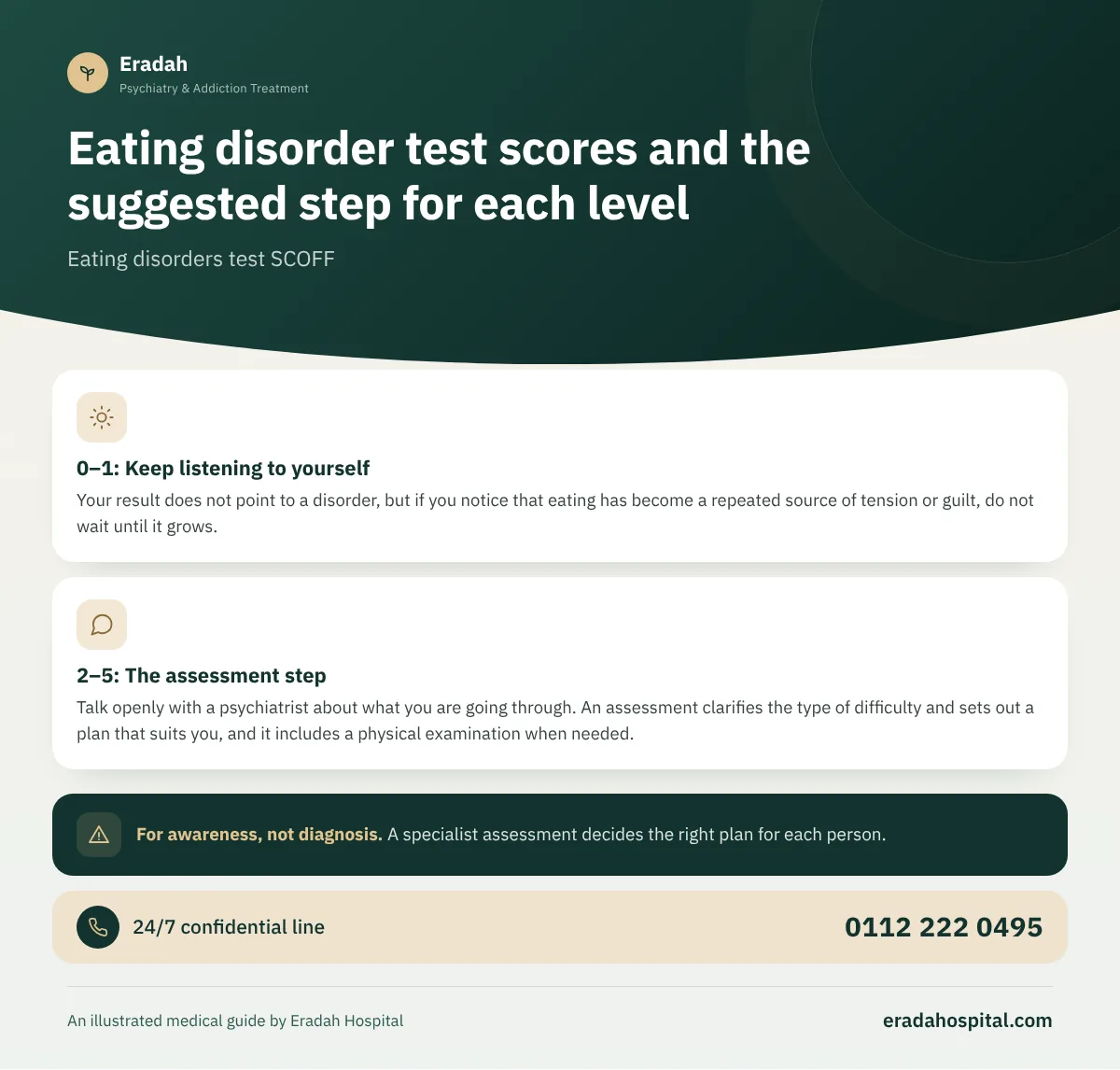
Each “yes” answer earns one point and each “no” earns zero, so the final score is from 0 to 5. The scale is not read as degrees of severity but as a single cutoff: two or more points means the screen is positive and an assessment is warranted.
| Level | Meaning | Suggested step |
|---|---|---|
| 0 – 1 | Negative screen | No action needed, but stay alert to any change in your relationship with food |
| 2 – 5 | Positive screen | Assessment with a psychiatrist or a specialist in eating disorder treatment |
What to do after your result
Your result does not point to a disorder, but if you notice that eating has become a repeated source of tension or guilt, do not wait until it grows.
Talk openly with a psychiatrist about what you are going through. An assessment clarifies the type of difficulty and sets out a plan that suits you, and it includes a physical examination when needed.
If you are worried about your son or daughter, choose a calm moment to talk, express your concern for their health and feelings rather than their body shape, and avoid commenting on what they eat in front of others. The Eradah team sees children and teenagers for assessment, with their parents taking part.
Signs worth noticing whatever your score
Your score may be low while other signs appear that the five questions do not cover. Pay attention if you notice any of the following, in yourself or someone close to you, over an extended period:
- Avoiding eating in front of others, or repeatedly making excuses to skip meals.
- Large binge episodes accompanied by a feeling of loss of control, followed by intense guilt or shame.
- Frequently going to the bathroom straight after eating.
- Exercising excessively even when ill or exhausted, and severe distress when a session is missed.
- Constant preoccupation with body shape, checking it in the mirror, or avoiding looking at it altogether.
- Mood swings and withdrawing from friends and from occasions that involve food.
In an assessment session, the doctor listens to your story without blame and asks about your eating pattern, mood, and sleep. They may request simple tests to make sure your physical health is safe, and then propose a plan that suits you, which may combine psychotherapy, nutritional follow-up, and family support. You are not asked to change everything at once; recovery moves in small steps that you set together with your treatment team.
What is the SCOFF questionnaire?
The British physician John Morgan and his colleagues developed this questionnaire, and it was published in the British Medical Journal in 1999. Its name comes from the key words of its questions in English: Sick, Control, One stone (weight), Fat, and Food. In his first study it identified every case of anorexia and bulimia in the sample, with about 87% accuracy in ruling out people without these conditions.
In a 2020 systematic review that pooled 25 studies, its sensitivity was about 86% and its specificity about 83%, but it performed less well in men and in people with binge eating disorder. For this reason it is used as a quick first step, not as a substitute for a medical interview.
Limits of the test
- It does not diagnose eating disorders; a diagnosis requires an interview with a psychiatrist.
- It was designed mainly for anorexia and bulimia, and it may miss binge eating disorder or less common disorders.
- It performs less well in men, so a low score is not enough to reassure you if you are truly struggling.
- Some physical conditions, such as thyroid problems and digestive issues, cause changes in weight and appetite.
- British guidelines advise doctors not to rely on a screening tool alone to decide whether an eating disorder is present.
Eating disorders and addiction
Eating disorders often overlap with depression and anxiety, and with the use of alcohol, stimulants, or non-prescription medications to control appetite or calm feelings. When both conditions are present, treatment needs a single plan that addresses them together, and this is what dual diagnosis treatment provides. You can also take the depression test to see the full picture.
If you want to talk with a specialist about your result, or about someone you care about, contact us on 01122220495 for a free and completely confidential consultation, with no judgment and no obligation.