What are the main symptoms of eating disorders?
There is no single sign that reveals an eating disorder. Instead, a group of changes in thoughts, feelings, behavior and the body builds up slowly. It often starts with something that looks innocent, such as “healthy eating” or “exercise,” and gradually turns into rigid rules or binges the person cannot stop.
The picture differs by type. In some types restriction and fear of eating dominate, in others binge eating and loss of control, and in a third type the avoidance comes from sensitivity to texture or a fear of choking rather than from concern about weight. But many signs are shared, and we set them out here.
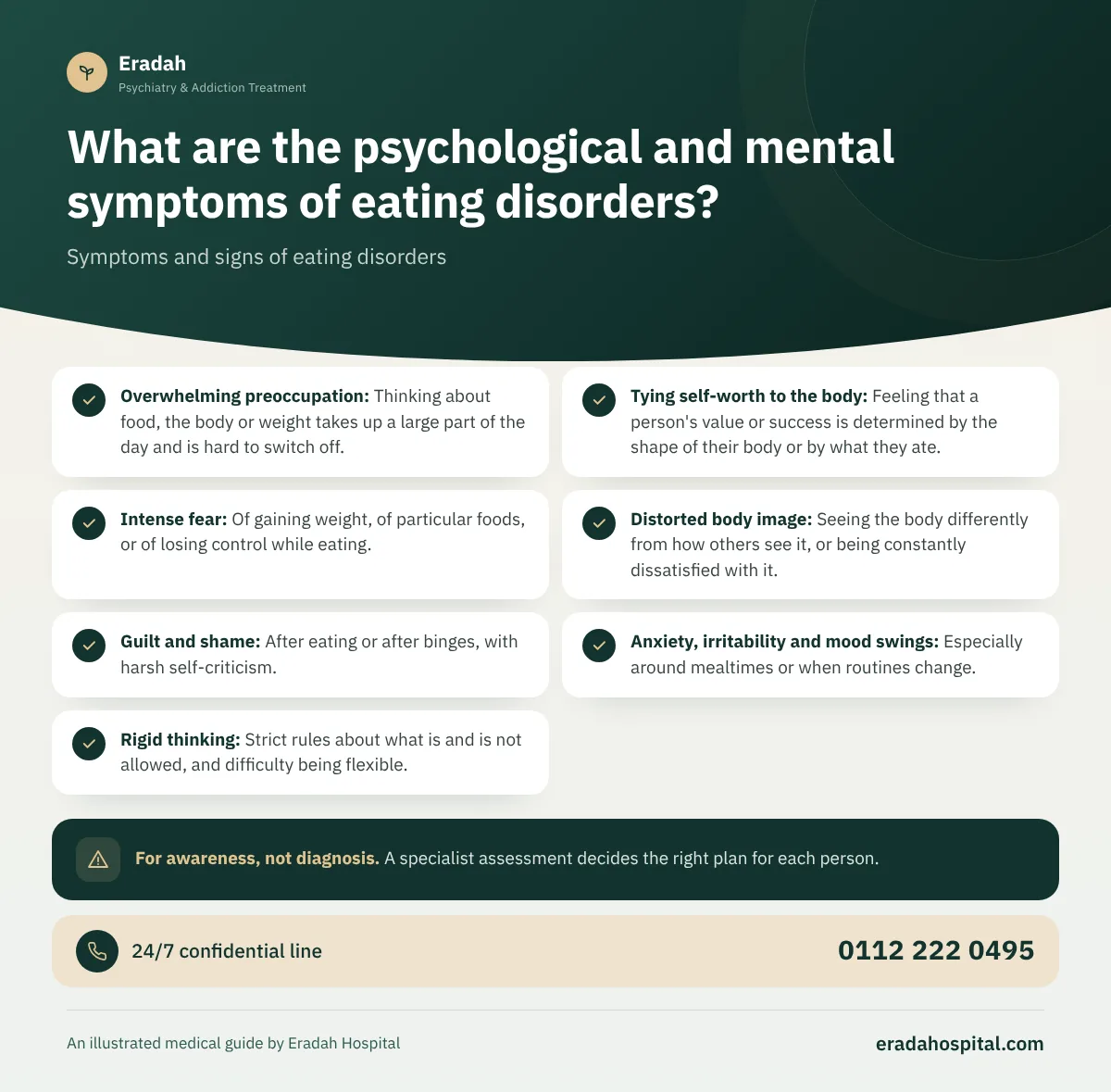
What are the psychological and mental symptoms of eating disorders?
- Overwhelming preoccupation: Thinking about food, the body or weight takes up a large part of the day and is hard to switch off.
- Tying self-worth to the body: Feeling that a person's value or success is determined by the shape of their body or by what they ate.
- Intense fear: Of gaining weight, of particular foods, or of losing control while eating.
- Distorted body image: Seeing the body differently from how others see it, or being constantly dissatisfied with it.
- Guilt and shame: After eating or after binges, with harsh self-criticism.
- Anxiety, irritability and mood swings: Especially around mealtimes or when routines change.
- Rigid thinking: Strict rules about what is and is not allowed, and difficulty being flexible.
These may be accompanied by symptoms of depression, anxiety or obsessive thoughts, which is why a comprehensive assessment is necessary.
How does behavior change with eating disorders?
- Skipping meals with repeated excuses (“I ate out,” “I'm not hungry”).
- Avoiding eating in front of others or withdrawing from invitations and gatherings.
- Unusual rituals around food, such as cutting it up excessively, eating extremely slowly, or arranging it rigidly.
- Disappearing quantities of food, or hiding food and leftovers.
- Frequently disappearing right after meals.
- Exercising compulsively, even when ill, tired or injured.
- Weighing oneself or checking the body in the mirror repeatedly, or on the contrary avoiding mirrors altogether.
- Wearing very loose clothing and a change in the way of dressing.
- A steadily shrinking list of “acceptable” foods.
These signs differ from one type to another. A person with binge eating disorder may eat normally in front of others and then have binges in secret, while a person with ARFID may look merely “picky” with no interest in weight at all. The details of each type are on the types of eating disorders page.
What are the physical signs of eating disorders?
| System | Signs that may appear | Note |
|---|---|---|
| General | Constant fatigue, weakness, always feeling cold | May be among the earliest signs |
| Heart and circulation | Dizziness on standing, fainting, palpitations | Call for an urgent medical check-up |
| Digestive system | Abdominal pain, constipation, bloating, heartburn | Common, and often mistaken for a purely digestive problem |
| Hormones | Irregular or absent periods, delayed puberty | An important sign in girls and women |
| Skin, hair and teeth | Dry skin, hair loss, tooth sensitivity or enamel erosion | A dentist may be the first to notice |
| Sleep and concentration | Insomnia, difficulty concentrating, scattered attention | Shows up in school and work |
| Weight and growth | Noticeable or fluctuating changes in weight, or stalled growth in children | Weight can be normal even when a serious disorder is present |
How do eating disorders appear in children and teenagers?
In teenagers, symptoms may begin after a hurtful comment about appearance, or with a sudden “eating plan” or exercise routine. They show up as withdrawal from family gatherings, irritability around meals, and a decline in schoolwork or, on the contrary, an excessive drive for perfection.
In younger children the picture may be different: strong refusal of many foods because of texture or smell, a fear of choking or vomiting after a frightening experience, or an obvious lack of interest in eating, with delayed growth or low energy. These features may point to avoidant/restrictive food intake disorder, not to “being spoiled.”
In both cases, the pediatrician and the psychiatrist should be involved early, because a growing body is more sensitive to any shortfall in nutrition.
Are the signs of eating disorders different in men?
In men the disorder may appear as a compulsive preoccupation with muscle and “cutting,” very rigid rules about eating and training, or binge episodes with intense shame. Because these behaviors may be praised socially as “discipline,” diagnosis is often badly delayed.
Some young men also turn to products or substances to change their body shape without medical supervision, which adds another danger. Any change in mood, isolation, or training despite injury deserves a calm conversation and a specialist assessment.
How do eating disorders appear in adults and in midlife?
Eating disorders are not limited to young people. They may return in a woman after childbirth or at menopause, or begin in a man or woman after a divorce, a loss or intense work pressure. Adults often live with binge eating disorder for years without knowing that what they are going through has a name and a treatment.
How can you tell it has gone beyond habit into a disorder?
| Aspect | Ordinary concern | A sign that calls for assessment |
|---|---|---|
| Thinking | Thinks about food when hungry or planning meals | Food and the body occupy most of the day |
| Flexibility | Can eat at an occasion without much worry | Panic or withdrawal when rules are broken |
| Feelings after eating | Contentment or fullness | Guilt, shame and harsh self-criticism |
| Social life | Takes part in meals and gatherings | Avoids them or hides eating |
| The body | Usual energy, sleep and concentration | Exhaustion, dizziness, and disturbed periods or sleep |
How can a family notice the signs of eating disorders?
Secrecy is a basic part of eating disorders; the patient often feels ashamed or is afraid of being forced to change. For this reason families rely on noticing accumulated changes rather than on a direct admission: tension around mealtimes, repeated excuses, disappearing food, withdrawal, excessive exercise, and changes in clothing and mood.
When you talk, focus on the behavior and feelings you have observed (“I've noticed you've been tense at mealtimes and distant from us”), not on weight or appearance, and avoid confronting the person in front of others or during a meal.
Questions to help you assess yourself
- Do thoughts about food, weight or your body shape take up a large part of your day?
- Do you feel intense guilt or shame after eating?
- Do you have episodes in which you eat and feel you cannot stop?
- Do you avoid eating in front of others, or avoid occasions, because of food?
- Is your mood or your sense of self-worth determined by what you ate or by how your body looks today?
- Do you hide your eating habits from the people close to you?
- Has someone close to you said they are worried about your eating or your health?
When do the signs of an eating disorder call for seeing a doctor immediately?
- Fainting, severe dizziness, chest pain or palpitations.
- Severe weakness, confusion, or inability to carry out simple daily tasks.
- Vomiting blood or severe abdominal pain.
- Completely refusing food or drink for days, especially in children.
- Any talk of death or self-harm.
In these situations call the ambulance (123) or go to the emergency room. In other cases, book an early assessment with a psychiatrist, and read about the complications of eating disorders to understand why this cannot wait.
Medical danger or suicidal thoughts? Get help now
- Repeated fainting or severe dizziness, or chest pain
- Very slow, fast or irregular heartbeat
- Confusion, severe weakness, or inability to stand and move
- Vomiting blood, or inability to keep down any fluids
- Talk of death, despair or saying goodbye to family
Eating disorders can cause sudden danger to the heart even if the person seems “fine.” Do not wait: call the ambulance on 123 or go to the nearest emergency room, and tell the doctors there is an eating disorder. If there is any talk of death, stay with the person and listen without blame, contact the mental health support line 16328, and keep medications and dangerous objects out of their reach.
Ambulance 123 Mental health support line 16328