Can eating disorders be treated? And what is the goal of treatment?
Yes, eating disorders are treatable, and many patients recover fully. The goal is not only to change what the person eats, but to restore a calm relationship with food and the body, learn new ways of coping with feelings and pressure, and return to the life the disorder stole.
- Medical safety first: Assessing the heart, electrolytes and general condition, and treating any urgent risk.
- Regular eating and restoring nutrition: With a gradual plan set by the team.
- Working on thoughts and feelings: Fear of food, tying self-worth to the body, perfectionism, and binges.
- Treating accompanying conditions: Such as depression, anxiety, obsessive-compulsive disorder and substance use.
- Relapse prevention: A clear plan for handling early warning signs after improvement.
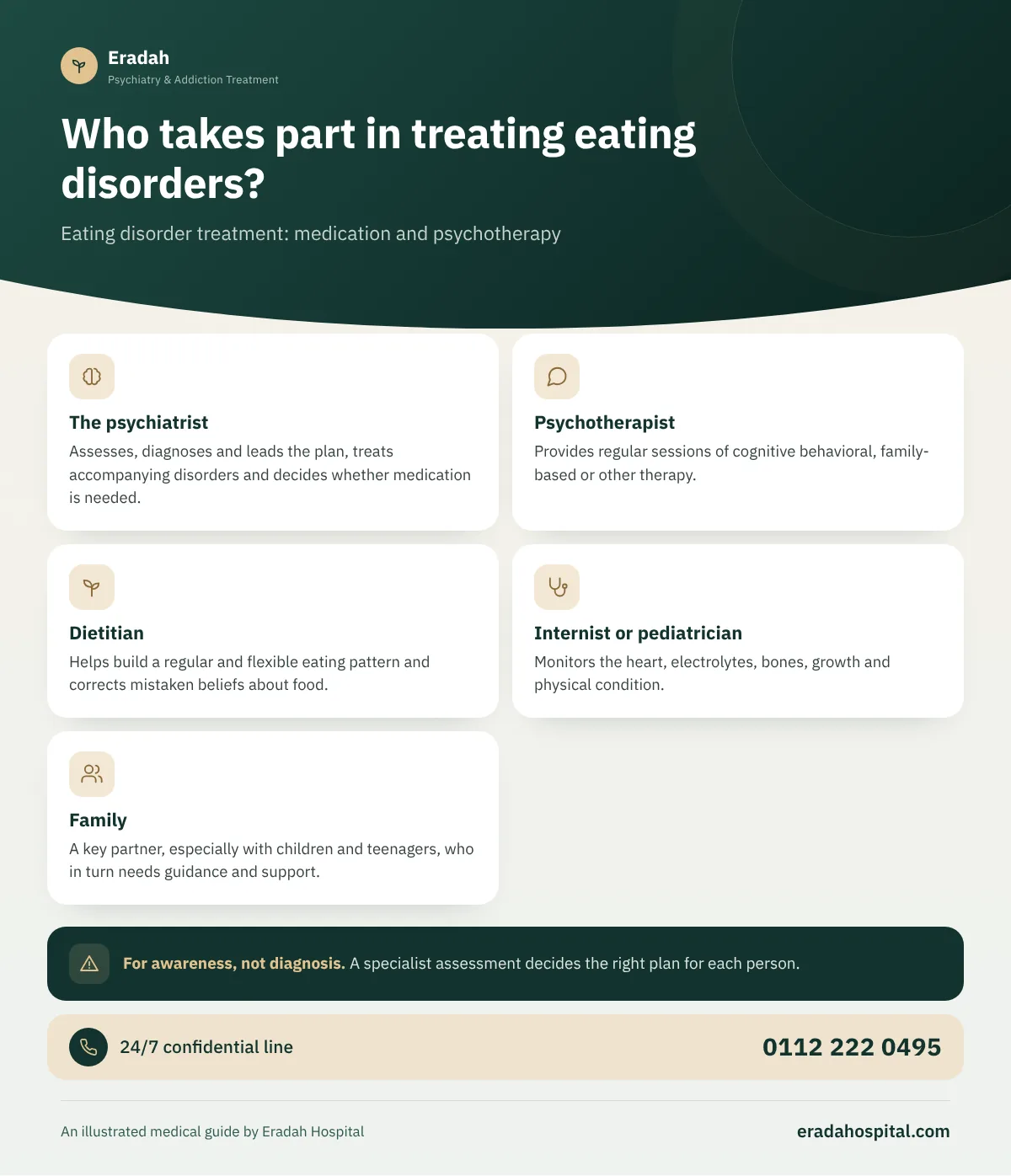
Who takes part in treating eating disorders?
Assesses, diagnoses and leads the plan, treats accompanying disorders and decides whether medication is needed.
Provides regular sessions of cognitive behavioral, family-based or other therapy.
Helps build a regular and flexible eating pattern and corrects mistaken beliefs about food.
Monitors the heart, electrolytes, bones, growth and physical condition.
A key partner, especially with children and teenagers, who in turn needs guidance and support.
What types of psychological therapy are used for eating disorders?
The UK's National Institute for Health and Care Excellence guideline (NICE NG69) recommends specific psychological therapies for each type, and it is among the most widely adopted guidelines in the world:
| Disorder | Adults | Children and teenagers |
|---|---|---|
| Anorexia nervosa | Cognitive behavioral therapy for eating disorders (CBT-ED), the Maudsley Model of Anorexia Nervosa Treatment for Adults (MANTRA), or specialist supportive clinical management (SSCM) | Family-based treatment for anorexia (FT-AN) first, with alternatives of cognitive behavioral therapy or psychotherapy designed for adolescents |
| Nervous bulimia | A guided self-help program based on cognitive behavioral therapy, then individual CBT-ED if needed | Family-based treatment for bulimia (FT-BN), with individual CBT-ED as the alternative |
| Binge eating disorder | A guided self-help program, then group or individual CBT-ED | The same approach, taking age into account and involving the family |
| Other specified eating disorders | Treatment of the type that most closely resembles the presentation | Treatment of the closest type, involving the family |
Cognitive behavioral therapy focuses on breaking the cycle that keeps the disorder going: regular eating, understanding the triggers of restriction or binges, challenging thoughts that tie worth to appearance, and learning other ways of coping with feelings. Interpersonal therapy may also be used, especially for bulimia and binge eating.
Why is family-based treatment the first choice for teenagers?
In family-based treatment, the family is not treated as the cause of the illness but as the strongest tool for recovery. Parents learn how to support their child in restoring regular eating at home, responsibility is handed back to the teenager gradually as they improve, and finally the focus returns to the normal tasks of adolescence and independence.
This approach has proven effective for anorexia and bulimia in children and teenagers, which is why NICE places it first. It needs a specialist therapist and patience from the family, especially in the difficult early weeks.
How is nutrition restored safely?
Restoring regular eating is a core part of treatment, because the brain cannot recover psychologically while it is undernourished. But after a long period of severe deficiency, a rapid and unplanned return to eating can cause a dangerous electrolyte imbalance known as refeeding syndrome, which can affect the heart and breathing.
A dietitian helps build a regular and flexible eating pattern, gradually reintroduces the foods the patient fears, and lets go of rigid diet rules. The goal is freedom from constant thoughts about food, not following a new “system.”
What is the role of medication in treating eating disorders?
Medication is not the main treatment for eating disorders, and NICE guidelines state that medication should not be offered as the sole treatment for anorexia, bulimia or binge eating disorder. But it may help in specific cases, and we mention it for awareness only, without any doses:
| Medication or class | When it may be used | General notes |
|---|---|---|
| Fluoxetine (an SSRI antidepressant) | Nervous bulimia | The only medication approved by the US Food and Drug Administration for this disorder, used together with psychological therapy |
| Lisdexamfetamine | Moderate to severe binge eating disorder in adults | Approved in the United States. It is a controlled stimulant used only by prescription and under medical follow-up, and it is not included in NICE recommendations |
| Antidepressants in general | Accompanying depression, anxiety or obsessive-compulsive symptoms | They treat the accompanying disorder and do not replace treatment of the eating disorder itself |
| Other medications at the doctor's discretion | Selected cases of anorexia or ARFID | Sometimes used off-label and with great caution under specialist supervision |
How is avoidant/restrictive food intake disorder treated?
ARFID treatment is different because the problem is not body image. It usually relies on a version of cognitive behavioral therapy designed for it, gradual exposure to feared or new foods, family involvement, and a dietitian's monitoring of growth and nutrients. With children it is preferable for the psychiatrist and pediatrician to work together, while treating any accompanying anxiety or developmental traits.
When does a person with an eating disorder need hospital admission?
Most patients are treated as outpatients. More intensive levels exist, such as day programs or hospital stays, and the team decides on them according to the medical and psychological condition, not a single number; NICE guidelines state that a single measure such as body mass index or illness duration should not be used to decide who deserves treatment.
- Medical instability: abnormal heart rhythm, blood pressure or electrolytes, or repeated fainting.
- A need for refeeding under close monitoring.
- High suicide risk or self-harm.
- No improvement despite regular outpatient treatment, or rapid deterioration.
- An eating disorder together with addiction, which requires safe withdrawal from the substance under medical supervision.
The Mental Patient Care Law No. 71 of 2009 protects patients' rights in these situations and allows compulsory admission only in specific cases and with safeguards. This is a general awareness overview and not legal advice.
How long does recovery take? And how do we prevent relapse?
The length varies greatly from person to person. Some patients improve within months of regular treatment, while others, especially those who have been ill for a long time, need years of follow-up. Relapse is common in the first year after improvement and does not mean that treatment has failed.
- Keep up follow-up even after apparent improvement, and do not stop it suddenly.
- Know your own early warning signs: the return of rigid rules, binges, or preoccupation with the body.
- Have a written plan for what to do when they appear and whom to call.
- Take care during times of pressure and big transitions such as exams, travel and childbirth.
- Stay away from harsh diets and online content that glorifies thinness or restriction.
- Treat any accompanying depression, anxiety or substance use.
How can the family help in the treatment of eating disorders?
Families need to balance firmness with tenderness: sticking to the team's plan at mealtimes without turning them into a battle, separating the child from the illness (“the disorder is the one talking right now”), avoiding any comment on weight or appearance even as praise, and watching for medical or psychological warning signs.
Parents should take care of themselves too; exhaustion and guilt are common, and family counseling sessions help them keep going. It helps for the family to give consistent messages and to explain to younger siblings, simply, what is happening.
What if the problem is emotional eating and not a disorder?
Not all eating driven by stress is an eating disorder. If the problem is daily emotional eating without repeated episodes of loss of control and intense distress, you will find practical tools on the food addiction and emotional eating page. If you suspect binge eating disorder or any other type, a specialist assessment is the right place to start.
Choosing a Hospital for Eating Disorder Treatment
Eating disorders are among the mental health conditions most dangerous to the body, since the heart and electrolytes can be disturbed while the patient looks normal. So the quality of a place is not measured only by how well it talks about body image, but by whether it has a team that reads the medical signs and knows when a clinic is enough and when a general hospital is needed before any psychological session.
- It offers cognitive behavioral therapy designed for eating disorders, not general anxiety treatment.
- It involves the family strongly if the patient is a teenager, since family-based treatment is the first choice at this age.
- It monitors weight and lab tests in cooperation with an internist, and does not judge severity by a single number.
- It asks directly about deliberate vomiting, laxatives and excessive exercise, and about any accompanying substance use.
- It has a defined route for transfer to a general hospital when the patient is unstable.
At Eradah, the psychiatrist assesses the case and sets the medication plan when depression or anxiety is present, psychologists lead the sessions, and children and teenagers are seen for assessment, treatment and follow-up with the family program. If the case needs internal medicine care, the patient is taken by ambulance to the nearest hospital. Residential treatment with us is for men only; women receive an initial consultation and are then directed to a facility suited to their condition. To learn about the best-known form, see anorexia nervosa. We answer at 01122220495 by phone or WhatsApp around the clock, and the first consultation is free and confidential for everyone, or send a confidential message to the Eradah team.
Eating disorder treatment at Eradah
At Eradah Psychiatry & Addiction Treatment Center, treatment begins with a comprehensive psychological and medical assessment, then an individual plan in which the psychiatrist, therapist and dietitian take part, with the medical follow-up needed, and with special attention to cases where an eating disorder occurs together with depression or addiction. We offer outpatient follow-up or residential care when needed, in complete confidentiality and with family involvement with the patient's consent.
Medical danger or suicidal thoughts? Get help now
- Repeated fainting or severe dizziness, or chest pain
- Very slow, fast or irregular heartbeat
- Confusion, severe weakness, or inability to stand and move
- Vomiting blood, or inability to keep down any fluids
- Talk of death, despair or saying goodbye to family
Eating disorders can cause sudden danger to the heart even if the person seems “fine.” Do not wait: call the ambulance on 123 or go to the nearest emergency room, and tell the doctors there is an eating disorder. If there is any talk of death, stay with the person and listen without blame, contact the mental health support line 16328, and keep medications and dangerous objects out of their reach.
Ambulance 123 Mental health support line 16328