What is anorexia nervosa?
“Whenever we sit down to eat she says she already ate at school, her clothes have gotten loose on her, and when we talk about it she gets angry and says she's still fat.” This is what many families describe about the beginnings of anorexia nervosa: increasing thinness, repeated excuses, and a strange insistence that the body is still “too big.”
Anorexia nervosa is one of the main types of eating disorders. The US National Institute of Mental Health (NIMH) describes it as a severe and persistent reduction in food intake that leads to a very low weight for the person's age, sex and health, along with a relentless pursuit of thinness, a distorted body image and an intense fear of gaining weight.
The Arabic name is slightly misleading, because the person usually does not lose the sensation of hunger but resists and suppresses it. NIMH notes that some patients may also go through episodes of eating and vomiting, which sometimes brings the picture closer to bulimia.
Who gets anorexia nervosa?
The NHS notes that men and women of any age can get anorexia nervosa, but it is more common in young women and usually starts in the mid-teens. NIMH reports that the average age of onset is 18 and that its lifetime prevalence among American adults is 0.6%. Factors that raise the likelihood, according to the NHS, include:
- A personal or family history of eating disorders, depression or addiction.
- Being criticized for eating, body shape or weight.
- Excessive preoccupation with thinness, especially with social or professional pressure, as among athletes, dancers and models.
- Anxiety, low self-esteem, or an obsessive or perfectionist personality.
- Emotional, physical or sexual abuse.
What are the signs of anorexia nervosa?
or failure to gain weight and height as expected in those under 18.
Avoiding many foods, cutting food into tiny pieces, and eating alone.
Insisting they are fat when their weight is normal or low.
Punishing daily workouts regardless of tiredness or illness.
Loss of periods, or delayed onset of periods in girls.
Feeling lightheaded, hair loss, dry skin and constantly feeling cold.
The NHS notes that some people may vomit or use laxatives, diuretics or appetite suppressants. The general signs of all eating disorders are covered in eating disorder symptoms.
What does anorexia nervosa do to the body?
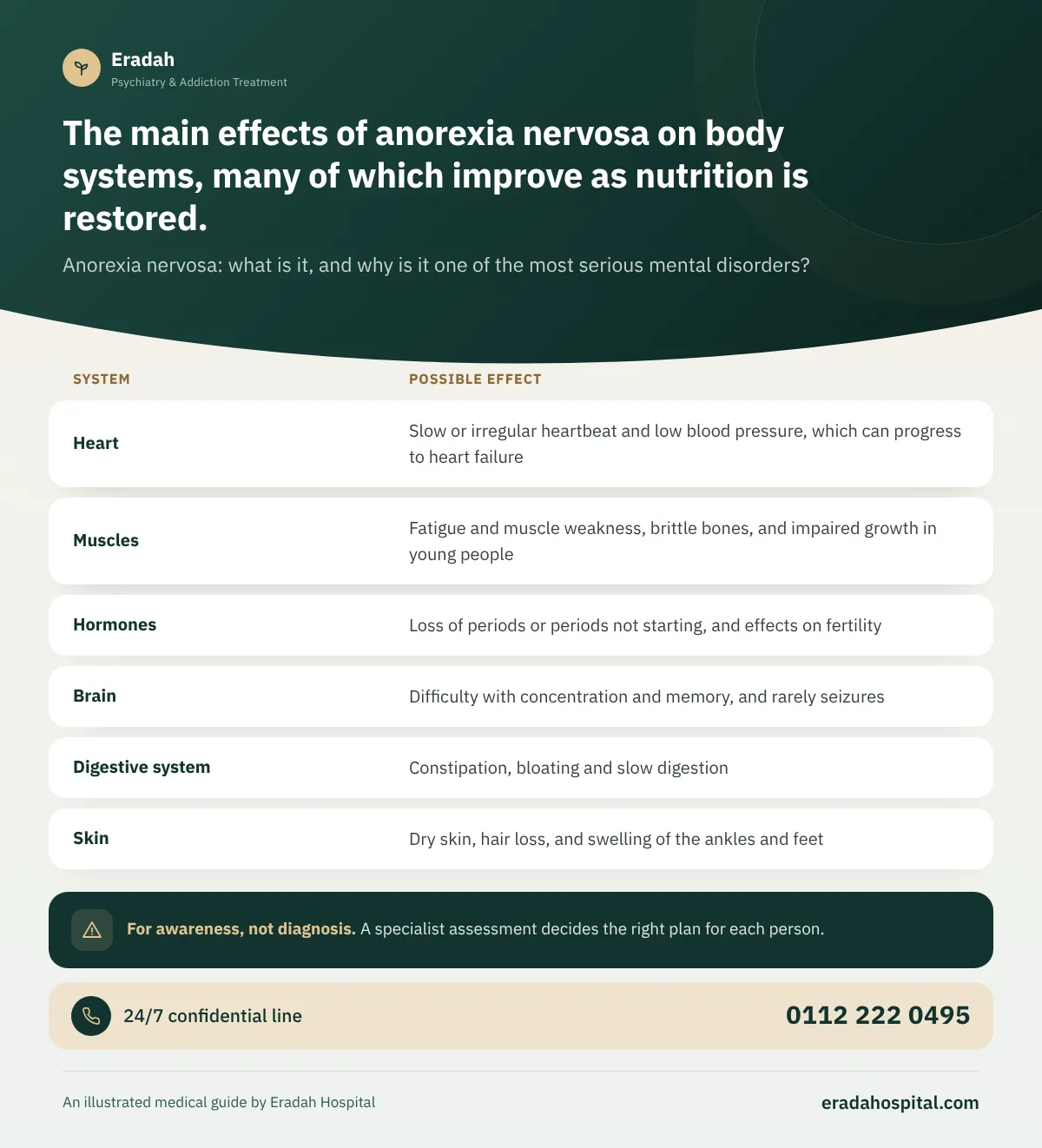
The NHS notes that long-term anorexia can cause serious health problems linked to malnutrition, but they usually begin to improve as eating improves:
| System | Possible effect |
|---|---|
| Heart | Slow or irregular heartbeat and low blood pressure, which can progress to heart failure |
| Muscles | Fatigue and muscle weakness, brittle bones, and impaired growth in young people |
| Hormones | Loss of periods or periods not starting, and effects on fertility |
| Brain | Difficulty with concentration and memory, and rarely seizures |
| Digestive system | Constipation, bloating and slow digestion |
| Skin | Dry skin, hair loss, and swelling of the ankles and feet |
That is why the doctor usually checks weight, heart rate, blood pressure and temperature, and may order blood tests, as the NHS notes. The complications are detailed in harms of eating disorders.
Why is anorexia nervosa life-threatening?
The World Health Organization states that anorexia nervosa can lead to early death, often from medical complications or suicide, and that its death rate is higher than that of any other mental disorder. In an analysis of 36 studies published in Archives of General Psychiatry in 2011:
These numbers are shocking, but they are not inevitable. They reflect cases in which treatment was delayed or never received, which is why the NHS stresses that getting help as quickly as possible gives the best chance of recovery. Any talk of death or self-harm calls for contacting the 16328 line or ambulance (123) immediately.
How is anorexia nervosa treated?
The UK's NICE guidelines recommend one of three specialized psychological treatments for adults: eating-disorder-focused cognitive behavioral therapy, the Maudsley Anorexia Nervosa Treatment for Adults (MANTRA), or specialist supportive clinical management (SSCM). For children and adolescents they recommend family therapy tailored to anorexia.
NICE states that medication should not be offered as the sole treatment for anorexia, and NIMH notes that there are currently no medications approved by the US Food and Drug Administration (FDA) to treat its symptoms, although the doctor may treat accompanying depression or anxiety. Nutrition is restored gradually and under medical supervision, because refeeding quickly after prolonged starvation carries risks. Most patients are treated outside the hospital, and admission is needed when there is medical or psychological danger. The details of the plan are in eating disorder treatment. Do not start or stop any medication without a doctor.
How can the family respond to anorexia nervosa?
- Talk about your concern for their health and mood, not about weight and shape.
- Avoid commenting on bodies and diets in front of the patient, even meaning it as praise.
- Do not get into battles at every meal; agree on a plan with the treating team.
- Expect denial and anger; the patient often sees the illness as part of who they are.
- Look after yourselves and ask for support; treatment may take a long time.
At Eradah Hospital, the psychiatrist assesses the case and determines the level of care required, with medical and nutritional follow-up and treatment of any accompanying depression or obsessive-compulsive symptoms. Residential treatment is for men only, while the free, confidential first consultation is available to everyone, with referral to the appropriate specialist provider for girls and women.
Medical or psychological danger signs with an eating disorder? Get help now
- Fainting, severe dizziness, palpitations or a very slow heartbeat
- Chest pain, severe muscle weakness or seizures
- Repeated vomiting with blood, or being unable to keep down any food or drink
- Complete refusal of food and drink, or rapid deterioration
- Talk of death, self-harm, or being a “burden” on the family
These are medical emergency signs that cannot wait: call ambulance (123) or go to the nearest emergency department, because salt imbalance and heart rhythm problems can occur even when weight looks normal. Stay with the person and speak calmly, without blame or comment on their appearance or eating. If they talk about death or harming themselves, do not leave them alone and contact the mental health support line 16328, available around the clock.
Ambulance 123 Mental health support line 16328