What is bulimia nervosa?
“I go two days barely eating, then at night I eat everything in the fridge and can't stop, and afterward I feel awful and do anything to get rid of it.” This painful episode is the core of bulimia, and it usually happens in complete secrecy, while from the outside the person looks entirely normal.
Bulimia nervosa is one of the main types of eating disorders. The US National Institute of Mental Health (NIMH) describes it as repeated binge episodes, meaning eating a large amount of food in a short time with a sense of loss of control, followed by “compensatory” behavior such as deliberate vomiting, excessive use of laxatives or diuretics, fasting, or excessive exercise.
NIMH adds that people with bulimia, unlike those with anorexia nervosa, may be at a normal weight or above, but like them they fear gaining weight and feel intense dissatisfaction with the shape of their bodies.
How common is bulimia?
These figures come from the US National Comorbidity Survey data presented by NIMH. There are no unified Egyptian figures, but secrecy and shame mean that many cases never reach a doctor at all.
How does the bulimia cycle work?
Therapists understand bulimia as a self-feeding cycle, where every attempt at “control” sets up the next episode:
- 1Strict restriction
Harsh eating rules, skipped meals, or severe dieting out of fear of weight gain.
- 2Binge episode
Accumulated physical and psychological hunger bursts out in an episode with a sense of loss of control.
- 3Guilt and shame
A sharp sense of failure and self-disgust after the episode.
- 4Compensation
Vomiting, laxatives, fasting or excessive exercise to erase what happened.
- 5Return to restriction
A promise to be strict from tomorrow, and the cycle begins again.
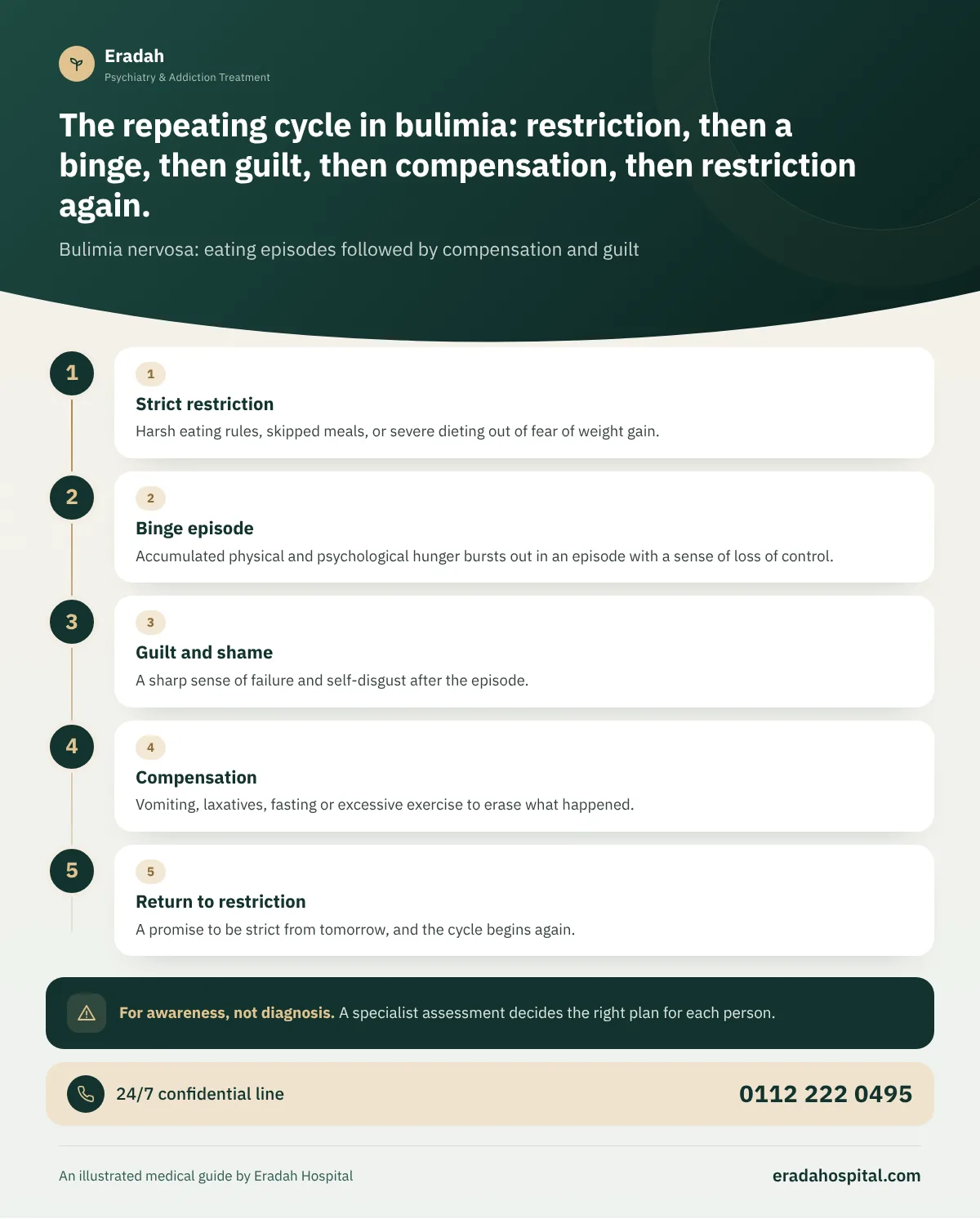
That is why it is not enough to tell the person “eat in moderation”; treatment targets the whole cycle, beginning with restoring a regular eating pattern that reduces the hunger that triggers episodes.
What signs of bulimia might the family notice?
The NHS lists a number of signs, including:
- Episodes of eating large amounts in a short time, and food disappearing from the house unexplained.
- Going to the bathroom right after eating, or finding packets of laxatives or diuretics.
- Constant preoccupation with weight and shape, and harsh criticism of the body.
- Mood swings: tension, irritability, anxiety or depression.
- Feelings of guilt and shame, and secrecy about eating habits.
- Swelling on both sides of the face and below the ears due to enlarged salivary glands.
The general signs of all eating disorders are explained in eating disorder symptoms.
What harm does bulimia do to the body?
The NHS notes that over time bulimia can cause physical problems linked to malnutrition, repeated vomiting and excessive laxative use, and that it can become life-threatening without the right support:
| System | Possible complication |
|---|---|
| Teeth and mouth | Erosion of tooth enamel from stomach acid with repeated vomiting |
| Throat and esophagus | Damage to the lining of the throat from acid |
| Bones | Weakened bones (low bone density) |
| Heart and salts | Imbalance of body salts such as potassium, which can cause irregular heartbeats |
That is why the NICE guidelines recommend assessing fluid and salt balance in people who use compensatory behaviors, and an electrocardiogram (ECG) when there are risk factors. A scientific analysis published in Archives of General Psychiatry in 2011 found that the death rate in people with bulimia rises to about twice what is expected in the general population. The complications are detailed in harms of eating disorders.
The difference between bulimia, binge eating disorder and anorexia
| Aspect | Bulimia nervosa | Binge eating disorder | Anorexia nervosa |
|---|---|---|---|
| Binge episodes | Recurrent | Recurrent | May be present in some patients |
| Compensation by vomiting or fasting | Regular | Not present regularly | May be present |
| Weight | Often normal or above | Often above normal | Dangerously low |
| Fear of weight gain | Severe | Not required | Very intense |
Some patients may move from one type to another over time, as the guide to types of eating disorders explains, and this differs from food addiction, which does not involve compensatory behavior.
How is bulimia treated?
The UK's NICE guidelines recommend that adults start with a guided self-help program designed for bulimia, and if it is not suitable or does not help after 4 weeks, move on to eating-disorder-focused cognitive behavioral therapy (CBT-ED). For children and adolescents they recommend family therapy tailored to bulimia. They state explicitly that medication should not be offered as the sole treatment for bulimia.
NIMH notes that medications may be used to treat symptoms of some eating disorders, including bulimia, and to treat accompanying anxiety and depression. The NHS notes that treatment may last months or years depending on how long the illness has lasted and how severe it is, and that hospital admission may be needed when there are serious health problems or a risk of self-harm. The full plan is in eating disorder treatment. Do not start or stop any medication without a doctor.
How do you talk to someone you suspect has bulimia?
- Choose a quiet, private time, away from meals and from any episode.
- Talk about your feelings and what you have noticed without accusing: “I'm worried about you, and I feel like you're struggling.”
- Do not comment on weight, shape or how much they eat, and do not monitor the bathroom.
- Expect denial or anger; shame is part of the illness. Repeat your offer of help calmly.
- Offer to go with them to the doctor; having a supportive person makes the first step easier.
At Eradah Hospital, the psychiatrist assesses the case and makes a plan that combines psychological treatment, medical follow-up and treatment of any accompanying depression or substance use. Residential treatment is for men only, while the free, confidential first consultation is available to everyone, with referral to the appropriate provider for women.
Medical or psychological danger signs with an eating disorder? Get help now
- Fainting, severe dizziness, palpitations or a very slow heartbeat
- Chest pain, severe muscle weakness or seizures
- Repeated vomiting with blood, or being unable to keep down any food or drink
- Complete refusal of food and drink, or rapid deterioration
- Talk of death, self-harm, or being a “burden” on the family
These are medical emergency signs that cannot wait: call ambulance (123) or go to the nearest emergency department, because salt imbalance and heart rhythm problems can occur even when weight looks normal. Stay with the person and speak calmly, without blame or comment on their appearance or eating. If they talk about death or harming themselves, do not leave them alone and contact the mental health support line 16328, available around the clock.
Ambulance 123 Mental health support line 16328