Self-confidence is one thing, and narcissistic personality is another. This questionnaire helps you reflect calmly on traits such as a constant need for admiration and difficulty with empathy, so you can see whether talking to a specialist is worth a step.
Start the narcissistic personality test
How is the score calculated?
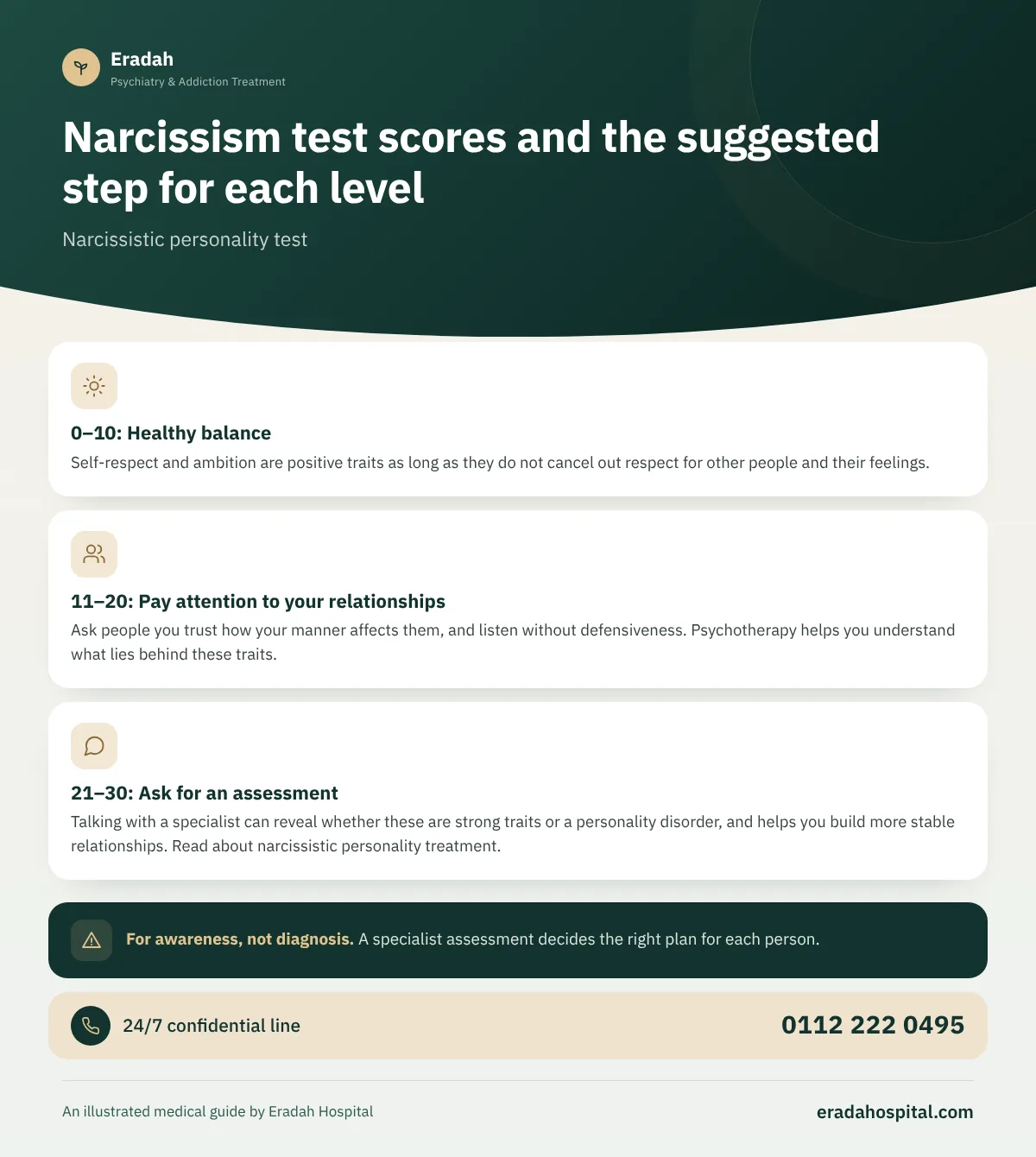
Each statement has four answers: “Disagree” = 0, “Slightly agree” = 1, “Agree” = 2, and “Strongly agree” = 3. The scores of the ten statements are added to give a number from 0 to 30. There is no sharp line between “narcissistic” and “not narcissistic”; traits exist on a continuum in everyone, and the score only estimates your position on that spectrum. It is read as follows:
| Level | Explanation | Suggested step |
|---|---|---|
| 0 – 10 | Few traits | No specific action needed |
| 11 – 20 | Noticeable traits | Reflect on their effect on your relationships, and talk with a specialist if they are troubling you |
| 21 – 30 | Many traits | Assessment with a psychiatrist or psychotherapist |
What to do after your result
Self-respect and ambition are positive traits as long as they do not cancel out respect for other people and their feelings.
Ask people you trust how your manner affects them, and listen without defensiveness. Psychotherapy helps you understand what lies behind these traits.
Talking with a specialist can reveal whether these are strong traits or a personality disorder, and helps you build more stable relationships. Read about narcissistic personality treatment.
Narcissistic traits and narcissistic personality disorder
Everyone carries some self-love and a desire for recognition, and that is normal, even necessary. Narcissistic personality disorder, however, is a medical diagnosis that requires a stable pattern of grandiosity, a need for admiration, and reduced empathy. It begins by early adulthood, shows up in many situations, and meets at least five of the nine criteria in the diagnostic manual. The inflated image often hides a fragile sense of worth that is shaken by the slightest criticism. This is why diagnosis needs a psychiatrist, not a label thrown out in a family quarrel or on social media.
Narcissism is also not a single picture. There is the overt type, who talks loudly about himself and openly asks for admiration, and there is the covert type, who seems shy or sensitive but feels inwardly more entitled than others and is deeply hurt when not appreciated. In both cases the greatest cost is usually in close relationships: repeated conflicts, difficulty apologizing, and a feeling in the other person of being unseen. Understanding this dynamic is a first step toward changing it, whether you are the person with the traits or the one living with them.
How do you deal with a narcissistic person?
If you are reading this page because someone close to you has these traits, here are brief principles that protect your balance:
- Set clear, calm boundaries, and stick to them without long explanations or justification.
- Avoid open-ended arguments to prove who is right, and stick to specific facts.
- Do not build your self-esteem on their opinion of you, and keep supportive relationships outside this one.
- Encourage them to seek help without calling them narcissistic, because the label closes the door to dialogue.
- If the relationship turns abusive or threatening, your safety comes first, so seek support immediately.
Individual or family psychotherapy helps people who live with a narcissistic person understand what is happening and regain their confidence, even if the other person is not yet ready to change.
You will find more detail in the guide to dealing with a narcissistic personality.
Limits of the test
- An awareness questionnaire that is not scientifically validated and is not suitable for diagnosis.
- It is not suitable for judging another person by answering on their behalf.
- Self-reported answers are affected by how self-aware and candid the person is.
- Manic episodes and stimulant use can temporarily produce traits that resemble narcissism.
- A low score does not rule out relationship difficulties that deserve attention.
Narcissism and addiction
When the ideal image that a narcissistic person draws of themselves is shaken, they may turn to alcohol or drugs to bear the feeling of failure or emptiness. Denial of the problem often delays seeking treatment, because admitting the need for help seems like weakness. When narcissistic traits and addiction occur together, a plan is needed that treats both together under dual diagnosis.
Free confidential consultation
Whether the result concerns you or you are looking for a way to deal with someone close to you, the Eradah team is glad to listen without judgment. Contact us for a free, confidential initial consultation on 01122220495.