Do you wash your hands again and again, or go back to check the door even though you locked it? Sometimes that is ordinary carefulness, and sometimes it is a sign of obsessive-compulsive disorder. These questions help you tell the two apart.
Start the OCD test
How is the score calculated?
For the first seven questions and the tenth: “Never” = 0, “Sometimes” = 1, “Often” = 2, and “Almost always” = 3. The time question and the impact question each have their own answers, which also run from 0 to 3. The scores are added to give a number from 0 to 30. These cutoffs are guidelines that we set for awareness purposes, not approved diagnostic thresholds:
| Level | What it means | Suggested step |
|---|---|---|
| 0 – 7 | Low likelihood | No action needed, but retake the questionnaire if symptoms increase |
| 8 – 15 | Moderate likelihood | Consult a mental health specialist to understand the symptoms |
| 16 – 30 | High likelihood that an assessment would help you | Assessment by a psychiatrist soon |
What to do after your result
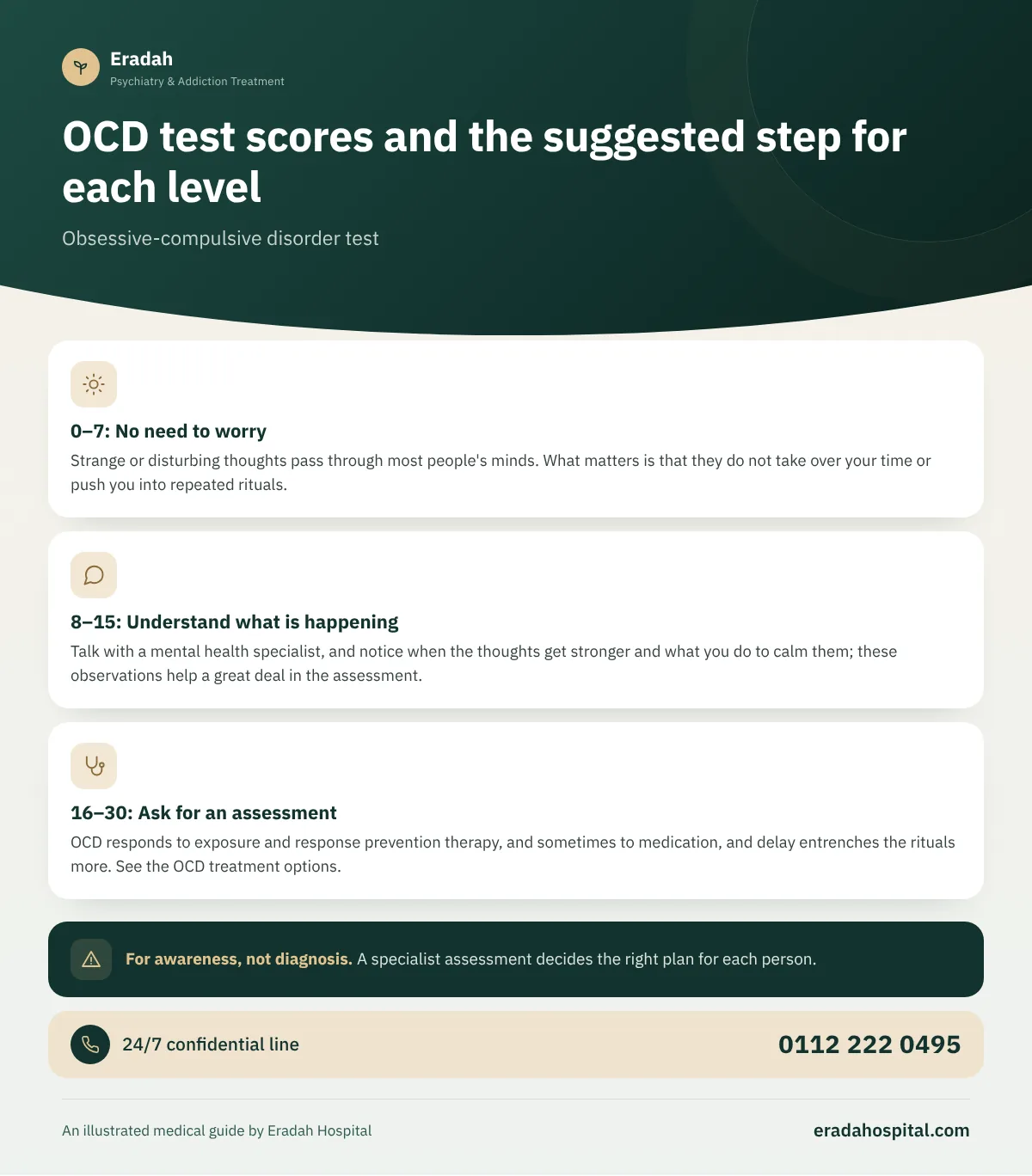
Strange or disturbing thoughts pass through most people's minds. What matters is that they do not take over your time or push you into repeated rituals.
Talk with a mental health specialist, and notice when the thoughts get stronger and what you do to calm them; these observations help a great deal in the assessment.
OCD responds to exposure and response prevention therapy, and sometimes to medication, and delay entrenches the rituals more. See the OCD treatment options.
OCD: intrusive thoughts and repeated actions
OCD has two parts: obsessions, which are thoughts, images, or urges that invade the mind against the person's will and trigger intense anxiety, and compulsions, which are visible behaviors such as washing and checking, or mental ones such as counting and repeating phrases, that the person performs to relieve that anxiety. The problem is that the relief is brief, so the thought returns and demands the ritual again.
It takes many forms: fear of contamination, doubt and checking, the need for symmetry, violent or taboo thoughts that the person strongly rejects, and religious obsessions about worship and ritual purity. What makes it a disorder and not just a personality quirk is the time it consumes and the distress it causes.
When the family joins in the rituals
Families often find themselves part of the OCD without meaning to: answering the same reassurance questions dozens of times, washing things again, or changing the whole household routine to avoid an episode of distress. This looks like kindness, but it feeds the OCD and prolongs it. What helps the patient more is for the family to agree with the therapist on a gradual plan to reduce this involvement, with plenty of patience and encouragement, instead of sudden refusal or blame, which only raises tension at home.
About this questionnaire
This awareness questionnaire was designed based on the OCD criteria in the Diagnostic and Statistical Manual of Mental Disorders. It is not standardized and has not undergone validation studies. Doctors rely on approved tools to rate severity, such as the Yale-Brown scale (Y-BOCS), which is administered in an interview with a specialist. The aim of our questions is to help you notice what you are going through and decide whether you need that step.
Limits of the test
- An awareness questionnaire that is not validated and is not suitable on its own for diagnosis.
- It does not distinguish OCD from related disorders such as generalized anxiety or obsessive-compulsive personality disorder.
- Strong carefulness and orderliness can raise the score without a disorder being present.
- Some people with OCD have grown so used to their rituals that they no longer notice them, so their score comes out lower than the reality.
- It is not suitable for assessing children; OCD in young people needs an assessment in which the parents take part.
OCD and addiction
The constant pressure that obsessions create pushes some people to sedatives or hashish to quiet the thoughts, even for a few hours. But these substances do not treat OCD, and they may increase anxiety when their effect wears off and add a new dependence problem. If you have both, treating them needs one integrated plan, as the article on OCD and addiction explains.
Free confidential consultation
OCD is not weak willpower or lack of faith; it is a disorder with treatment. If you want to understand your result or ask about the next step, contact the Eradah team for a free, confidential consultation on 01122220495.