What is religious OCD?
“I do my ablution and then doubt that it was broken. I repeat the prayer three or four times, and in the end I feel God didn’t accept it.” Anyone living with this knows that the problem is not a lack of care, but care that has turned into torment, consuming time and peace of mind. This is exactly what religious OCD looks like.
The International OCD Foundation (IOCDF), which calls it “scrupulosity,” defines it as a type of obsessive-compulsive disorder in which the obsessions revolve around religion or morality. The person becomes intensely preoccupied with the idea that a thought that crossed their mind, or something they did, may be a sin, and worries about what their thoughts say about who they really are. They then carry out visible or mental compulsions to ease this anxiety, which bring a little relief before the cycle returns stronger.
Is religious OCD common in Egypt?
Yes. In a study by a team from Ain Shams University of 90 patients with OCD at the Cairo psychiatric institute clinic, published in 1994, religious and contamination obsessions were the most common, at 60%, and repetition rituals were the most common compulsions, at 68%. The researchers noted the influence of religious upbringing on the form OCD takes in Egyptians.
A review published in Current Psychiatry Reports in 2010 explains that the proportion of religious obsessions among people with OCD ranges from 0% to 93% across studies, depending on how important religion is in the society being studied, and that the evidence that religiosity itself causes OCD is scant. Religion often determines the subject of the obsession, not whether it exists.
The most common forms of religious OCD
Repeated doubt about whether something has been discharged or whether water reached every part, so ablution and washing after using the toilet become long and repeated, to the point of missing prayer times.
Repeating the opening takbir, the Fatiha or the whole prayer for fear of a mistake in the intention, the count or the wording.
Thoughts that insult God or sacred things, which the person hates and is terrified of, and which grow stronger during worship.
A constant fear that some sin has not been forgiven, or that one has fallen into disbelief without meaning to.
Fear that a passing word or thought may have caused a divorce, with repeated questions about the ruling.
Fear that clothes, places or hands are impure, with washing and avoidance that disrupt daily life.
When is conscientiousness devotion, and when does it become religious OCD?
The dividing line is not how much worship someone performs, but what drives it and what it does to them. Devotion brings calm and is satisfied with what is required; OCD is driven by fear and is never satisfied by any amount. Signs worth noticing include:
- You repeat your ablution or prayer because you “don’t feel” it was valid, not because a real mistake happened.
- The answer of a trusted scholar does not satisfy you, so you ask another, and then another, about the same question.
- You avoid congregational prayer or the mosque for fear of embarrassment over your repetition.
- You do far more than what is required, or you give up worship entirely because it has become torment.
- Purification and worship take an hour or more a day beyond the usual, and affect work and family.
- You constantly monitor your thoughts and try to “cancel” a bad thought with a ritualized phrase or prayer.
You will find a short comparison between healthy religiosity and OCD on the page about types of OCD. If sexual thoughts intrude on you during worship, the page on sexual OCD explains this type.
Why does OCD attack what a believer holds most dear?
OCD picks what matters to you most. A person who loves their children is visited by thoughts of harming them, and a person who cares about their faith is visited by thoughts of disbelief and doubts about worship. The cause is not the thought itself, since strange thoughts pass through most people’s minds, but the terrifying interpretation of it: “Since it crossed my mind, I am responsible for it, and maybe I want it.” This confusion between thought and action, together with an exaggerated sense of responsibility, is what turns a passing thought into a recurring obsession.
That is why trying to force the thought away, or repeating a seeking-refuge prayer in a ritualized way until the thought “disappears,” makes it more present. The mind remembers exactly what we try hardest to forget.
What does religion say about obsessive doubt? And the role of a trusted scholar
Al-Bukhari recorded in his Sahih (hadith no. 5269) that the Prophet, peace be upon him, said: “God has forgiven my community for what their souls whisper to them, as long as they do not act on it or speak it.” Many scholars rely on this principle to reassure people with obsessive doubts that thoughts they hate and push away are not held against them. A well-known legal maxim also says that “certainty is not removed by doubt,” so a person who was certain of their purity and then doubts whether it was broken remains in a state of purity.
The IOCDF notes that clergy may take part in treatment when the patient wishes, by clarifying the religious position on a matter related to recovery. What matters is that there is one trusted scholar, asked once, whose answer is then accepted, because repeating the question and moving from one sheikh to another becomes a compulsion in itself and feeds the OCD.
Treating religious OCD with exposure and response prevention
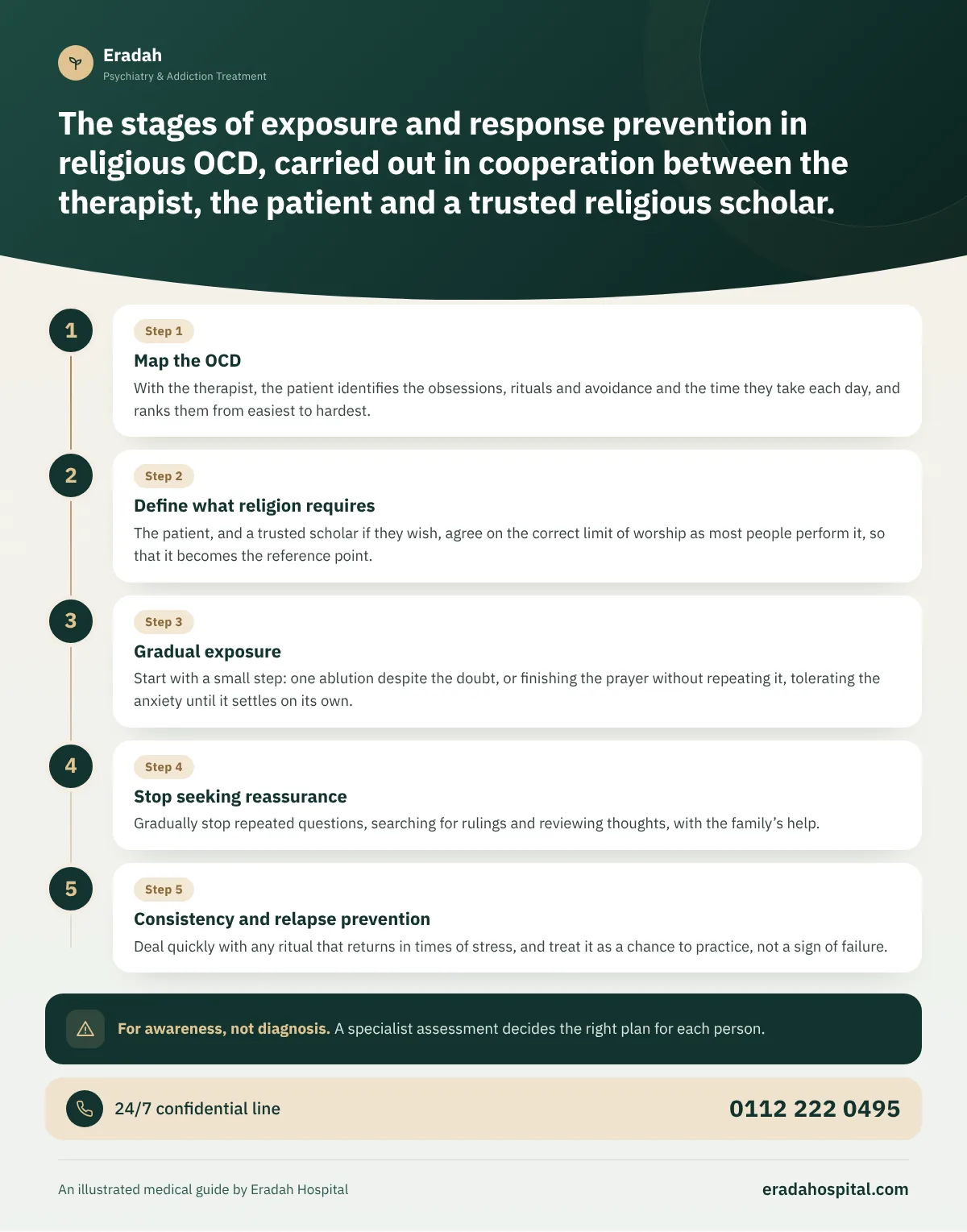
The core treatment is exposure and response prevention, a type of cognitive behavioral therapy recommended by the British NICE guidelines for OCD. In religious OCD, the exercises are designed to stay within the limits of what the patient’s faith accepts. The patient is never asked to do anything forbidden, only to stop the excess that the OCD imposes:
- Step 1Map the OCD
With the therapist, the patient identifies the obsessions, rituals and avoidance and the time they take each day, and ranks them from easiest to hardest.
- Step 2Define what religion requires
The patient, and a trusted scholar if they wish, agree on the correct limit of worship as most people perform it, so that it becomes the reference point.
- Step 3Gradual exposure
Start with a small step: one ablution despite the doubt, or finishing the prayer without repeating it, tolerating the anxiety until it settles on its own.
- Step 4Stop seeking reassurance
Gradually stop repeated questions, searching for rulings and reviewing thoughts, with the family’s help.
- Step 5Consistency and relapse prevention
Deal quickly with any ritual that returns in times of stress, and treat it as a chance to practice, not a sign of failure.
A review in Current Psychiatry Reports confirms that cognitive behavioral therapy can be adapted for religious patients while respecting their beliefs. The doctor may add a medication from the selective serotonin reuptake inhibitor (SSRI) group when needed, deciding the type and dose; never start or stop any medication without a doctor. Details of the options are in the guide to treating OCD.
How can the family help someone with religious OCD?
- Do not mock them or accuse them of weak faith or of being overly strict; they are suffering more than you can see.
- Do not answer the same question many times. Instead say gently: “I know you’re anxious, and I’m sure you can bear the doubt.”
- Do not repeat ablution or wash things on their behalf to give them relief.
- Encourage them to see a psychiatrist, and offer to go with them to the first visit.
If the rituals take hours of their day, if sadness and despair accompany them, or if they have begun to avoid prayer and people, it is time to seek help. At Eradah they can receive a confidential assessment with a psychiatrist and a therapist in the outpatient clinics, with full respect for their beliefs.
Suicidal thoughts or severe despair because of OCD? Seek help now
- Talking about death, or a conviction that they are doomed and have no chance of repentance
- Severe despair and a feeling that life with the obsessions is unbearable
- Stopping eating, sleeping or going out altogether because of purity rituals or fear of sin
- Harming or punishing themselves as “atonement” for thoughts they did not choose
- Saying goodbye to family, or a strange sudden calm after a period of intense suffering
Stay with the person and listen calmly without blame or preaching, and reassure them that you are with them and that what they are going through is a treatable illness. Keep medications and dangerous objects out of their reach. Call an ambulance (123) or go to the nearest emergency room if the danger is imminent, and contact the mental health support line (16328), available around the clock.
Ambulance 123 Mental health support line 16328