Does OCD have official types?
When people talk about “types of OCD,” they usually mean its themes: cleanliness, checking, religion, and so on. In research these are called “dimensions” or “symptom clusters.” They are very useful for understanding and treatment, but they are not separate diagnoses.
Officially, the illness is diagnosed under a single name, obsessive-compulsive disorder, and the doctor then adds “specifiers” that describe the picture of the condition, the most important being how far the patient recognizes that their thoughts are illogical, and whether there is a history of tic disorders.
What are the main types of OCD by theme?
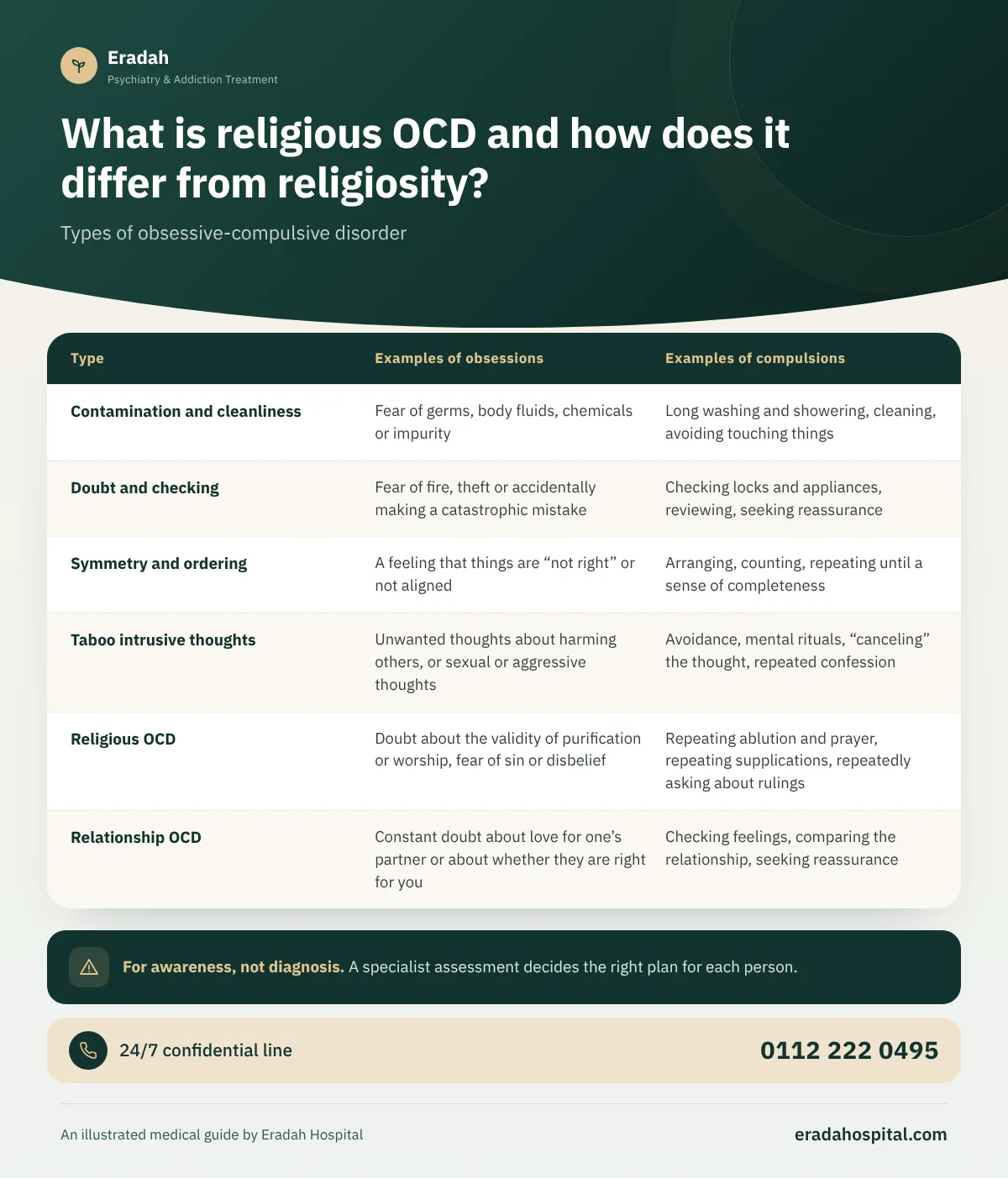
| Type | Examples of obsessions | Examples of compulsions |
|---|---|---|
| Contamination and cleanliness | Fear of germs, body fluids, chemicals or impurity | Long washing and showering, cleaning, avoiding touching things |
| Doubt and checking | Fear of fire, theft or accidentally making a catastrophic mistake | Checking locks and appliances, reviewing, seeking reassurance |
| Symmetry and ordering | A feeling that things are “not right” or not aligned | Arranging, counting, repeating until a sense of completeness |
| Taboo intrusive thoughts | Unwanted thoughts about harming others, or sexual or aggressive thoughts | Avoidance, mental rituals, “canceling” the thought, repeated confession |
| Religious OCD | Doubt about the validity of purification or worship, fear of sin or disbelief | Repeating ablution and prayer, repeating supplications, repeatedly asking about rulings |
| Relationship OCD | Constant doubt about love for one’s partner or about whether they are right for you | Checking feelings, comparing the relationship, seeking reassurance |
What is cleanliness and contamination OCD?
One of the best-known and most visible types of OCD. It revolves around fear of becoming contaminated or contaminating others, so that the patient or someone they love falls ill. The fear may not be of a specific illness, but of the feeling of “dirtiness” itself, which they cannot tolerate.
The patient performs long washing rituals in a fixed order, divides the house into “clean” and “contaminated” zones, and avoids handshakes or public places. This has nothing to do with loving cleanliness; some patients live in disorder because they avoid touching things altogether.
What is doubt and checking OCD?
It centers on responsibility and fear of making a mistake: Did I turn off the gas? Did I lock the car? Did I send the message to the wrong person? Did I hit someone with my car without noticing? The patient goes back to check many times, or takes photos of locks, or asks others to make sure.
The problem is that checking does not bring lasting certainty; as soon as the person moves away, the doubt returns, because memory itself loses confidence with excessive checking, a phenomenon researchers have observed.
What is symmetry and ordering OCD?
Here the driver is often not fear of disaster but an uncomfortable inner feeling that things are “not right.” The patient arranges objects at exact angles, touches things evenly with both hands, or rewrites a word until it looks “right.” This type is sometimes linked to tics and often begins in childhood.
What is intrusive thought OCD?
One of the most painful types, and the most hidden. Thoughts or images that completely contradict the patient’s values invade the mind: the idea of harming their child or mother, sexual thoughts they do not want, or sudden aggressive urges. Because these clash with who they are, they cause intense terror and guilt, so the person avoids knives or being near children, and constantly monitors their thoughts.
This type is sometimes called “purely obsessional OCD,” but the name is partly misleading, because the patient usually performs hidden, ongoing mental rituals such as reviewing, analyzing and “canceling” the thought.
Religious OCD in brief
Religious OCD is a form of OCD centered on worship, ritual purity and guilt. Among the most common forms in Egyptian patients are doubting the validity of ablution and prayer and repeating them again and again, intrusive thoughts insulting sacred things that the patient is terrified of and rejects, and repeatedly asking about the same ruling without being reassured. The difference from healthy religiosity is that here worship brings torment and doubt, not calm.
We explain its forms, causes and treatment, without touching the patient’s faith, on the page Religious OCD: symptoms, how it differs from religiosity, and treatment.
Is hoarding a type of OCD?
Hoarding, meaning difficulty discarding things and piling them up until spaces are full, was once considered a type of OCD. But since DSM-5 in 2013, and then ICD-11, hoarding disorder has been a separate diagnosis within the group of OCD-related disorders, because it differs in its symptoms and in how it responds to treatment; the person often does not find their thoughts distressing, and is emotionally attached to the objects.
Even so, a patient with OCD may accumulate things for an obsessional reason, such as fear that throwing away a piece of paper might cause harm. Here it is part of the OCD and not a separate disorder. Hoarding symptoms are among the factors linked to a slower response to treatment.
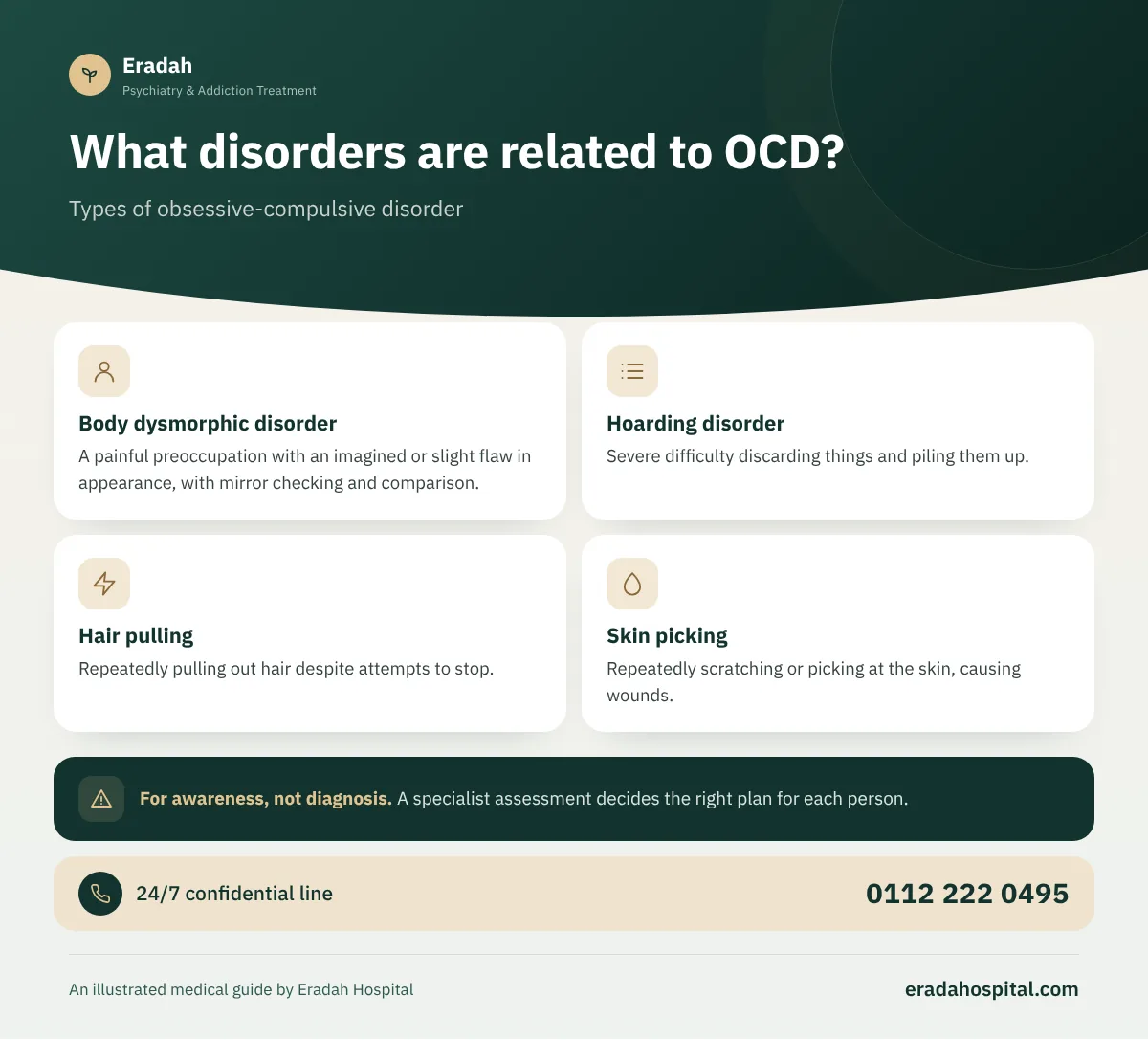
What disorders are related to OCD?
A painful preoccupation with an imagined or slight flaw in appearance, with mirror checking and comparison.
Severe difficulty discarding things and piling them up.
Repeatedly pulling out hair despite attempts to stop.
Repeatedly scratching or picking at the skin, causing wounds.
What are the OCD specifiers: insight and tics?
| Specifier | Meaning | Why it matters |
|---|---|---|
| Good or fair insight | The patient recognizes that their beliefs are probably not true | The most common picture |
| Poor insight | The patient believes their beliefs may be true | Needs more encouragement to stay with treatment |
| Absent insight | Complete conviction that the obsession is true | Rare, and needs careful distinction from psychosis |
| Tic-related | A current or past history of motor or vocal tics | More common in males and with childhood onset, and may influence the choice of medication |
Medical reviews indicate that only a small proportion of patients, around 2 to 4%, lose insight completely, which distinguishes OCD from psychotic disorders.
Are there special forms of OCD by age or life stage?
- Childhood OCD: often begins in males before puberty and is more strongly linked to tics and heredity.
- Infection-related OCD in children: a sudden, severe onset after a bacterial infection, which needs special assessment.
- OCD during pregnancy and after childbirth: usually centered on the baby’s safety and contamination.
- OCD in early adulthood: the most common period for symptoms to appear in adults.
Why does identifying the type of OCD matter for treatment?
Because the core of exposure and response prevention is facing each patient’s own trigger. The exercises for a patient with contamination fears are completely different from those for a patient with checking or religious OCD. Some forms, such as hoarding, tic-related cases or poor insight, may also need adjustments to the medication or psychological plan. That is why the therapist starts with a careful map of the patient’s obsessions and rituals before any exercise.