What are the main symptoms of OCD?
OCD has two linked parts: what goes on in the mind against the person’s will, and what they do to get rid of the anxiety it causes. The details vary a great deal from one patient to another, but the basic feeling is the same: a doubt that will not settle and an urgent need to do something about it.
People around them need not notice anything. Many patients are skilled at hiding their rituals, or perform them only in their mind, or avoid the situations that trigger them, so nothing shows in front of anyone.
What are the thought and emotional symptoms of OCD?
- Repeated doubt: “Did I lock the door?”, “Did I run someone over without noticing?”, “Did I say something hurtful?”
- Fear of contamination: from germs, body fluids, chemicals or “impurity.”
- Disturbing intrusive thoughts: images or urges about harming a loved one, or thoughts that conflict with the person’s religion or morals.
- A need for symmetry and perfection: a feeling that things must be perfectly aligned or “just right.”
- Exaggerated responsibility: fear of causing a disaster if every possibility is not guarded against.
- A sense of incompleteness: a vague feeling that something is “not right” until an action is repeated.
- Guilt, shame and disgust: strong feelings that accompany the thoughts and increase the effort to hide them.
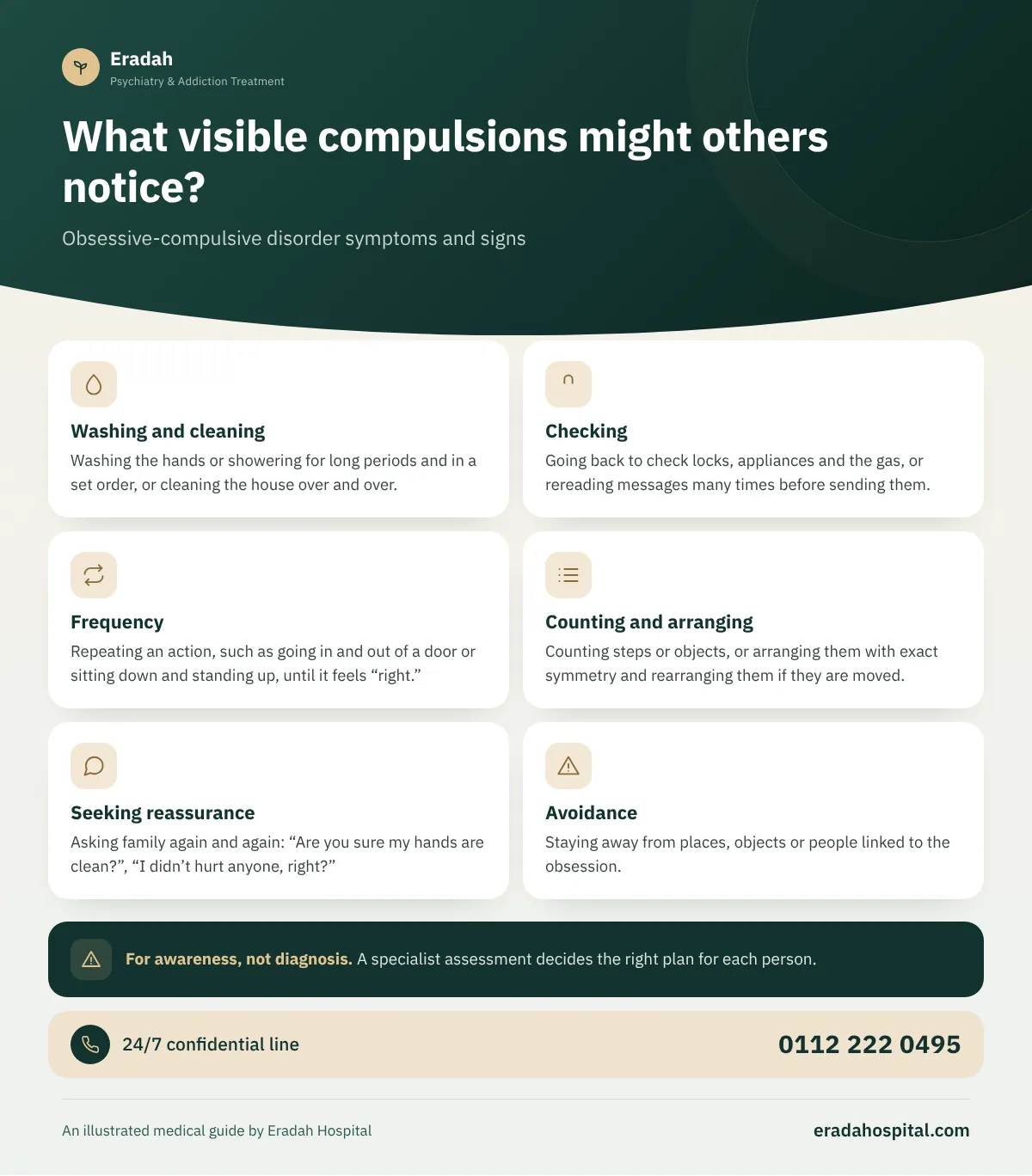
What visible compulsions might others notice?
Washing the hands or showering for long periods and in a set order, or cleaning the house over and over.
Going back to check locks, appliances and the gas, or rereading messages many times before sending them.
Repeating an action, such as going in and out of a door or sitting down and standing up, until it feels “right.”
Counting steps or objects, or arranging them with exact symmetry and rearranging them if they are moved.
Asking family again and again: “Are you sure my hands are clean?”, “I didn’t hurt anyone, right?”
Staying away from places, objects or people linked to the obsession.
What are the hidden mental compulsions?
These are among the hardest symptoms for the patient and the least understood by others, because they happen entirely inside the mind. Some people wrongly think that those who have them have “obsessions without compulsions,” when in fact they are performing exhausting mental rituals:
- Replaying a situation or conversation in the mind again and again to make sure they did not make a mistake.
- Mentally repeating certain words, prayers or numbers a set number of times.
- “Canceling” a bad thought by calling up a good image or thought.
- Trying to reach complete “certainty” through nonstop analysis of thoughts.
- Constantly checking inner feelings to make sure they do not “want” the intrusive thought.
Does OCD have physical signs?
OCD is mainly a psychological disorder, but the rituals and anxiety leave physical signs that the family or doctor may notice:
| The sign | Link to OCD |
|---|---|
| Dry, cracked, red hands | Repeated washing and excessive use of disinfectants |
| Exhaustion and lack of sleep | Night rituals or checking before bed, and nonstop thinking |
| Muscle tension and headaches | Constant anxiety and resisting thoughts |
| Disordered eating or weight loss | In some patients, avoiding foods they consider contaminated |
| Frequent lateness | The long time taken by morning or leaving-the-house rituals |
How do OCD symptoms appear in children?
Children may not be able to explain their thoughts, and may not even realize, as adults do, that they are illogical. So the problem often shows up in behavior:
- Long bedtime rituals, and refusing to sleep if they are not done “right.”
- Repeated reassurance questions that the answer never satisfies, however often it is given.
- Excessive handwashing or intense fear of getting dirty at school.
- Rewriting or erasing homework many times until the letters look “perfect.”
- Great upset if someone moves their things or changes their arrangement.
- Late homework and schoolwork despite intelligence, because of repeating and checking.
What do the symptoms look like in teenagers and adults?
In adolescence, the obsessions may center on religion, morality, intrusive sexual thoughts or identity, subjects that are hard for a teenager to talk about. They suffer in silence and their school performance drops without their parents understanding why.
In adults, the symptoms often show up at work and at home: lateness because of leaving-the-house rituals, rechecking papers and messages again and again, slowness in finishing tasks despite competence, and family arguments over cleanliness, order or repeated reassurance.
What are the symptoms of OCD during pregnancy and after childbirth?
OCD may appear or worsen during pregnancy or in the first months after childbirth. Among its most common forms are a mother’s excessive fear of contaminating the baby and sterilizing everything over and over, or terrifying intrusive thoughts about accidentally harming the child, which make her avoid holding or bathing the baby.
These thoughts terrify the mother because they are the exact opposite of what she wants, and they do not mean she is a bad mother or a danger to her child. But they deserve prompt help, because treatment eases her suffering and protects her relationship with her baby. If they come with a break from reality or fixed convictions in strange ideas, that is a different, urgent condition that needs a doctor immediately.
What is the difference between mild and severe OCD?
| Level | Approximate time consumed | Effect on life |
|---|---|---|
| Mild | Less than an hour a day | Clear distress, but able to do most tasks |
| Moderate | One to three hours a day | Lateness and disruption at school or work, and family tension |
| Severe | More than three hours a day, and it may take up most of the day | Unable to work or study, isolation, and sometimes depression |
Statistics from the US National Institute of Mental Health indicate that about half of adults with OCD have severe impairment in their lives, a high proportion among mental disorders.
How does the family notice OCD?
- Water bills or soap and cleaning product use far above normal.
- A very long time spent in the bathroom or getting ready to leave.
- Repeated questions in the same wording asking for reassurance.
- Strict rules imposed on the home: taking off shoes in a certain way, or forbidding anyone to touch their things.
- Intense upset or anger if they are stopped from completing a ritual.
Self-assessment questions: is what I am going through OCD?
These questions are for awareness only and are not a diagnosis; an accurate diagnosis needs a psychiatrist:
- Do disturbing thoughts, images or doubts that you do not want invade your mind and prove hard to push away?
- Do you feel an urgent drive to repeat certain actions or thoughts until you feel at ease?
- Do you know that what you do is excessive, but cannot stop?
- Do these thoughts and actions take an hour or more of your day?
- Do you avoid places or things for fear of triggering these thoughts?
- Do you repeatedly ask your family for reassurance about the same thing?
If most of your answers are “yes,” consult a psychiatrist. If this comes with severe despair or thoughts about death, seek help immediately through an ambulance (123) or the mental health support line (16328).
Suicidal thoughts or danger to self? Get help now
- Talking about death or saying that life with OCD is “unbearable”
- Severe despair and a conviction that things will never get better
- Complete isolation, or giving up eating or sleeping because of rituals or fear
- Saying goodbye to family or writing farewell messages
- A sudden change to strange calm after a period of intense suffering
Stay with the person and listen calmly without blame, and don't dismiss what they say. Call an ambulance (123) or go to the nearest emergency room if the danger is imminent, contact the mental health support line 16328, and keep medications and dangerous objects out of their reach.
Ambulance 123 Mental health support line 16328