How common is addiction among people with OCD?
“I felt like the only pill that could quiet my brain at night was the sedative. At first it was one, and after a year I couldn't sleep without it, and the OCD was exactly the same.” This story repeats among people with OCD more than many realize.
In the large US national survey known as the NCS-R, researchers found that OCD is linked to high rates of co-occurring disorders, not only anxiety and depression but also substance use disorders. In a treatment sample of 323 patients, whose results were published in the Journal of Anxiety Disorders in 2009, 27% met criteria for a substance use disorder at some point in their lives.
An important observation in the same study is that OCD came at least a year before substance use in 70% of those who had both problems, and that early-onset OCD and borderline personality disorder were linked to a higher risk. This supports the idea that many people start using substances in an attempt to cope with OCD.
Why do people with OCD turn to alcohol or sedatives?
A person with OCD lives through hours of anxiety and rituals, then discovers that a certain substance eases the tension quickly. The US National Institute on Drug Abuse (NIDA) notes that mental disorders and substance use disorders share risk factors, and that some people use substances to relieve their symptoms. With OCD, certain patterns recur:
- Numbing thoughts at night: alcohol or a sedative to stop the mental reviewing and get to sleep.
- Getting through frightening situations: a sedative before going out, shaking hands or going to work.
- Escaping after a day of rituals: hashish or alcohol to “switch off” from the exhaustion.
- Co-occurring depression: when OCD goes untreated for long, sadness follows, and the pull toward substance use grows.
Which substances are most linked to OCD?
| Substance | Why some people turn to them | What happens over time |
|---|---|---|
| Sedatives (benzodiazepines) | Fast calming of anxiety and insomnia | Tolerance, dependence and difficult withdrawal, while the OCD itself does not improve |
| Alcohol | Forgetting thoughts and sleeping | Deepens depression, disrupts real sleep and weakens commitment to treatment |
| Hashish | Relaxation and escape from tension | May increase anxiety and doubt in some people, and weakens concentration in therapy sessions |
| Pregabalin | Calming anxiety without a prescription | Misuse and dependence, especially with doses outside medical supervision |
| Stimulants such as shabu and Captagon | Temporary energy and focus | Worse insomnia, anxiety and tension, and they may trigger psychotic symptoms |
This table does not mean every person with OCD will use substances. It means that paying attention early to any growing use protects against a second problem on top of the first.
Are sedatives a treatment for OCD?
No. The British NICE guidelines recommend against using anti-anxiety medications to treat OCD, except with caution and for short periods to relieve the tension that accompanies the start of antidepressants. The main treatment is exposure and response prevention, with a selective serotonin reuptake inhibitor (SSRI) medication when needed.
And the problem runs deeper: the core of treatment is that the patient faces what they fear and tolerates the anxiety until it settles on its own, so the brain learns that the danger is not real. A sedative or alcohol switches the anxiety off artificially, acting as a new ritual that blocks this learning. So do not start or stop any medication without a doctor, and tell them honestly if you are using a sedative without a prescription.
What is the difference between a compulsion and an addiction?
People sometimes confuse the two words because both are repetition that is hard to stop. But the motive is different, and that changes the treatment:
| Point of comparison | Compulsion in OCD | Addictive behavior |
|---|---|---|
| Initial motive | Getting rid of fear or distress caused by an intrusive thought | Often seeking pleasure or a high, then escaping withdrawal |
| Feeling during it | No pleasure, just temporary relief from anxiety | Pleasure at first that fades with tolerance |
| The person's attitude toward it | Often sees it as illogical and wishes to stop | May justify it or downplay its risk |
| Main treatment | Exposure and response prevention | Safe withdrawal, then psychotherapy, rehabilitation and relapse prevention |
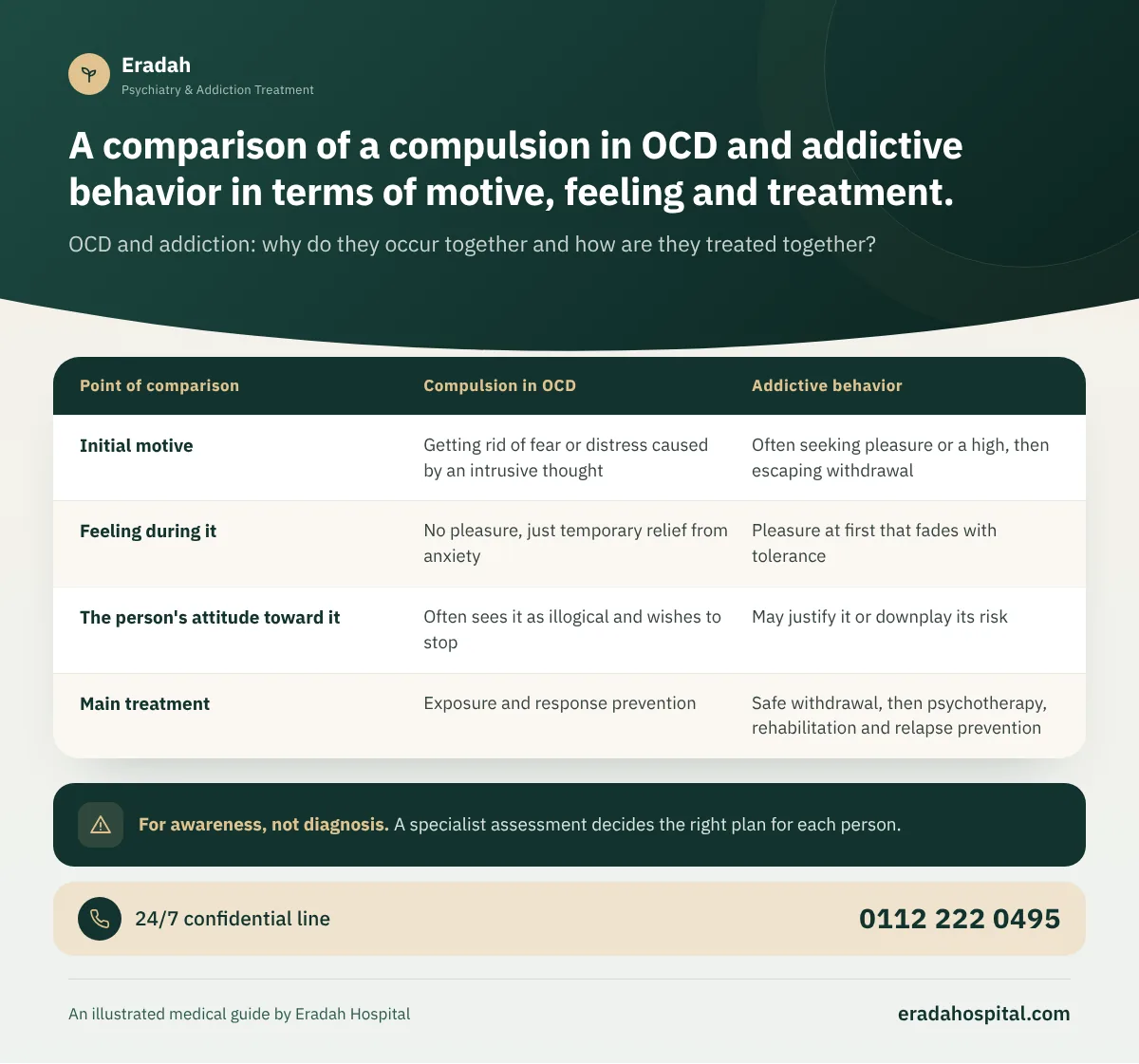
When the two come together, the sedative or alcohol itself becomes part of the OCD cycle: anxiety, then a substance, then brief relief, then worse anxiety.
How are OCD and addiction treated together?
The foundation is dual diagnosis: one team that sees both problems together, instead of each doctor treating a separate part. The plan usually goes through these stages:
- 1Comprehensive assessment
Determining the severity of the OCD, the type and amount of substances, and the presence of depression or suicidal thoughts.
- 2Safe withdrawal
When there is dependence on alcohol or sedatives, stopping is done under medical supervision, because sudden withdrawal from them can be dangerous.
- 3OCD treatment
Starting exposure and response prevention once the patient is stable, with medication set by the doctor.
- 4Replacement skills
Learning to deal with anxiety without a substance, through cognitive behavioral therapy and support groups.
- 5Relapse prevention
A plan for high-risk situations, regular follow-up, and involving the family.
You can find the details of the withdrawal stage in the detox program, and the details of OCD treatment itself in OCD treatment.
Signs that call for the family's attention
- Increasing use of a sedative, or asking for it from more than one doctor or pharmacy.
- Drinking or using before facing OCD situations or before sleep every night.
- Irritability, insomnia or tremor when the substance runs out.
- Neglecting therapy sessions or the prescribed medication.
- Growing depression or talk of hopelessness.
At Eradah we offer a free, confidential first consultation and a dual diagnosis program that combines addiction and OCD treatment in one plan, with residential treatment for men when withdrawal under medical supervision is needed.
Severe despair or suicidal thoughts because of OCD? Get help now
- Talking about death or saying that life with OCD is “unbearable”
- Giving up eating, sleeping or going out altogether because of rituals or fear
- Severe skin wounds or infections from washing or disinfectants
- Hurting or punishing oneself because of thoughts they did not choose
- Saying goodbye to family, or a sudden strange calm after intense suffering
Stay with the person and listen calmly without blame or mockery, and reassure them that what they are going through is a treatable illness. Keep medications and dangerous objects out of their reach. Call an ambulance (123) or go to the nearest emergency room if the danger is imminent, and contact the mental health support line (16328), available around the clock.
Ambulance 123 Mental health support line 16328