The way you talk to yourself inside affects your choices, your relationships, and your mental health. This short scale helps you find out whether your view of yourself is balanced, or whether low self-esteem is weighing on you more than you think.
Start the self-esteem test
How is the self-esteem test result calculated?
For the positive statements (1, 3, 4, 7, and 10), “Strongly agree” earns 3 points, “Agree” 2, “Disagree” 1, and “Strongly disagree” zero. The negative statements (2, 5, 6, 8, and 9) are reverse-scored, so strongly disagreeing with them earns 3 points. The points are then added to give a number from 0 to 30.
| Level | Reading | Suggested step |
|---|---|---|
| 0 – 14 | Low self-esteem | Talk with a mental health specialist and have your mood assessed |
| 15 – 25 | Normal range | Pay attention to situations that shake your confidence |
| 26 – 30 | High self-esteem | Keep up what supports you |
Rosenberg himself did not set official diagnostic cutoffs, so this grouping is commonly used for reading only. What matters most is how you feel in your daily life: does the way you see yourself stop you from applying for a job, from expressing your opinion, or from ending a relationship that hurts you?
It helps to look at your answers one by one and not only at the total. Your overall score may be in the normal range while you strongly agree with a statement such as “I am inclined to feel that I am a failure”; that statement alone deserves a pause and a conversation with someone you trust or with a specialist.
What to do after your result
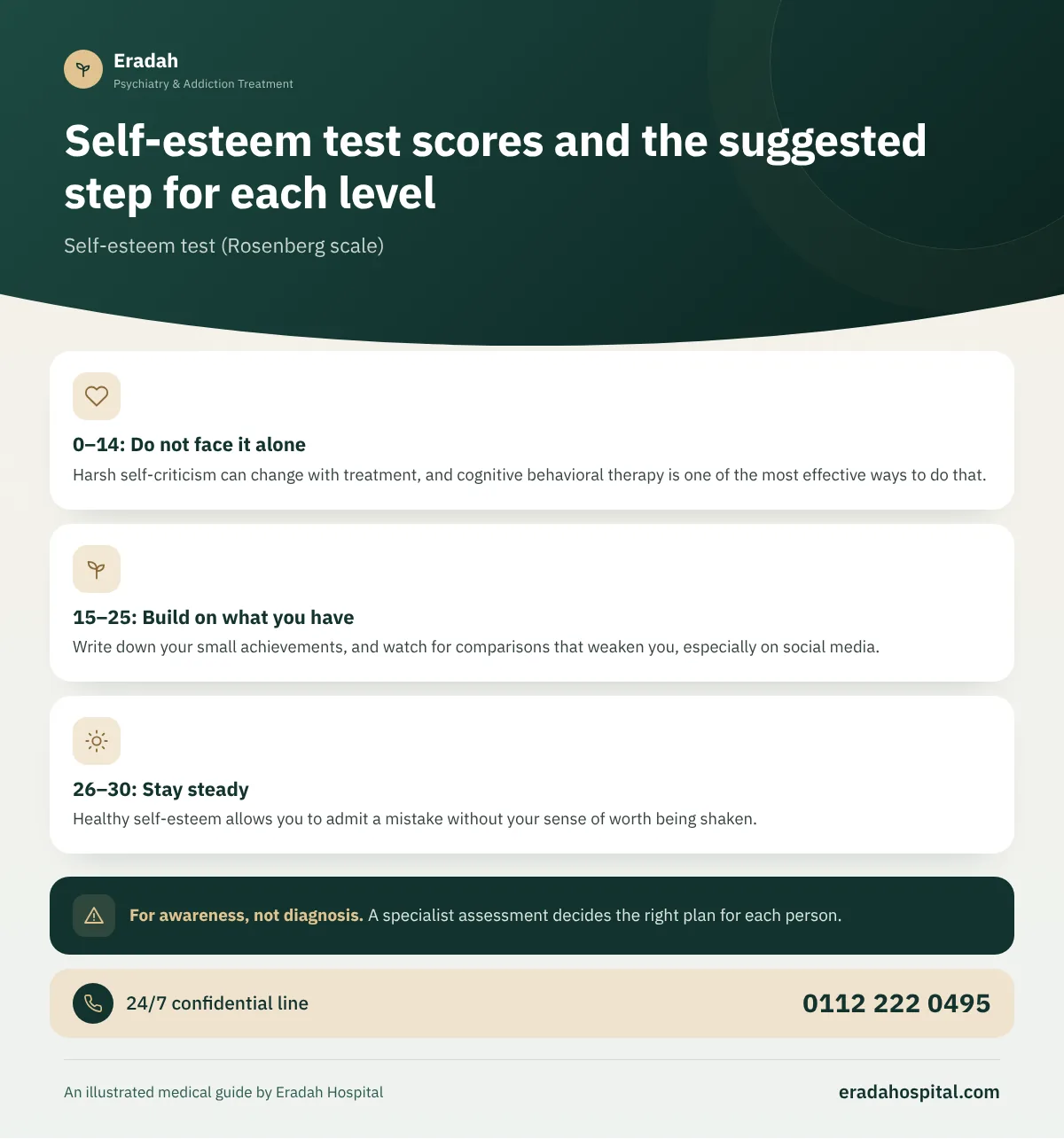
Harsh self-criticism can change with treatment, and cognitive behavioral therapy is one of the most effective ways to do that.
Write down your small achievements, and watch for comparisons that weaken you, especially on social media.
Healthy self-esteem allows you to admit a mistake without your sense of worth being shaken.
What is the Rosenberg scale?
The American sociologist Morris Rosenberg created this scale in 1965 in a study of thousands of high school students, to measure the general sense of self-worth and not confidence in any particular skill. Since then it has become the most widely used self-esteem scale in the world, and in one study applied in 53 countries it showed good reliability across different cultures and languages.
Half of its statements were deliberately worded positively and half negatively, so that the respondent does not tend to agree with everything without thinking. This is why the scores of the negative statements are reversed in the calculation, which makes the result a truer expression of how you actually see yourself.
Signs of low self-esteem in daily life
- Difficulty saying “no” for fear of other people's rejection or anger.
- Interpreting any criticism as proof that you are worth nothing.
- Constantly comparing yourself with others and always coming out the loser.
- Attributing your success to luck and your failure to a flaw in you.
- Avoiding new opportunities for fear that your weakness will be exposed.
- Staying in harmful relationships because you feel you do not deserve better.
Limits of the self-esteem test
- It does not diagnose any mental disorder; it measures your general view of yourself.
- It is affected by your mood on the day of the test, and the result may differ after a frustrating situation.
- It does not distinguish healthy self-esteem from arrogance or an inflated self-image.
- Depression can lower the score sharply, and it often improves with treatment.
- A high score does not mean you are immune to stress or problems.
If your score is low and you also feel persistent sadness or a loss of pleasure, the depression test may also help you, because the two often occur together.
Self-esteem and addiction
Low self-esteem is one of the factors that make some people more vulnerable to substance use; a substance may give temporary confidence in social situations, or silence the inner critic for a few hours. Then addiction arrives with its losses and guilt, which deepens self-contempt, and the cycle starts again. Many people in recovery describe their shame about themselves as harder for them than the withdrawal symptoms themselves.
This is why recovery is not complete without rebuilding the view of oneself, and it is a core part of the dual diagnosis program, which treats the psychological side and the addiction together.
Free confidential consultation
Your worth is not determined by a score on a test. If you want to talk with a specialist about how you feel about yourself, contact the Eradah team on 01122220495 for a free, confidential consultation.