Can food addiction be overcome?
Yes, many people regain a calmer relationship with food. But change is usually a gradual journey, not a single decision; it starts with understanding when and why you eat, then building alternatives for handling feelings, then adjusting your environment and routine, with specialist support when needed.
What we aim for is restoring a sense of choice: eating when you are hungry, stopping when you are full, and finding other ways to deal with stress, sadness and boredom, without "banning" food or chasing a number on the scale. That is why we do not offer diets or food lists here; a dietitian sets those for each person's situation.
Practical steps to calm your relationship with food
- Do not skip meals: regular meals prevent the built-up hunger that weakens control later.
- Record your feelings before eating for two weeks: time, place and feeling. You will discover your own triggers.
- Check your hunger before eating: is it real hunger, or a feeling looking for comfort?
- Eat away from screens and at the table, so you notice taste and fullness.
- Keep trigger foods out of easy reach at home, without banning them completely.
- Allow yourself flexibility: letting yourself have a food you love now and then reduces the cravings that come from restriction.
- Talk to someone you trust; breaking the secrecy weakens the cycle of shame.
How do you deal with a sudden craving for food?
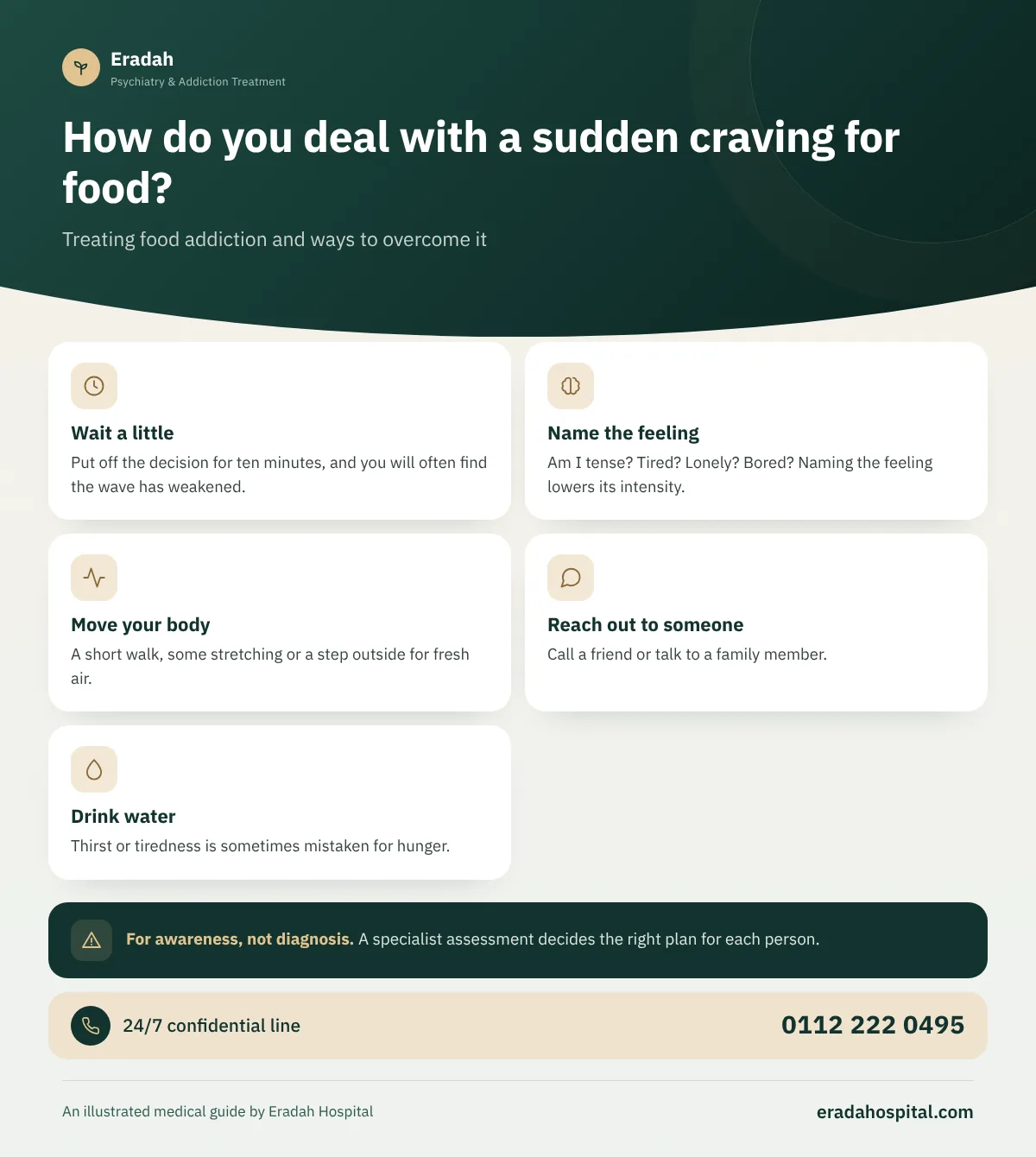
A craving is like a wave: it rises, peaks and falls within minutes. You are not asked never to feel it; what is needed is to give yourself a moment to choose:
Put off the decision for ten minutes, and you will often find the wave has weakened.
Am I tense? Tired? Lonely? Bored? Naming the feeling lowers its intensity.
A short walk, some stretching or a step outside for fresh air.
Call a friend or talk to a family member.
Thirst or tiredness is sometimes mistaken for hunger.
If you then decide to eat, eat attentively and calmly, without beating yourself up. The goal is conscious choice, not complete prohibition.
Mindful eating: how does it help?
Mindful eating means giving full attention to the experience of eating: the taste, smell and texture, the signals of hunger and fullness, and your thoughts and feelings while eating, without judging yourself. A review from the Harvard School of Public Health notes that studies have found it may reduce emotional eating and binge-eating episodes and improve the sense of fullness, although many of the studies are small and short-term.
- Eat slowly and chew well, and put your spoon down between bites.
- Notice the first signs of fullness and stop there.
- Use all your senses and enjoy the food without guilt.
- Eat in a quiet place without a phone or TV as far as possible.
- Notice your feelings before and after eating without judging yourself.
Stress management and better sleep
Since stress and poor sleep are among the strongest triggers, dealing with them is a core part of treatment, not just an add-on:
| The trigger | Suggested alternatives |
|---|---|
| Stress after work or study | Walking, breathing exercises, a warm bath, writing down your feelings |
| Boredom and empty time | A hobby, an activity with friends, learning a new skill |
| Sadness and loneliness | Real social contact, and a psychological assessment if the sadness continues |
| Poor sleep and exhaustion | A fixed bedtime, screens off before bed, avoiding heavy meals at night |
| Anger and frustration | Putting feelings into words, physical activity, a time-out before responding |
How does cognitive behavioral therapy help with emotional eating?
Cognitive behavioral therapy is among the most widely used treatments for emotional eating and loss of control. It works on understanding the chain of trigger, then thought, then feeling, then eating, changing the thoughts that set the stage for overeating, such as "I've ruined my day, so I may as well carry on" or "I don't deserve anything", and building practical skills for organizing meals, handling feelings and solving problems.
Some people may also benefit from skills drawn from dialectical behavior therapy for regulating emotions, and from acceptance and commitment therapy, which teaches noticing an urge without being led by it. The therapist often works with a dietitian who sets a flexible, non-strict plan, and with an internal medicine doctor to follow physical health.
Are there medications for food addiction?
There is no approved medication for food addiction, because it is not an official diagnosis to begin with. The psychiatrist turns to medication if there is depression, anxiety or one of the eating disorders that have specific drug treatments, and decides after a full assessment. Appetite suppressants or any "slimming products" sold online must not be taken without medical supervision; some are dangerous to the heart and mental health.
How can the family help?
- Stop commenting on weight, shape and the plate completely, even as a "joke".
- Keep family meals regular and calm, without arguments or scorekeeping.
- Do not use food as a reward or punishment for children.
- Ask about feelings and pressures, not about how much they eat.
- Encourage shared activities and movement for enjoyment, not as punishment.
- Offer to go with them to a specialist if the person is struggling.
An eating episode after improvement: how do you deal with it?
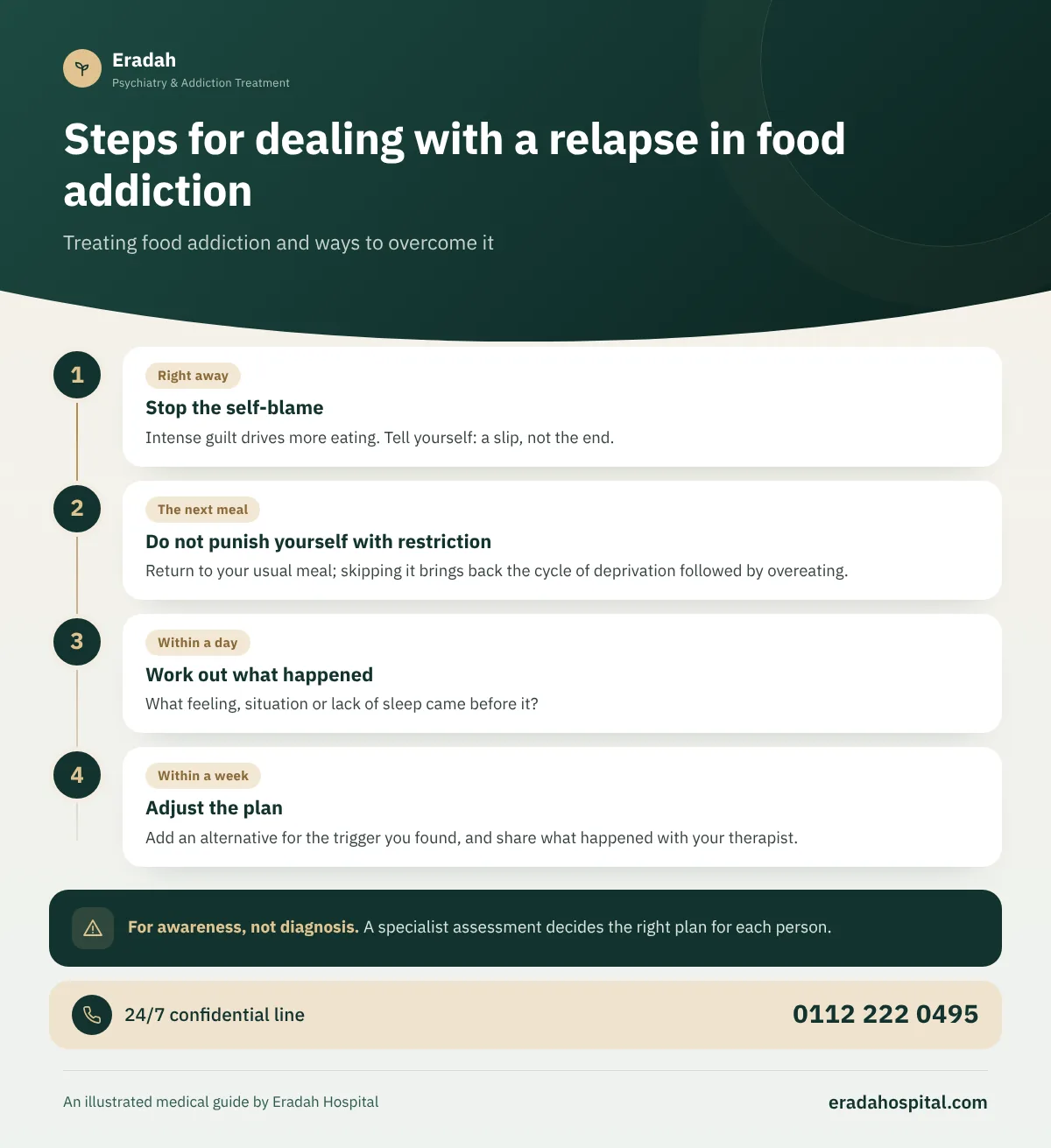
An eating episode after a period of improvement does not mean everything is lost. The real difference is what happens afterward:
- Right awayStop the self-blame
Intense guilt drives more eating. Tell yourself: a slip, not the end.
- The next mealDo not punish yourself with restriction
Return to your usual meal; skipping it brings back the cycle of deprivation followed by overeating.
- Within a dayWork out what happened
What feeling, situation or lack of sleep came before it?
- Within a weekAdjust the plan
Add an alternative for the trigger you found, and share what happened with your therapist.
When do you need a specialist, not just a self-help plan?
- You have tried self-help steps for several months with no clear improvement.
- You have repeated eating episodes with complete loss of control and severe distress; you may need an assessment for eating disorders.
- You turn to vomiting, long periods without eating, or non-prescribed medication after eating.
- It comes with persistent sadness, anxiety or insomnia, or with alcohol or substance use.
- You have thoughts of self-harm, in which case help is urgent: 16328 or 123.
Choosing a hospital for food addiction treatment
Food addiction does not involve a detox phase and in most cases does not need a hospital bed, so the right place is not necessarily the one with the biggest building, but the one best able to read what lies behind the eating episodes. The real danger is that it is treated as a weight problem only, so the patient is given a strict diet that restarts the cycle of deprivation followed by overeating, or that a full eating disorder such as binge eating or vomiting after meals is missed. Before booking anywhere, put these questions to the facility:
- Does the assessment start with a psychiatrist who can tell emotional eating from eating disorders that need a different pathway?
- Do they ask about depression, anxiety and insomnia, and about any alcohol or substances used to calm the same feelings?
- Are the sessions built on cognitive behavioral therapy and emotion regulation, not on preaching or weekly weigh-ins?
- Does the team talk about the body respectfully, without comments that increase the shame that feeds the episodes?
- Is there follow-up after improvement, since a slip months later is to be expected and needs a plan, not blame?
At Eradah, assessment is led by psychiatrists under the supervision of Dr. Mahmoud El-Sawy, and the case is usually managed through the outpatient clinic and day program with individual and group sessions with psychologists, adding treatment for any co-occurring depression or anxiety if it appears. If you are not yet sure that what you are going through is really addiction, review the signs of food addiction first.
Talk to us on 01122220495 by phone or WhatsApp at any hour, or leave your details through the Eradah contact page. The first consultation session is free and fully confidential, and in it we explain whether outpatient treatment is enough for you; note that residential treatment with us is for men only.
Food addiction treatment at Eradah
At Eradah Psychiatry & Addiction Treatment Center, we handle emotional eating and loss-of-control problems confidentially and without judgment or comments about the body. Treatment starts with a psychological assessment that identifies the nature of the pattern and rules out a co-occurring eating disorder, depression or anxiety, followed by an individual plan that combines, as needed, cognitive behavioral therapy, emotion-regulation skills, mindful eating and family support, in coordination with a dietitian and an internal medicine doctor when required.