What is food addiction?
People use the phrase “food addiction” to describe a state in which food turns from natural nourishment and enjoyment into a repeated way of soothing feelings, with intense cravings for certain foods, eating more than intended, repeated failed attempts to cut down, and then a sense of guilt that drives another round.
This concept is closely tied to what is called emotional eating: eating in response to stress, sadness, loneliness, boredom or tiredness, not in response to hunger. Almost everyone eats out of emotion at times, in joy, in sorrow or at a social occasion, and this is completely normal and does not mean there is a problem.
But when food becomes the main or only way of coping with difficult feelings, and the person feels they have lost control and suffers because of it, then it deserves understanding and support, free from blame, mockery or comments about the body.
Is food addiction a recognized medical diagnosis?
The honest answer: no. Neither the International Classification of Diseases ICD-11 nor the American manual DSM-5-TR has a diagnosis called “food addiction.” A scientific review published in the British Medical Journal (BMJ) in 2023 confirmed that this concept is not yet an official diagnosis, despite growing research on it.
Researchers measure this pattern with a tool called the Yale Food Addiction Scale, which is built on the criteria for substance use disorders such as cravings, loss of control and persistence despite harm. But it is a research and screening tool, not a diagnostic tool in the clinic.
Physical hunger or emotional eating? The key difference
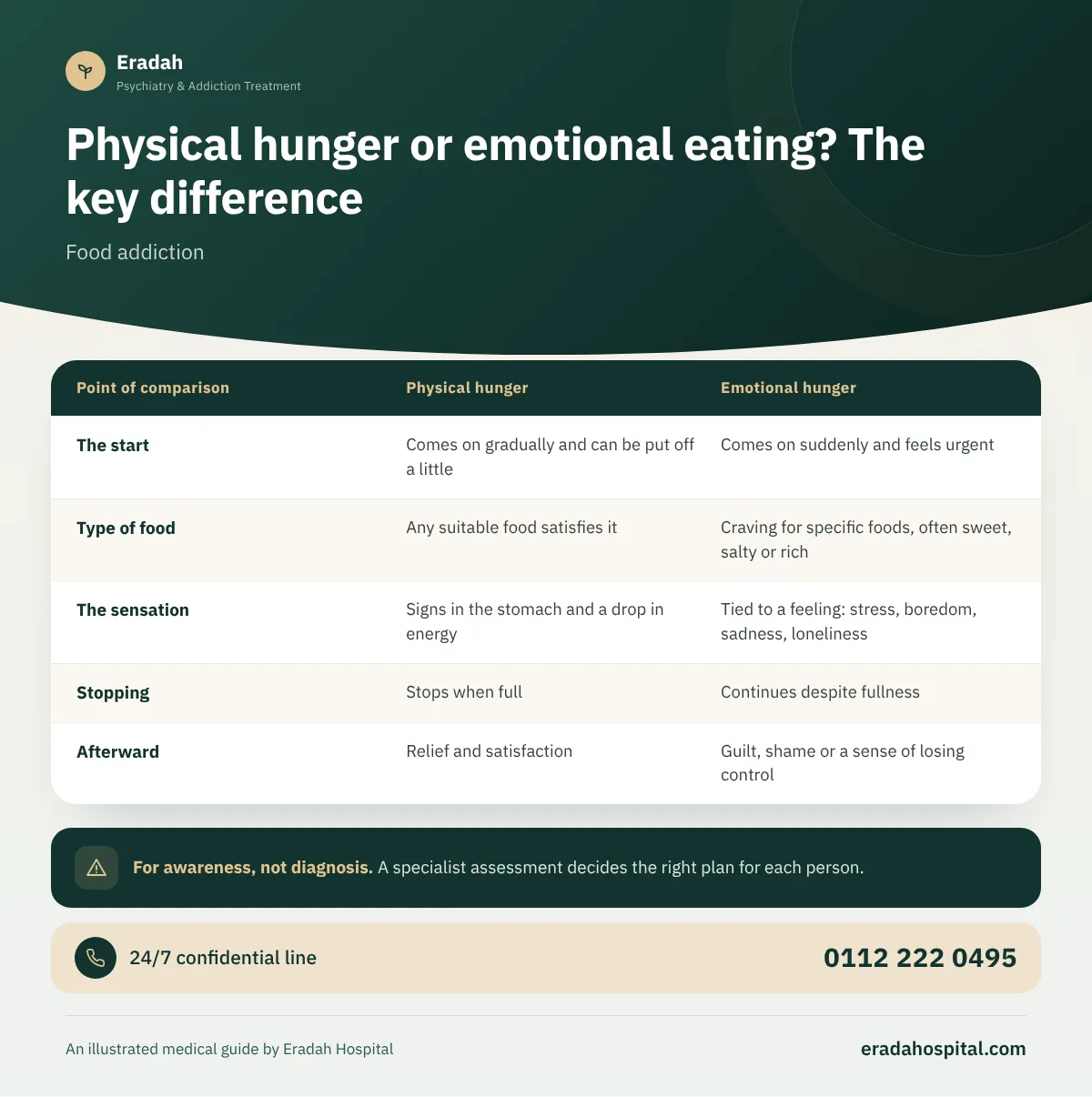
The first step in understanding your relationship with food is telling apart two kinds of “hunger.” Mayo Clinic advises what it calls a “reality check on hunger”: have you eaten recently? Do you feel real hunger signs in your stomach? If not, it is most likely emotional hunger:
| Point of comparison | Physical hunger | Emotional hunger |
|---|---|---|
| The start | Comes on gradually and can be put off a little | Comes on suddenly and feels urgent |
| Type of food | Any suitable food satisfies it | Craving for specific foods, often sweet, salty or rich |
| The sensation | Signs in the stomach and a drop in energy | Tied to a feeling: stress, boredom, sadness, loneliness |
| Stopping | Stops when full | Continues despite fullness |
| Afterward | Relief and satisfaction | Guilt, shame or a sense of losing control |
How common is food addiction, and who is most at risk?
A large pooled analysis presented in a BMJ review, covering hundreds of studies from dozens of countries, found that about 14% of adults and 12% of children met the criteria for “food addiction” on the Yale scale. These are striking figures, but they come from a research tool, not a medical diagnosis, and there are no reliable Egyptian figures.
Susceptibility is higher in people who use food to soothe stress, in those with depression, anxiety or insomnia and poor sleep, in those who have gone through repeated strict diets, and in those who grew up in homes where food was used as a reward or punishment. It affects children and adults, men and women.
What happens in the brain when we crave food?
Eating is one of the oldest natural sources of reward, and it releases dopamine, which pushes us to repeat what gives us comfort. Research suggests that highly processed foods that combine refined sugars and fats in high concentration may stimulate this system more strongly than natural foods, and are linked more than others to cravings and loss of control.
With repetition the brain learns that these foods are a “quick fix” for stress or boredom, so the craving appears automatically with the same feeling. The scientific debate continues over how similar this is to substance addiction, but what is certain is that learned habits can be changed, and that food itself is not the enemy.
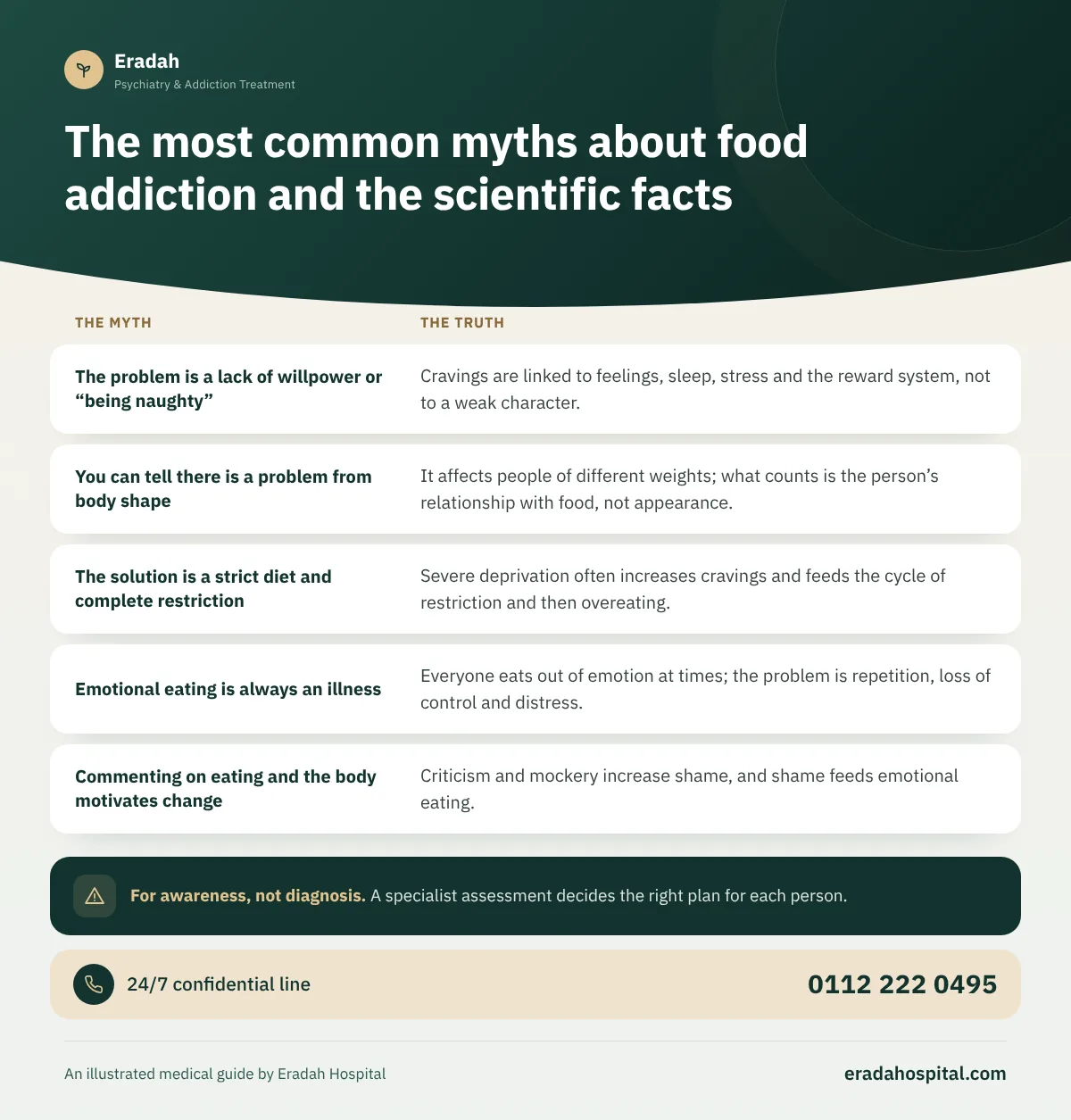
Myths and facts about food addiction
| The myth | The truth |
|---|---|
| The problem is a lack of willpower or “being naughty” | Cravings are linked to feelings, sleep, stress and the reward system, not to a weak character. |
| You can tell there is a problem from body shape | It affects people of different weights; what counts is the person’s relationship with food, not appearance. |
| The solution is a strict diet and complete restriction | Severe deprivation often increases cravings and feeds the cycle of restriction and then overeating. |
| Emotional eating is always an illness | Everyone eats out of emotion at times; the problem is repetition, loss of control and distress. |
| Commenting on eating and the body motivates change | Criticism and mockery increase shame, and shame feeds emotional eating. |
The role of the family: support without commenting on the body
In our culture food is tied to love and hospitality, and at the same time there is a lot of commenting on other people’s bodies. A supportive family talks about feelings, not weight, avoids using food as a reward or punishment for children, makes sure to have regular, calm family meals, and stops comparisons and hurtful comments even when they are “just joking.”
If you notice a family member eating repeatedly out of sadness or stress, start by asking about how they are and what pressures they face, not about their plate, and offer help reaching a specialist if they are struggling.
When does emotional eating need a mental health specialist?
- You feel you repeatedly lose control over eating and you suffer because of it.
- You eat a lot in secret and feel intense shame or guilt afterward.
- You have tried to change many times without success, or you swing between severe restriction and overeating.
- It is accompanied by persistent sadness, anxiety or insomnia, or constant thinking about food and the body.
- You turn to vomiting or not eating after episodes, or you have thoughts of self-harm; here the assessment is urgent.
The psychiatrist or therapist helps you understand what lies behind the eating, rules out one of the eating disorders or a depression or anxiety that needs its own treatment, and works with a dietitian when needed.
Food addiction guide: everything you need to know
We have gathered everything about food addiction in 4 pages, each answering one question in detail. Choose what you are looking for:
Signs of food addiction
The behavioral and psychological signs of emotional eating and loss of control in children, teenagers and adults, with non-diagnostic self-assessment questions and how to start the conversation.
Causes of food addiction
The role of stress, lack of sleep and difficult feelings, the design of highly processed foods and advertising, strict diets, the family, and risk and protective factors.
Harms of food addiction
The effect of loss of control over eating on physical health, sleep, mood, self-esteem and relationships, why stigma harms, and how to avoid complications.
Food addiction treatment
Practical steps for dealing with cravings, mindful eating, managing stress and sleep, cognitive behavioral therapy, and when you need a specialist.
Severe despair or worrying physical signs? Get help now
- Talk about wanting to die or intense hatred of oneself or one’s body
- Fainting, severe dizziness, palpitations or an irregular heartbeat
- Repeated deliberate vomiting after eating, or refusing food completely for days
- Collapse and overwhelming shame after repeated eating episodes, with withdrawal from everyone
- Increased use of alcohol, sedatives or medications without a prescription
Stay with the person and listen without commenting on eating or the body; blame now increases the risk. Call the ambulance on 123 or take them to the nearest emergency room for fainting or heart rhythm problems, or call the mental health support line 16328 (24 hours) if there are thoughts of self-harm, and do not leave them alone.
Ambulance 123 Mental health support line 16328