Why do some people develop food addiction and others do not?
Everyone enjoys tasty food, and everyone eats for emotional reasons now and then, yet only some people lose control and suffer for it. The difference is not down to "willpower" alone but to an interaction between emotions, the body and the food environment around us.
You can picture it as three circles: the emotions circle (stress, sadness, boredom, loneliness), the body circle (sleep, hormones, built-up hunger from skipped meals), and the environment circle (food that is always available, advertising, family habits). The larger the area where they overlap, the more likely emotional eating is to become a pattern that is hard to break.
Stress and cortisol: why do we eat when we are tense?
Under pressure, the body releases stress hormones such as cortisol, which prepare it to face danger. With chronic stress, many people notice stronger cravings for sweet and fatty foods, because these give quick but temporary comfort.
Mayo Clinic lists some of the most common emotional eating triggers as work pressure, relationship conflict, fatigue, financial worries and health fears, along with boredom and loneliness. Some people even overeat during positive emotions, such as celebrations and special occasions.
Poor sleep: an underestimated trigger
Not getting enough sleep is one of the factors people overlook most. Staying up late and being exhausted weaken the ability to control impulses and make decisions, and research suggests that poor sleep is linked to changes in the hormones that regulate hunger and fullness, and to stronger cravings for high-reward fast food.
The result is a familiar loop: late nights, then daytime tiredness, then eating for energy, then late-night eating, then even worse sleep. That is why improving sleep is often one of the quickest steps to make a difference, and you can find more about sleep problems in our guide to insomnia.
Difficult emotions: food as a way to soothe
Many people learn from childhood that food "makes you feel better", so it becomes the fastest way to deal with feelings they do not know how to express:
A search for quick comfort to fill the emptiness; it may be linked to depression that needs treatment.
Eating to fill time or break the monotony, especially in front of screens.
Food is an always-available companion that never rejects or judges.
Temporary relief followed by greater anxiety and guilt.
A quick release for feelings that have not been put into words.
These feelings are sometimes linked to mental health conditions such as depression, generalized anxiety and attention-deficit/hyperactivity disorder (ADHD) because of impulsivity, and sometimes to difficult experiences or old trauma. Treating those conditions is itself an important part of the solution.
How do ultra-processed foods and advertising contribute?
Studies suggest that the foods most strongly linked to cravings and loss of control are ultra-processed foods that combine refined sugars or starches with fat, a mix that is rare in nature. These products are designed to be highly palatable and quick to eat, and they do not provide lasting fullness.
| Factor | How does it affect you? |
|---|---|
| Sugar and fat combined | Strongly stimulates the reward system and is eaten quickly, before fullness registers |
| Constant availability | Food is available everywhere at any time, so the gap between wanting and eating disappears |
| Delivery apps | Ordering with one tap, day or night, with no effort that might give you time to think |
| Ads and promotions | Images, smells and offers that stir desire even without hunger, especially in children |
| Large packages | Encourage continuous eating without paying attention to the amount |
Do strict diets make the problem worse?
Yes, and this is one of the great paradoxes. Severe restriction and skipped meals leave the body hungry and the mind preoccupied with the forbidden food, so cravings build until control breaks at some point. Overeating follows, then guilt, then a decision to restrict even more. This cycle of deprivation followed by overeating is one of the things that most feeds the sense of being addicted to food.
For this reason, specialists do not recommend strict diets as a solution to this problem. They focus instead on regular meals and on dealing with emotions. If dieting is tied to a painful preoccupation with the body or to compensatory behaviors, an assessment for one of the eating disorders is needed.
Family and childhood habits
Much of our relationship with food is shaped in childhood: using sweets as a reward for success or to stop a child crying, withholding them as punishment, forcing a child to finish their plate despite being full, or constant comments about the body. All of this can teach a child that food is a way to cope with feelings, not a source of nourishment.
We do not mean that the family is the "cause" of the problem; family habits can raise or lower the risk. Regular, calm family meals and talking about feelings are among the strongest protective factors.
Everyday emotional eating triggers
A cause makes a person more vulnerable over the long term, while a trigger is the moment that sparks the urge. It helps to recognize the common triggers:
- Feelings: stress after a workday, an argument, boredom, loneliness, sadness.
- Times: late at night, after coming home from work or school, holidays.
- Places: in front of the TV or phone, the kitchen, the car.
- Physical states: built-up hunger after a skipped meal, exhaustion, poor sleep.
- Social situations: invitations and gatherings with pressure to "have some more".
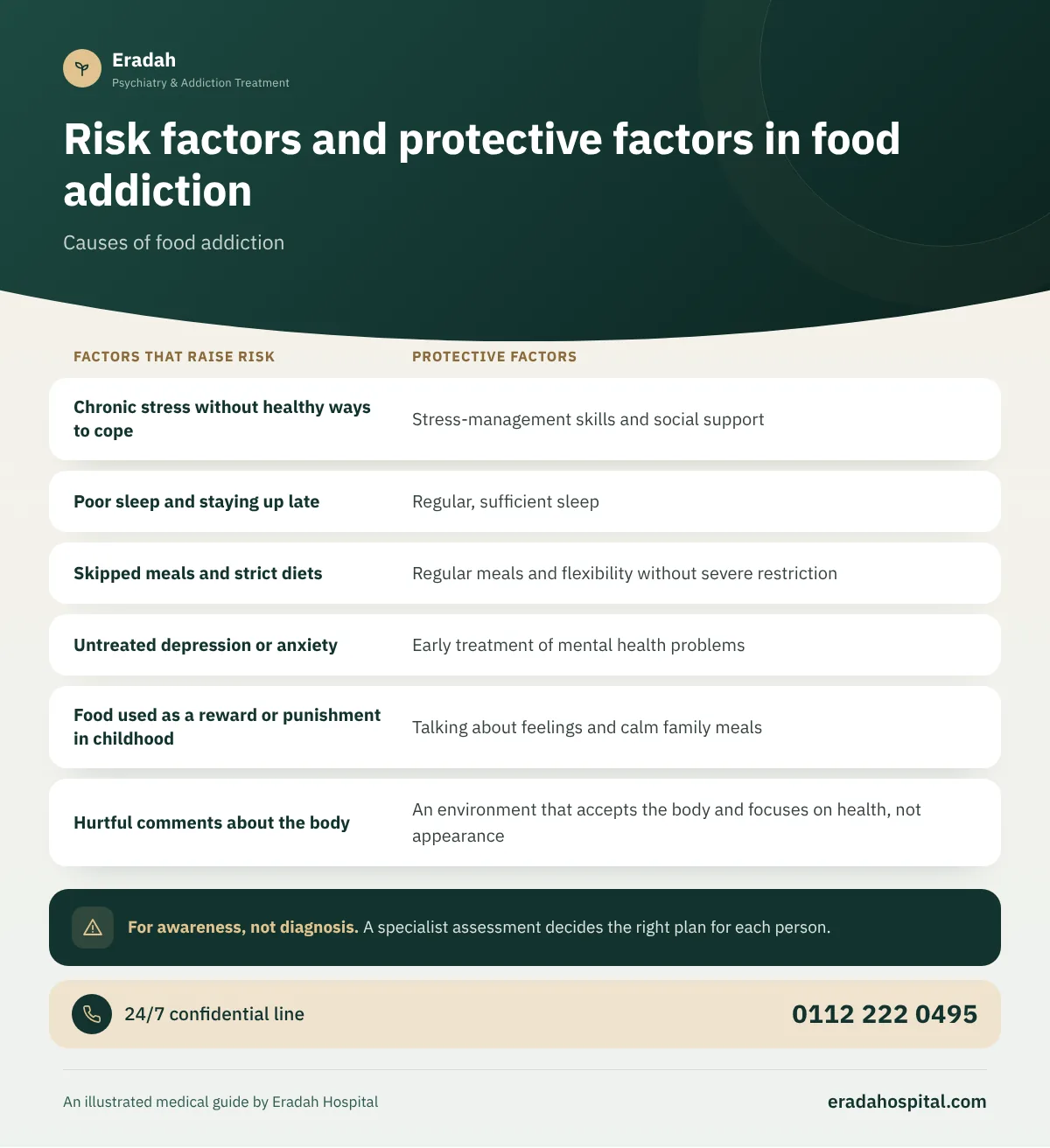
Risk and protective factors in food addiction
| Factors that raise risk | Protective factors |
|---|---|
| Chronic stress without healthy ways to cope | Stress-management skills and social support |
| Poor sleep and staying up late | Regular, sufficient sleep |
| Skipped meals and strict diets | Regular meals and flexibility without severe restriction |
| Untreated depression or anxiety | Early treatment of mental health problems |
| Food used as a reward or punishment in childhood | Talking about feelings and calm family meals |
| Hurtful comments about the body | An environment that accepts the body and focuses on health, not appearance |
Understanding the causes is half the journey; the other half is practical steps, which you will find on the food addiction treatment page.