Can love addiction be treated? And what is the goal of treatment?
Yes, recovery from unhealthy attachment is possible. The goal is to leave a relationship that harms you if necessary, and to build the capacity for safer relationships that do not cost you yourself, without ceasing to love or being afraid of it.
Medical ethics researchers argue, in a paper published in 2017, that the decision to treat should not depend on calling the condition a “disease,” but on the harm to your health and your life. If the attachment disrupts your work and sleep and keeps you in a harmful relationship, it deserves help whether or not we call it an addiction.
What are the first steps to overcome unhealthy attachment?
- Acknowledge the pattern, not just the person: what keeps repeating in your relationships? And when do you go back?
- Reduce or cut contact after a harmful relationship: block, mute, stop following accounts, and avoid the “one last message.”
- Remove triggers: photos, gifts and songs tied to the relationship, even if only temporarily.
- Write down what actually happened: a list of the hurtful incidents that you can read when nostalgia makes the past look prettier.
- Tell someone you trust about your decision so they can support you in moments of weakness.
- Look after your body: regular sleep, food and daily movement, since withdrawal is harder on an exhausted body.
If contact is necessary, for example because of children or shared work, keep it short and limited to the practical matter, and in writing if possible.
Why does a breakup hurt so much?
Because the pain is real in the brain. In a study published in the journal PNAS in 2011, people who had been through an unwanted breakup showed activation of areas that process physical pain when they looked at a photo of their ex. In another study in 2010, rejected people who were still attached showed activation of reward areas and areas linked to craving. That is why the first weeks after a breakup resemble withdrawal: compulsive longing, disturbed sleep, loss of pleasure, and an urgent wish to send “just one message.”
Understanding this helps: the urge to go back is an expected symptom that will ease, and it does not mean the decision was wrong. Every contact or check of their accounts is like a small “dose” that resets the counter to zero.
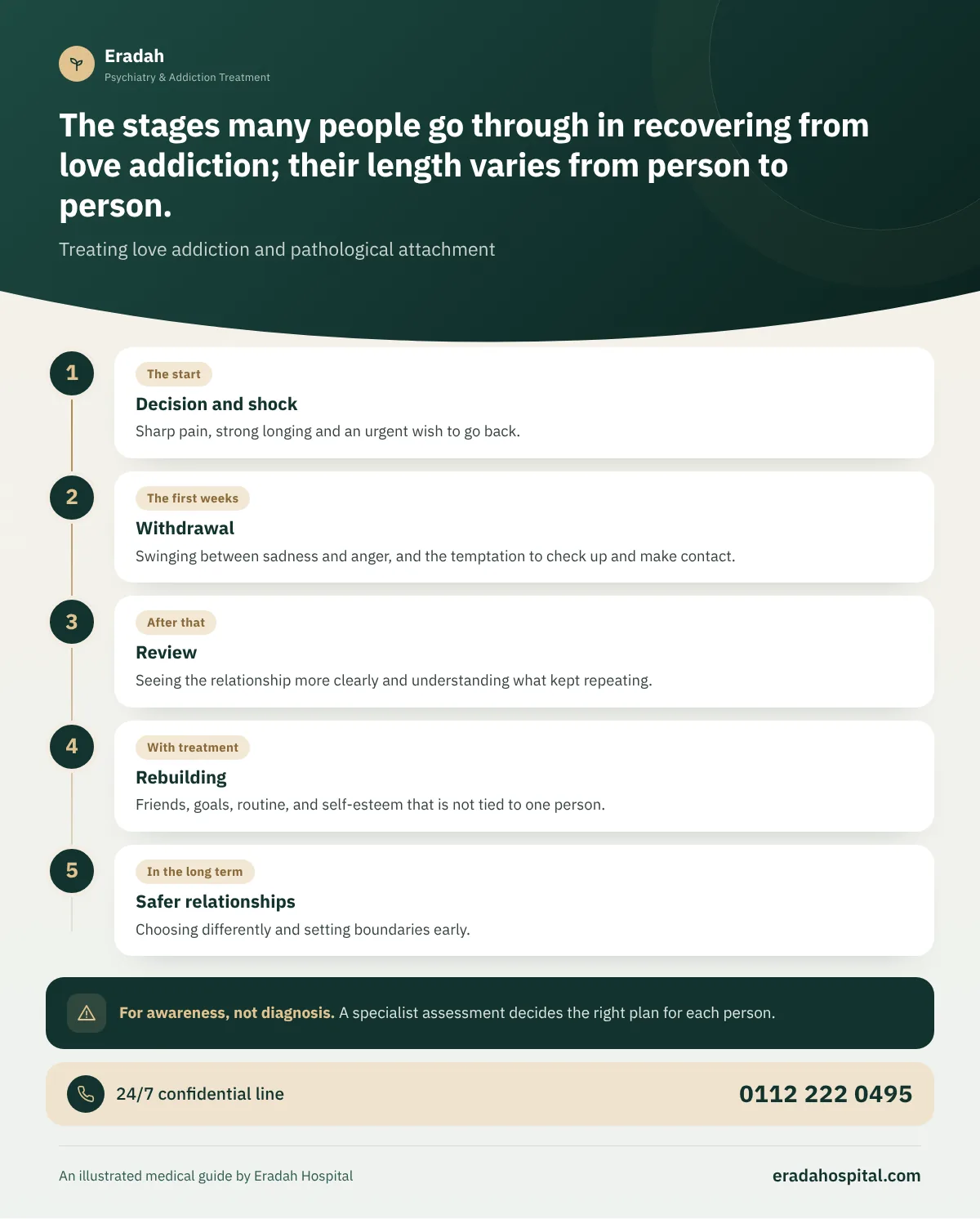
What are the stages of recovery?
- The startDecision and shock
Sharp pain, strong longing and an urgent wish to go back.
- The first weeksWithdrawal
Swinging between sadness and anger, and the temptation to check up and make contact.
- After thatReview
Seeing the relationship more clearly and understanding what kept repeating.
- With treatmentRebuilding
Friends, goals, routine, and self-esteem that is not tied to one person.
- In the long termSafer relationships
Choosing differently and setting boundaries early.
How does psychotherapy help treat love addiction?
Psychotherapy works on two fronts. The first is the thoughts that keep the attachment going, such as “I can’t live without him,” “No one will ever love me again,” or “If I change, he’ll go back to how he was,” and the person learns to examine and replace them. The second is the roots: the anxious attachment style that a 2026 systematic review linked to love addiction, and earlier experiences of loss and abandonment.
- Recognizing the triggers that come before the urge to go back: night, loneliness and special occasions.
- Learning to tolerate difficult feelings without escaping to the person or to a quick substitute.
- Building self-esteem that does not depend on a partner’s approval.
- Practicing setting boundaries and saying “no” in new relationships.
- Making a written plan for high-risk situations.
Many of these tools draw on cognitive behavioral therapy, and with intense fear of abandonment and emotional swings, dialectical behavior therapy may help.
Do group therapy and support groups help?
Research on love addiction treatment is still very limited; a systematic review published in 2023 found only 5 eligible studies out of 102 articles. But it concluded that group psychotherapy appeared to be an effective alternative, explaining that group dynamics speak to the brain’s reward and attachment systems. A group also breaks the feeling that you are the only one going through this. You can read more about group therapy.
When do you need a psychiatrist and medication?
There is no medication for love addiction itself, and medication should not be used to “forget” a person. But a breakup can uncover or set off real depression, severe anxiety, persistent insomnia, or patterns of borderline personality, and a psychiatrist treats these with psychotherapy and sometimes medication. Only the doctor can decide that, and you should not start or stop any medication without a doctor.
How do you avoid going back to a harmful relationship?
- Watch for the predictable moments of weakness: special occasions, night, loneliness, and news about the other person.
- Do not answer the “casual message” the moment it arrives; wait and talk to someone you trust first.
- Go back over the list of hurtful incidents you wrote down.
- Do not rush into a new relationship to numb the pain.
- If you do go back, do not punish yourself; review what happened with your therapist and adjust the plan.
Treatment of unhealthy attachment at Eradah
At Eradah, treatment begins with a confidential psychological assessment that looks for depression, anxiety, personality patterns and any turning to substances after the breakup, then an individual or group psychotherapy plan in the outpatient clinics. When emotional pain comes together with drinking or substance use, we treat both together under dual diagnosis, with care inside the psychiatric hospital for men when there is risk.
Violence or thoughts of self-harm after a relationship? Get help now
- Talk of death or a wish to self-harm after a breakup or rejection
- A relationship involving beating, threats, confinement or frightening stalking
- Being unable to eat or sleep for days with severe sadness that does not ease
- Turning to alcohol, sedatives or drugs to bear the pain of the breakup
- Threatening the other person, stalking them or thinking of harming them
Your safety comes first: if you are in a violent relationship, move to a safe place and ask for help from someone you trust. If you notice these signs in someone close to you, stay with them, ask calmly how they feel, and listen without blame or lecturing. If there is a danger to their life or anyone else's, call an ambulance (123) or go to the nearest emergency room, or call the mental health support line 16328 (24 hours), and do not leave them alone if they talk about harming themselves.
Ambulance 123 Mental health support line 16328