What is the goal of compulsive shopping treatment?
You cannot abstain from buying completely, the way a person can abstain from a drug, because we all need to buy food, clothes, and other necessities. So the goal is planned, mindful shopping: buying what you need within your budget, and learning other ways to deal with the feelings that used to push you to buy.
Treatment usually runs on two parallel tracks: an urgent track to stop the financial bleeding, and a deeper track to understand and change the underlying drivers. Doing only one of the two is often not enough.
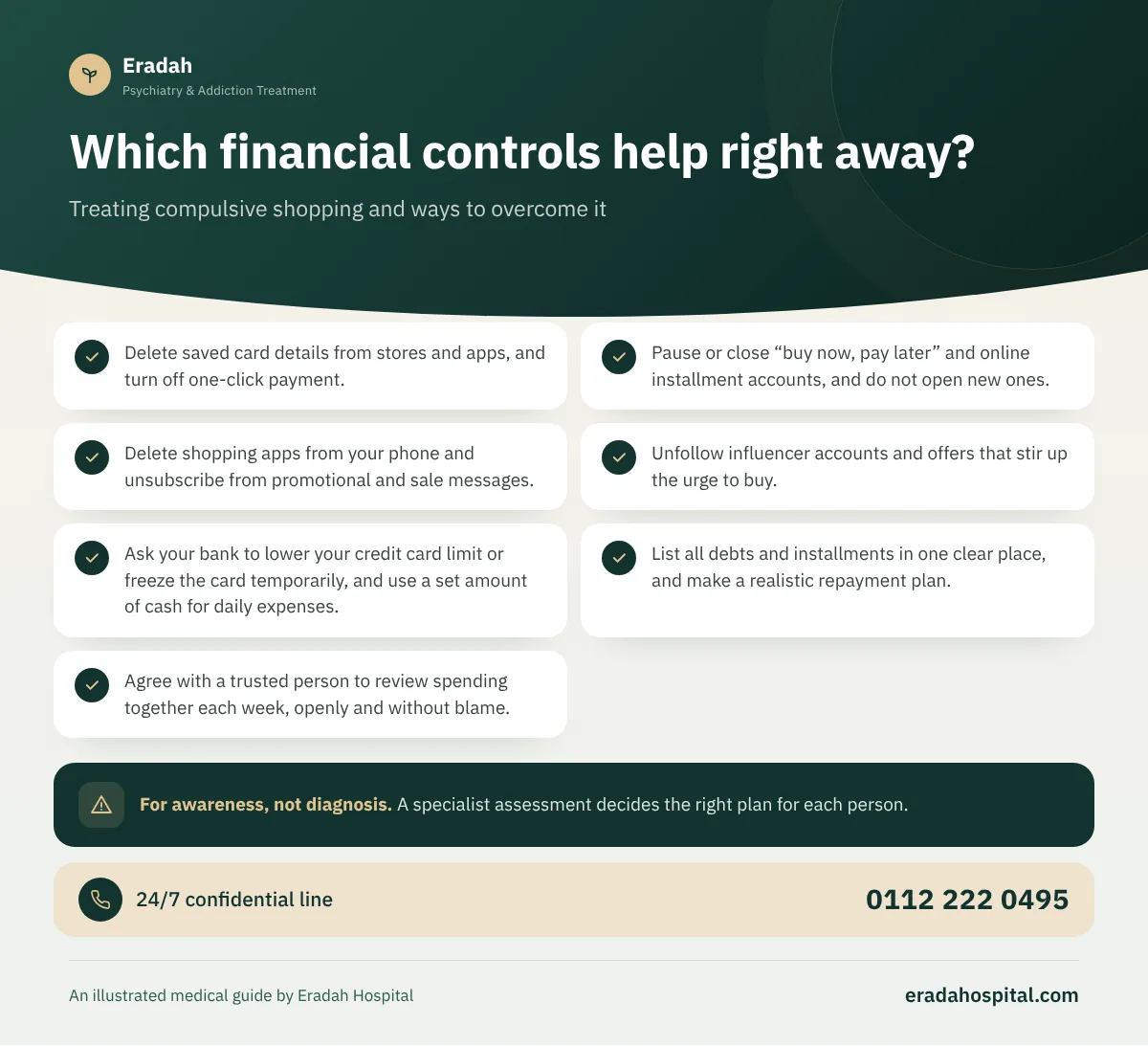
Which financial controls help right away?
These are practical steps that put “distance” between the urge and the payment, giving your mind a chance to think:
- Delete saved card details from stores and apps, and turn off one-click payment.
- Pause or close “buy now, pay later” and online installment accounts, and do not open new ones.
- Delete shopping apps from your phone and unsubscribe from promotional and sale messages.
- Unfollow influencer accounts and offers that stir up the urge to buy.
- Ask your bank to lower your credit card limit or freeze the card temporarily, and use a set amount of cash for daily expenses.
- List all debts and installments in one clear place, and make a realistic repayment plan.
- Agree with a trusted person to review spending together each week, openly and without blame.
What can I do myself to overcome compulsive shopping?
- Monitor yourself: For two weeks, write down every urge to buy: when it came, how you felt beforehand, whether you bought, and how you felt afterward.
- Know your triggers: You will often notice repeating patterns, such as buying after arguments, late at night, or when your salary arrives.
- Prepare alternatives: For each trigger, have a substitute activity: calling a friend, taking a walk, exercising, a hobby, or writing down how you feel.
- Shop with a list: Do not enter a store or app without a specific list, and leave as soon as you have finished it.
- Do not shop alone at first: For large purchases, bring someone who knows your plan.
- Deal with stockpiled purchases: Return what can be returned and donate some of the rest, since seeing them can be a trigger and a source of guilt.
How does cognitive behavioral therapy help?
Systematic reviews of the research indicate that cognitive behavioral therapy is the most studied and most effective treatment for compulsive shopping, and that its group version has shown particularly good results. It works on several fronts:
| Domain | What happens in sessions |
|---|---|
| Understanding the cycle | Mapping the patient’s own cycle of emotion, urge, purchase, and guilt |
| Thoughts | Examining thoughts such as “this offer won’t come again,” “I deserve this after my hard day,” or “I’ll look better with this” |
| Feelings | Learning to tolerate and manage difficult feelings without escaping into buying |
| Graded exposure | Practicing entering stores or seeing offers without buying, under the therapist’s supervision |
| Financial skills | Building a realistic budget and a debt plan |
| Relapse prevention | A written plan for high-risk situations and early warning signs of a return to old patterns |
The therapist may also use motivational interviewing to strengthen the motivation to change, along with techniques to build self-esteem that does not depend on possessions.
Why should co-occurring depression and anxiety be treated?
Because compulsive buying is often an attempt to soothe depression, anxiety, or impulsivity linked to attention-deficit/hyperactivity disorder (ADHD). If these conditions stay untreated, the drive remains and the risk of relapse rises. Bipolar disorder must also be ruled out if the spending comes in episodes with excess energy and little sleep.
Are there medications for compulsive shopping?
There is no approved medication for compulsive shopping itself. Some antidepressants and other drugs have been tried in small studies, but the results were mixed and inconclusive according to systematic reviews. So medication is used mainly to treat co-occurring conditions such as depression or anxiety, on the decision of a psychiatrist and under their supervision.
What is the role of the family and couples therapy?
The family is an important partner in recovery, but its role is to support, not to police. Family or couples therapy helps rebuild trust, agree on financial openness that works for both partners, divide responsibilities clearly, and learn to talk about money without shouting or accusation. The family may also need support itself, especially after the shock of discovering the debts.
When do you need a specialist for compulsive shopping?
- Your repeated attempts to control buying on your own have failed.
- Debts have piled up that you cannot handle, or legal problems have appeared.
- The buying comes with persistent sadness, severe anxiety, or impulsivity in other areas.
- Arguments have started to threaten the stability of the marriage or family.
- Compulsive shopping is combined with gambling or alcohol or substance use.
- Thoughts of hopelessness or self-harm have appeared. In that case help is urgent: call 123 or 16328.
How do you handle a relapse in compulsive shopping?
A buying episode after a period of improvement does not mean treatment has failed. What matters is to stop quickly, review the feelings and triggers that came before it, and return to your plan without beating yourself up, because intense shame is one of the biggest drivers of compulsive buying. Make sale seasons, holidays, and special occasions part of your relapse prevention plan, since these are high-risk times.
A hospital for shopping addiction treatment
Compulsive shopping leaves a mark that most other addictions do not leave as quickly: maxed-out cards, online installments, and marital arguments over money. So a good place to treat it combines therapy sessions with a practical financial plan, and first makes sure the buying episodes are not part of a manic episode, because treatment in that case is entirely different.
| What to ask about | Why it matters in this condition |
|---|---|
| Does the doctor screen for bipolar disorder? | Sudden large spending can be a symptom of mania, which needs medication, not behavioral sessions alone. |
| Is group CBT available? | The group format has the strongest evidence for this specific disorder. |
| Are spouses or family involved in sessions? | Broken financial trust is repaired within the family, not in the therapist’s room alone. |
| Are controls placed on payment methods from the first week? | The distance between the urge and the payment is what gives treatment a chance to work. |
| Are gambling or alcohol treated if present? | Having several impulsive behaviors raises the chance of relapse. |
At Eradah, it starts with an assessment by a psychiatrist, followed by individual and group sessions led by psychologists, along with the family program to organize conversations about money without blame. To gauge the size of the problem before you call, read about the harms of compulsive shopping.
Our number 01122220495 answers around the clock by phone or WhatsApp, and you can also book your first assessment appointment, which is free and kept confidential. Most of these cases are followed as outpatients; residential treatment is available for men only.
Compulsive shopping treatment at Eradah
At Eradah Psychiatry & Addiction Treatment Center, we begin with a comprehensive assessment with a psychiatrist to understand the buying cycle and what lies behind it, such as depression, anxiety, or impulsivity, and to rule out look-alike conditions such as manic episodes. We then build an individual plan that combines cognitive behavioral therapy, family or couples sessions, and follow-up of co-occurring conditions, helping the patient put realistic financial controls in place, in complete confidentiality.