What is adrenaline?
Adrenaline, also called epinephrine, is your body's emergency hormone. When a speeding car surprises you or you hear a scream at night, a nerve command reaches the adrenal gland, which releases adrenaline into the blood, and within moments it reaches almost every organ to prepare it to confront or flee.
Adrenaline belongs to the family of catecholamines, along with dopamine and norepinephrine, substances made in one chain from the amino acid tyrosine. Adrenaline is the last link in this chain, made from norepinephrine by an enzyme found mainly in the adrenal medulla.
Despite adrenaline's fame in movies and talk of an "adrenaline rush" in sports, it works quietly every day: it rises slightly when you wake up, when you climb stairs, when your blood sugar drops, and when you speak in front of an audience. It is a core part of the body's ability to adapt, and its role is broader than being the hormone of adventure.
Where is adrenaline released and how is it triggered?
Humans have two adrenal glands, one above each kidney. Each gland has two parts: the outer cortex, which releases cortisol and other hormones, and the inner medulla, which releases adrenaline along with a smaller amount of norepinephrine. The medulla is really closer to a specialized nerve ganglion than to an ordinary gland, which is why it responds with astonishing speed.
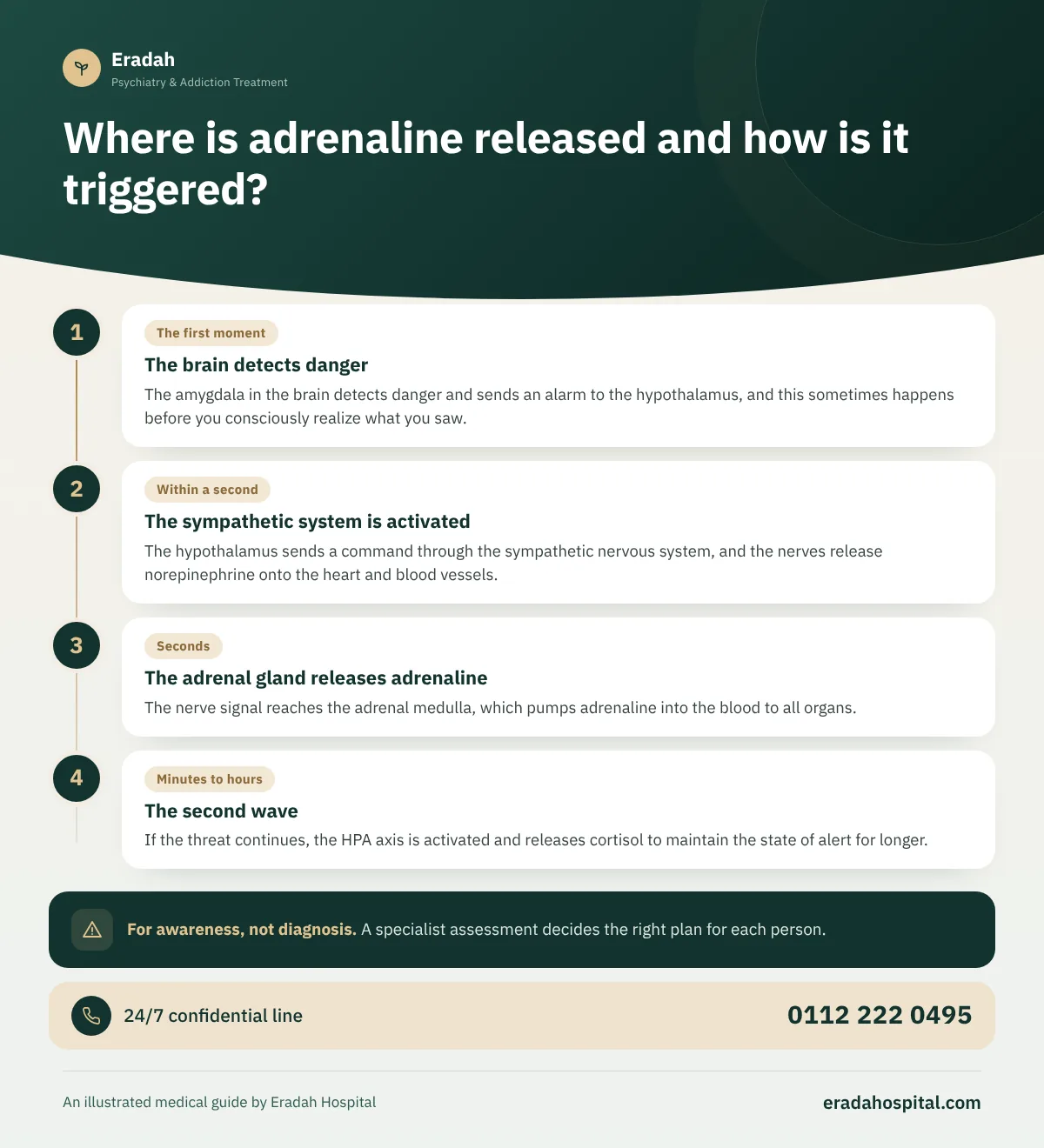
- The first momentThe brain detects danger
The amygdala in the brain detects danger and sends an alarm to the hypothalamus, and this sometimes happens before you consciously realize what you saw.
- Within a secondThe sympathetic system is activated
The hypothalamus sends a command through the sympathetic nervous system, and the nerves release norepinephrine onto the heart and blood vessels.
- SecondsThe adrenal gland releases adrenaline
The nerve signal reaches the adrenal medulla, which pumps adrenaline into the blood to all organs.
- Minutes to hoursThe second wave
If the threat continues, the HPA axis is activated and releases cortisol to maintain the state of alert for longer.
A nice detail is that the cortisol released by the gland's cortex passes through its medulla and helps switch on the enzyme that converts norepinephrine into adrenaline, so the two hormones work as one team in facing stress.
What does adrenaline do in the body during fight or flight?
It speeds up the pulse and strengthens the contraction, so the heart pumps more blood every minute; this is the pounding you feel when afraid.
It widens the airways so more air enters, which is why it is used to rescue people from anaphylaxis and severe shortness of breath.
It drives the liver to convert stored glycogen into sugar, and releases fat to serve as quick fuel for the muscles.
It directs blood toward the large muscles and reduces it in the skin and digestive system, so the face looks pale and appetite stops.
It dilates the pupil and heightens attention to every sound and movement.
Mild trembling, sweating and a dry mouth appear as part of the state of alert.
This response was designed for short situations: a danger appears and then passes. When it passes, adrenaline is broken down within minutes and the body gradually returns to calm. But when alarms repeat day after day because of constant pressures, the heart and blood vessels pay the price of this permanent alert.
What is the difference between adrenaline and norepinephrine?
The two names are similar and the two substances are chemically close; the chemical difference between them is a single small group. But this small difference changes where and how each works and its medical use:
| Point of comparison | Adrenaline | Norepinephrine |
|---|---|---|
| Other name | Epinephrine | Norepinephrine (noradrenaline) |
| Basic nature | A hormone that travels in the blood | Mainly a neurotransmitter between cells |
| Main source | The adrenal medulla | The adrenal medulla |
| The locus coeruleus in the brainstem and the endings of sympathetic nerves | Key effect | Speeding up the heart, widening the airways and raising blood sugar |
| Medical use | Raising alertness and attention, and narrowing blood vessels to maintain blood pressure | Anaphylaxis, cardiac arrest, and with local anesthesia |
| Raising blood pressure intravenously in shock in intensive care | Relationship to mental health and addiction | The physical symptoms of panic, and stimulants mimic its effect on the heart |
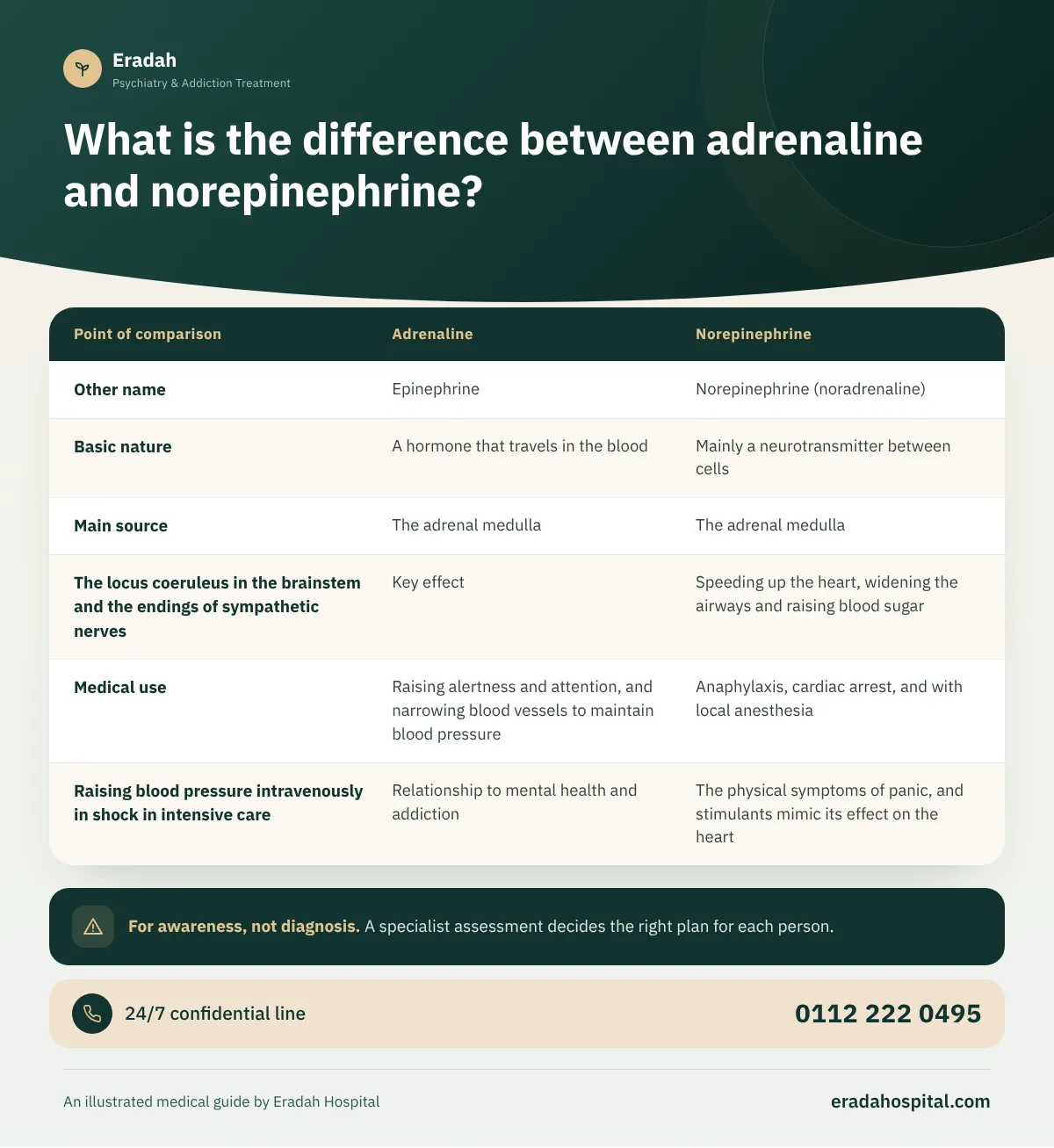
Put simply: norepinephrine wakes the brain and tightens the blood vessels, while adrenaline prepares the whole body for an emergency through the blood. They work together in the same situation, but each plays its role from a different position. To learn about norepinephrine's role in attention and mood, read the norepinephrine guide.
What is an "adrenaline rush," and why do some people look for it?
People describe the feeling after jumping from a height, riding a fairground ride or playing a decisive match as "high adrenaline": a pounding heart, sudden energy, sharp focus, and then a feeling of relief when it is over. A large part of this enjoyable feeling really comes from the accompanying dopamine and endorphins, not from adrenaline alone.
There is nothing wrong with safe thrilling sports as long as they follow safety rules. But families in Egypt sometimes ask about a son who is "looking for thrills" in reckless driving, betting or stimulant substances. Here, thrill-seeking becomes a sign worth noticing, because some young people's tendency toward risk-taking is a known risk factor for substance use, and it can be steered toward safe alternatives instead of being suppressed or ignored.
What are the medical uses of adrenaline?
| Use | Why adrenaline? | Important note |
|---|---|---|
| Hypersensitivity | Widens the airways, raises blood pressure and reduces swelling | The first medication in emergency care, and it comes in self-injectors that a doctor prescribes for people with severe allergies |
| Cardiac arrest | Stimulates the heart and raises blood pressure during resuscitation | Only within resuscitation protocols applied by the medical team |
| Local anesthesia | Narrows blood vessels, which prolongs the effect of the local anesthetic and reduces bleeding | As in some anesthetic injections at the dentist; tell the doctor about heart disease |
| Some cases of shock and severe shortness of breath | Supports the heart, blood pressure and breathing | In hospital and under continuous monitoring |
An adrenaline auto-injector is dispensed by prescription, and the doctor or pharmacist explains when and how to use it. It never replaces calling the ambulance after using it.
Can adrenaline be low in the body?
Low adrenaline on its own is an uncommon condition, and it has no separate page in our guide because its effect is usually limited; the sympathetic nerves make up for much of its work with norepinephrine. But there is one important situation that diabetes doctors know: when blood sugar drops, the body releases adrenaline, causing trembling, sweating, palpitations and hunger, which is the "alarm bell" that alerts the patient to eat.
In some people with diabetes who have repeated episodes of low blood sugar, this response can weaken, so the patient does not notice the drop until it is severe. That is why the doctor reviews the treatment plan if the patient notices they no longer feel the usual signs of low blood sugar.
Can adrenaline be measured by a test?
Yes, adrenaline, norepinephrine and their breakdown products, called metanephrines, can be measured in blood or urine. But this test is not ordered to diagnose anxiety or stress; it is ordered mainly when rare tumors that secrete these hormones in excess are suspected.
The reason is that its level changes within minutes with anxiety about the blood draw itself, standing up, exertion, caffeine, smoking, and certain foods and medications. That is why the lab gives specific instructions before the test, and the patient should not stop any medication except on their doctor's orders. A high result does not always mean a tumor; it needs the doctor's interpretation alongside symptoms and imaging.
Myths and facts about adrenaline
| The myth | The truth |
|---|---|
| Adrenaline and norepinephrine are the same thing | They are two different substances; adrenaline is mainly a hormone from the adrenal gland, and norepinephrine is mainly a neurotransmitter. |
| Adrenaline gives superhuman strength | It raises energy and attention temporarily and reduces the sensation of pain for a moment, but it does not remove the body's limits, and injuries may be discovered after it wears off. |
| Palpitations with anxiety mean heart disease | Usually a normal adrenaline response, but chest pain or fainting requires the emergency room to rule out a heart cause. |
| Thrill-seeking and adrenaline are an addiction like drugs | Thrill-seeking is not an addiction in itself, but it may lead to behaviors or substances that cause addiction. |
| Energy drinks give safe adrenaline | Their stimulants raise the pulse and blood pressure, and mixing them with alcohol or stimulants strains the heart. |
Why does understanding adrenaline matter for families and people with addiction?
Many misused substances mimic adrenaline's effect on the body. Cocaine, crystal meth (shabu) and Captagon push the heart and blood vessels into an artificial emergency state for hours on end, with no real danger to justify it, which explains heart attacks and strokes even in young people. The details of these risks are on the high adrenaline page.
During recovery, many people experience episodes of palpitations, sweating and panic that they mistake for a heart attack or for "withdrawal that never ends." Understanding adrenaline's role helps the person and their family handle these episodes calmly, while making sure to get a medical assessment when symptoms are new or severe.
Adrenaline guide: everything you need to know
We have gathered everything about adrenaline in 1 page that answers one question in detail. Choose what you are looking for:
Chest pain, severe palpitations or very high blood pressure? Call the ambulance (123) immediately
- Chest pain or pressure spreading to the arm, jaw or back, with sweating, shortness of breath or nausea
- A sudden severe headache with very high blood pressure, blurred vision or confusion
- Sudden drooping of the face, weakness in an arm or leg, or sudden difficulty speaking (signs of a stroke)
- A very fast or irregular heartbeat with severe dizziness or fainting
- Swelling of the throat or tongue and difficulty breathing after a food, a sting or a medication (anaphylaxis)
Call the ambulance (123) immediately. If you are not sure whether it is a panic attack or a heart attack, treat it as an emergency; an assessment in the emergency room is safer than guessing. In anaphylaxis, use the adrenaline auto-injector if the doctor has prescribed one and trained you to use it, then call the ambulance and have the person lie down rather than stand or walk. Tell the ambulance team about all the medications or substances the person has taken, and do not give them any blood pressure or heart medications from home that a doctor has not prescribed.
Ambulance 123 Mental health support line 16328