What does high adrenaline mean?
A momentary rise in adrenaline is a normal part of life: before an exam, when startled, during exercise. What deserves attention are three patterns: repeated elevation from stress or anxiety that does not settle, an artificial and intense rise caused by stimulants, or a rise in episodes with no clear cause that may point to a rare tumor that releases the hormone.
Unlike raised norepinephrine, which mostly concerns nerve activity in the brain and body, high adrenaline is a hormonal condition in the blood that affects the heart, breathing and blood sugar together, and in some cases it can be measured with tests.
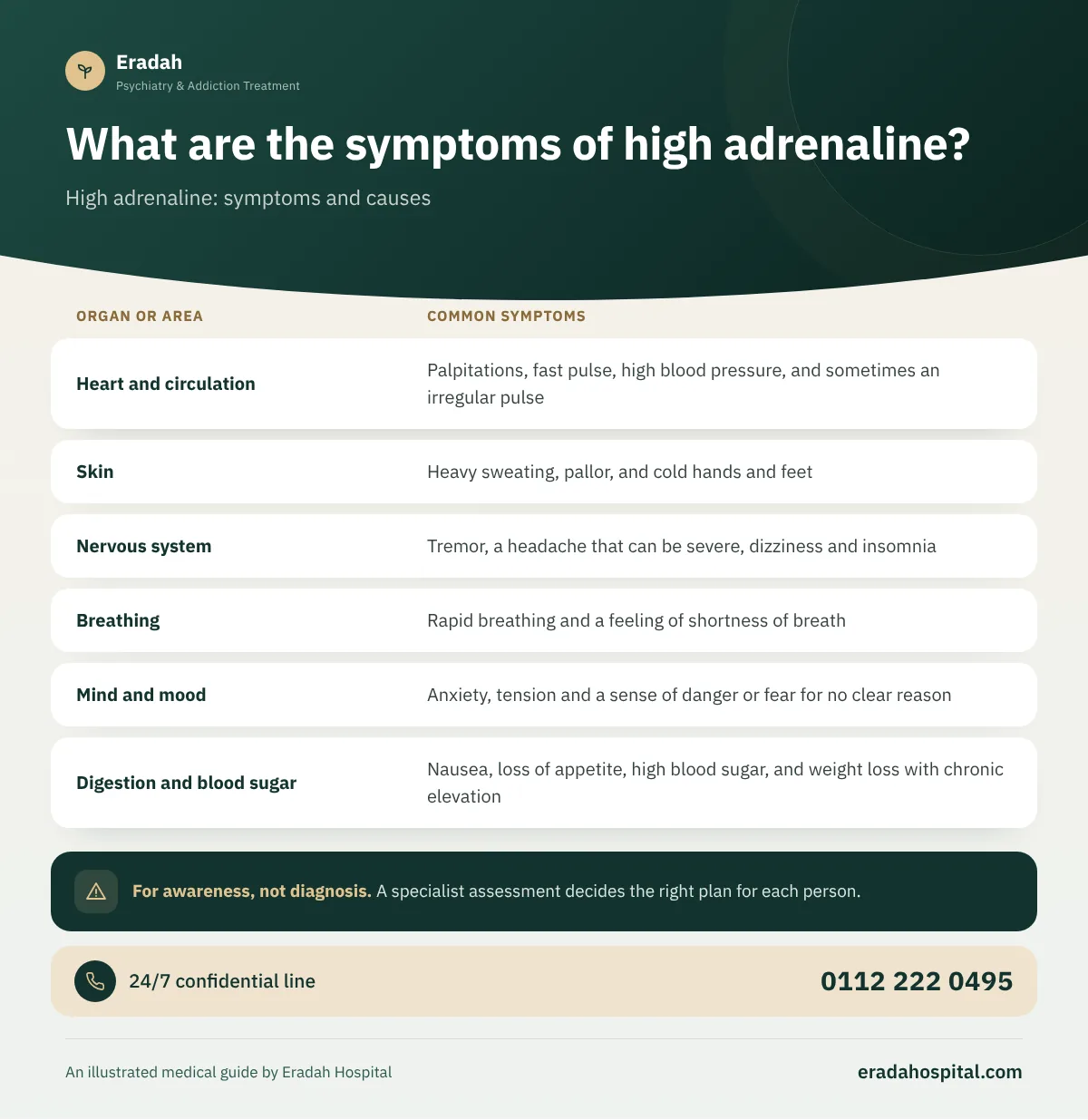
What are the symptoms of high adrenaline?
| Organ or area | Common symptoms |
|---|---|
| Heart and circulation | Palpitations, fast pulse, high blood pressure, and sometimes an irregular pulse |
| Skin | Heavy sweating, pallor, and cold hands and feet |
| Nervous system | Tremor, a headache that can be severe, dizziness and insomnia |
| Breathing | Rapid breathing and a feeling of shortness of breath |
| Mind and mood | Anxiety, tension and a sense of danger or fear for no clear reason |
| Digestion and blood sugar | Nausea, loss of appetite, high blood sugar, and weight loss with chronic elevation |
If these symptoms come as sudden episodes that last minutes and then pass, combining headache, sweating and palpitations with high blood pressure, this is a pattern that draws the doctor's attention to the possibility of a pheochromocytoma, even though it is a rare possibility.
What causes high adrenaline?
| Cause | What happens? | How serious it is |
|---|---|---|
| Intense, chronic stress | Repeated activation of the fight-or-flight response by work, family or money pressures | Wearing over the long term |
| Panic attacks and anxiety | A false alarm that triggers the emergency response with no real danger | Frightening but not dangerous in itself |
| Stimulants: cocaine, crystal meth and Captagon | Mimic adrenaline and strongly raise catecholamines for hours | High and potentially fatal |
| Nicotine, caffeine and energy drinks | Activate the sympathetic system and adrenaline release | Mild to moderate, and rising with excess |
| Low blood sugar | The body releases adrenaline to raise the sugar | Needs quick treatment of the sugar |
| Alcohol and sedative withdrawal | Overactivity of the sympathetic system after sudden stopping | May be dangerous |
| Pheochromocytoma and similar tumors | Tumor tissue that releases adrenaline and norepinephrine | Rare but dangerous until treated |
What is a pheochromocytoma?
A pheochromocytoma is a rare tumor of the adrenal medulla, mostly benign, but it releases large amounts of adrenaline and norepinephrine, continuously or in bursts. Related tumors arise from similar tissue outside the adrenal gland and are called paragangliomas.
Its symptoms usually come in sudden episodes lasting from minutes to about an hour, and include headache, heavy sweating, palpitations, high blood pressure, pallor, nausea, tremor and anxiety, and the episodes may become more frequent and more severe as the tumor grows. Some patients have no symptoms, and the tumor is found by chance on a scan done for another reason.
The UK National Health Service states that up to a third of pheochromocytoma cases are linked to inherited conditions, so family members may be advised to have genetic testing.
Without treatment it may cause heart rhythm disturbances, heart attacks, strokes and failure of some organs.
The tumor is usually removed surgically, often by keyhole surgery, after a period on medicines that control blood pressure and pulse to protect the patient during the operation.
Most patients recover well, but the tumor can return in some, so regular lifelong follow-up is needed.
Is it an adrenaline panic attack or a heart attack?
In a panic attack the brain sets off a false alarm, adrenaline surges, and palpitations, chest pain, shortness of breath, tremor, sweating and fear of dying appear. Most attacks last between 5 and 20 minutes, and according to medical references they are frightening but cause no physical harm.
| The sign | More like a panic attack | More like a heart attack |
|---|---|---|
| The start | With stress or fear or with no cause, peaking within minutes | With exertion or at rest, especially with cardiac risk factors or after stimulants |
| Nature of chest pain | A stabbing or variable tightness | Pressure or heaviness that may spread to the arm, jaw or back |
| Duration | Usually settles within twenty minutes | May continue or worsen |
| Who is more at risk | Young people and those who have had similar attacks before | Older adults, smokers, people with diabetes or high blood pressure, and stimulant users |
How do stimulants mimic adrenaline and what do they do to the heart?
Cocaine, crystal meth, Captagon and amphetamine strongly raise catecholamines in the body, putting the heart and vessels in an artificial state of emergency: a fast pulse, constricted vessels, high blood pressure and raised temperature, for hours on end and with no real danger to justify it.
The US National Institute on Drug Abuse states that cocaine is linked to heart rhythm disturbances, heart attacks, strokes and seizures, and that long-term use may cause inflammation of the heart muscle and weaken its contraction. A sudden rise in stress hormones may also cause a condition called stress cardiomyopathy or "broken heart syndrome," and Mayo Clinic lists illicit stimulants and some stimulant medicines among its triggers. These facts alone are reason enough to seek help early, and you can start from the page on crystal meth addiction treatment or cocaine addiction treatment.
As for smoking, nicotine raises the pulse and blood pressure with every cigarette, and repeating that thousands of times a year contributes to heart and vascular disease. Energy drinks, with the stimulants they contain, raise the pulse and blood pressure, and their effect increases when mixed with alcohol or stimulants.
What does chronically high adrenaline from stress do?
The fight-or-flight response is designed to last minutes, but modern life pressures may trigger it many times a day. Harvard Medical School references explain that repeated activation of this response raises blood pressure and strains the vessels, which over the long term increases the risk of heart attacks and strokes, while the accompanying cortisol contributes to increased appetite and fat storage.
- Insomnia and frequent waking with palpitations
- Muscle tension and repeated headaches
- Quick irritability and difficulty relaxing even on vacation
- Higher blood pressure readings at times of psychological pressure
- Turning to cigarettes, stimulants or sedatives to "cope"
The same references state that regular relaxation techniques, physical activity and social support help calm this response, and if the stress is tied to anxiety or depression, psychological treatment is effective and available. We explain stress management in detail on the page about ways to lower cortisol naturally.
What are the risks of high adrenaline to the heart and body?
| Complication | When does it usually happen? |
|---|---|
| Hypertensive crisis | With pheochromocytoma or stimulants, and it becomes an emergency at a pressure of 180/120 or more with symptoms |
| Heart rhythm disturbance | With stimulants, large doses of stimulant medicines, and pheochromocytoma |
| Heart attack or stroke | With cocaine and crystal meth even in young people, and with untreated pheochromocytoma |
| Stress cardiomyopathy | After severe psychological or physical shock, or some medicines and stimulants, and most patients recover |
| Chronically high blood pressure and sugar | With persistent stress or hormone-releasing tumors |
How does the doctor diagnose high adrenaline?
- Medical history: When do the episodes happen? How long do they last? Are they linked to stimulants, substances or medicines? Are there similar cases in the family?
- Blood pressure and pulse measurement during an episode if possible, and an ECG when there are palpitations or chest pain.
- General tests for sugar and thyroid function, since an overactive thyroid can cause similar symptoms.
- Metanephrines test in blood or urine when a pheochromocytoma is suspected, following the lab's instructions before the test.
- CT or MRI scan to locate the tumor if the tests are high, and sometimes specialized nuclear imaging.
- Psychological assessment if the episodes turn out to be panic attacks or anxiety, which is a real diagnosis that deserves treatment.
How is high adrenaline treated?
Treatment is determined by the cause, and we mention only the general categories, since the choice and doses are the doctor's decision:
| Cause | Focus of treatment |
|---|---|
| Pheochromocytoma | Medicines that block alpha and then beta receptors in an order set by the doctor, followed by surgical removal and long follow-up, with genetic testing when needed |
| Panic attacks and anxiety | Cognitive behavioral therapy, medicines prescribed by the psychiatrist, breathing exercises and reducing caffeine |
| Stimulant toxicity | Emergency: calming, heart monitoring and lowering the temperature, then a plan for addiction treatment |
| Chronic tension | Stress management, regular sleep, physical activity, and psychological and social support |
| Low blood sugar | Raise the sugar immediately, and review the diabetes treatment plan with the doctor |
The doctor may sometimes prescribe beta-blocker medicines to ease the physical symptoms of anxiety in specific situations, but they are not suitable for everyone, especially people with asthma. Do not use any heart or blood pressure medicine without a prescription, and do not stop it suddenly.
At Eradah we see many patients whose hearts have been strained by stimulants, or who are living through panic attacks during recovery; so we begin with a medical assessment of the heart and blood pressure, and then build a psychological and medical treatment plan for addiction and anxiety together.
When should you go to the emergency room for high adrenaline?
- Pain or pressure in the chest, especially if it spreads to the arm or jaw or happens after using stimulants.
- A sudden severe headache with very high blood pressure, blurred vision or confusion.
- Signs of a stroke: a drooping face, weakness in a limb, or sudden difficulty speaking.
- Severe irregular palpitations with dizziness or fainting.
- Severe agitation, high temperature or seizures after using stimulants.
Chest pain, severe palpitations or very high blood pressure? Call the ambulance (123) immediately
- Chest pain or pressure spreading to the arm, jaw or back, with sweating, shortness of breath or nausea
- A sudden severe headache with very high blood pressure, blurred vision or confusion
- Sudden drooping of the face, weakness in an arm or leg, or sudden difficulty speaking (signs of a stroke)
- A very fast or irregular heartbeat with severe dizziness or fainting
- Swelling of the throat or tongue and difficulty breathing after a food, a sting or a medication (anaphylaxis)
Call the ambulance (123) immediately. If you are not sure whether it is a panic attack or a heart attack, treat it as an emergency; an assessment in the emergency room is safer than guessing. In anaphylaxis, use the adrenaline auto-injector if the doctor has prescribed one and trained you to use it, then call the ambulance and have the person lie down rather than stand or walk. Tell the ambulance team about all the medications or substances the person has taken, and do not give them any blood pressure or heart medications from home that a doctor has not prescribed.
Ambulance 123 Mental health support line 16328