What is the “chemical” drug?
“It’s not hashish, it’s chemical, lighter and cheaper and doesn’t show up in the test.” This sentence sums up why “chemical” spread, and it contains three wrong ideas: it is not lighter, cheaper is not less harmful, and not showing up in a test does not mean it is safe.
“Chemical” is a popular name derived from the English word chemical, and by it people mean synthetic cannabinoids: compounds originally designed in research laboratories, then copied by unlicensed labs and added to dried herbs or vaping liquids to be sold. The US National Institute on Drug Abuse (NIDA) explains that these products are sometimes known as “K2” and “Spice,” and that using them is linked to severe, potentially life-threatening health problems.
They do not contain the cannabis plant, but they act on its receptors in the brain more strongly and less predictably than the THC found in bango and hashish. The full scientific explanation of the family is in the guide to synthetic hashish.
Names for “chemical”: Spice, K2, Strox and paper
Names keep changing because dealers change them for marketing and to evade enforcement, and the same name may carry a different compound from one month to the next. These are the best-known names for the same family:
Roughly the general popular name in Egypt for synthetic cannabis mixtures.
One of the best-known names worldwide, sometimes used to refer to the whole family.
A common American name that the US National Institute on Drug Abuse mentions alongside Spice.
The most widespread name in Egypt, which has become synonymous with synthetic cannabis for many people.
Another name for similar mixtures, sometimes marketed as “herbs.”
Paper or strips soaked with the substance and then dried, hard to recognize by eye.
“Chemical” in the form of soaked paper
“Chemical” does not always come as herbs; ordinary paper may be soaked with it and then dried so that it looks natural, which is known as paper drug. Analyses of paper strips seized in a US prison, published in 2024 in JAMA Network Open, found synthetic cannabinoids together with benzimidazole opioids, the family that includes the nitazenes.
- Can’t be recognized by eye: a soaked sheet looks like any ordinary paper.
- The amount is unknown: the concentration of the substance in the paper cannot be known without laboratory analysis.
- It has its own guide: what analyses found in seized papers, the symptoms of poisoning from them, and how they are detected, in the paper drug guide.
How does “chemical” affect the brain and body?
The effect may begin with relaxation and laughter and then suddenly turn into anxiety, panic and hallucinations. According to a systematic review published in 2016 in the journal Clinical Toxicology that gathered 106 studies on about 4,000 cases, the most common symptoms were a racing heart, agitation and nausea. Serious complications included:
- Heart and blood vessels: heart attacks and strokes, even in young people.
- Kidneys: acute kidney failure.
- Nervous system: generalized epileptic seizures.
- Mind: first-episode psychosis, paranoia and thoughts of self-harm.
- Digestive system: severe repeated vomiting.
The same review recorded at least 26 deaths among the cases studied. A systematic review of deaths linked to these substances, published in 2020 in Frontiers in Psychiatry, explains that typical toxic levels have not yet been established for them, meaning there is no known “safe amount.” Psychosis may also continue after the effect wears off, as explained in the guide to drug-induced psychosis.
Why does “chemical” spread despite its danger?
NIDA notes that people reported using these products because they were sometimes cheaper and easier to get than cannabis, and because they are mostly not detected by routine urine tests. To that we add reasons we hear often:
- Believing it is “herbs” or a “legal alternative” to hashish.
- Wanting to avoid a positive result on a workplace or family test.
- Imitating friends and trying it at gatherings, without knowing that each package may differ from the next.
- Using it to escape pressure, anxiety or untreated depression.
But relying on “not showing up” leads some people to replace hashish with a far more dangerous substance; specialized laboratories can detect many of its compounds, as detailed in the guide to how long Strox stays in the body and testing.
“Chemical” compared with hashish and bango
| Point of comparison | “Chemical” (synthetic cannabis) | Hashish and bango |
|---|---|---|
| Source | Laboratory compounds added to herbs, liquids or paper | The natural cannabis plant |
| Consistency of composition | The compound and its concentration change from one package to the next | The active ingredient, THC, is known |
| Acute complications | Seizures, clots and kidney failure are documented | Rare compared with synthetic cannabis |
| Routine urine test | Mostly does not detect it | Detects THC metabolites |
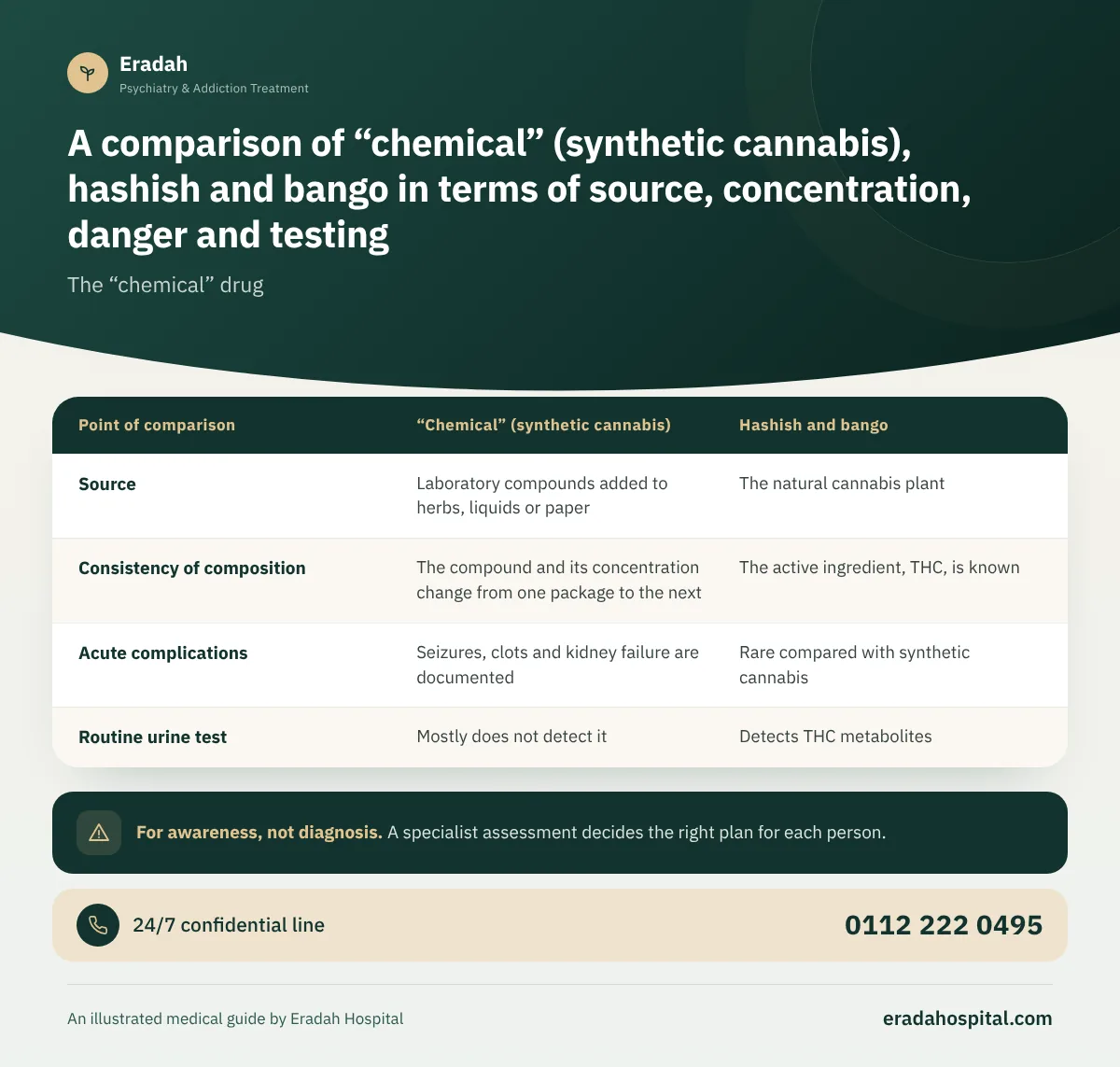
This does not mean that hashish is safe; it has real psychological and addictive harms, but “chemical” adds to them the risk of acute poisoning and sudden death.
The legal status of “chemical” in Egypt
“Chemical” is a prohibited substance in Egypt with no medical use. In February 2026, after a ruling by the Supreme Constitutional Court, the Minister of Health and Population issued Decree No. 44 of 2026 replacing the schedules attached to Narcotics Control Law No. 182 of 1960, and it was published in the Official Gazette. According to Egyptian press reports, the new schedules cover synthetic hashish substances such as Voodoo and Strox, and extend to chemical analogues and derivatives so that the law cannot be evaded by a slight change in a substance’s structure.
The Fund for Drug Control and Treatment of Addiction offers free, confidential treatment through the hotline 16023, and seeking treatment is a health right that fear should not prevent.
This is general educational information and not legal advice.
Synthetic cannabis in numbers
Sources: Tait et al., Clinical Toxicology 2016; and Kuai et al., JAMA Network Open 2024.
“Chemical” and Strox: where to find the details
Because “chemical” and Strox are two names for the same family, the details of harms, signs, withdrawal and treatment are explained in the Strox guide:
- Harms: on the heart, kidneys, brain and mental health, in Strox harms.
- Signs: what a family may notice, in Strox addiction symptoms and signs of use.
- Withdrawal: the symptoms and their timeline, in Strox withdrawal symptoms.
- Treatment: the stages, duration and rehabilitation, in Strox addiction treatment.
- Causes: why it spreads among young people, in causes of Strox addiction.
Use of “chemical” often occurs together with depression, anxiety or psychosis, and here dual diagnosis treatment becomes essential.
“Chemical” guide: everything you need to know
We have gathered everything about “chemical” into 6 pages, each answering one question in detail. Choose what you are looking for:
Harms of Strox to the body and mind
Learn about Strox harms to the heart, kidneys, brain and nervous system, the risk of seizures, psychosis and sudden death, and its harm to teenagers, pregnancy and social life.
Causes of Strox addiction
Why does Strox spread among young people and become addictive so quickly? Learn the causes of Strox addiction: the strength of the substance and rapid tolerance, psychological and genetic factors, and environment and misconceptions.
Strox addiction symptoms and signs of use
How do you know if someone is using Strox? The physical, behavioral and psychological signs of Strox use, how it differs from hashish, the criteria for diagnosing addiction, and how to talk to them.
Strox and Voodoo withdrawal symptoms
When do Strox and Voodoo withdrawal symptoms begin and how long do they last? The withdrawal timeline, physical and psychological symptoms, when it is dangerous, and why it needs medical supervision.
Strox and Voodoo addiction treatment
How are Strox and Voodoo addiction treated? The stages of treatment from assessment and safe detox to cognitive behavioral and family therapy and relapse prevention, and the duration of each stage.
How long Strox stays in the body and drug testing
How long does Strox stay in the body? How long it stays in urine, blood, saliva and hair, why it doesn’t show up in the usual hashish test, and the specialized tests that detect it.
What should a family do if they suspect “chemical” use?
- If you find strange herbs or papers or packages with names you don’t understand, don’t begin with accusations; note the changes you have seen in sleep, mood, spending and friends.
- Talk calmly at a time when they are not under the influence, and use the guide to persuading a person with addiction to accept treatment.
- Don’t wait for them to “come down” if emergency signs appear; call the ambulance (123).
- Seek a specialist assessment; treatment may need residential treatment if psychotic symptoms appear or relapses repeat.
Danger signs after using “chemical”: call the ambulance (123) immediately
- Seizures or loss of consciousness
- Chest pain, or a pulse that is very fast or very slow
- Difficulty breathing, or deep drowsiness with no response when called
- Severe agitation, panic or hallucinations with a high temperature
- Repeated vomiting that does not stop, or little urine
Call ambulance (123) immediately. If the person is unconscious but breathing, place them on their side so they do not choke on vomit. Stay with them and do not leave them alone. Do not give them food or drink, and tell the paramedics everything they took or used, and the amount and time if you know them.
Call the ambulance 123