What are endorphins?
Endorphins are peptides, meaning short chains of amino acids, that the body produces to relieve pain and cope with stress. The name comes from combining two words meaning “endogenous morphine,” because scientists discovered them in the 1970s while trying to work out why the brain has receptors for morphine at all.
It was a logical question: why would the brain have “locks” that fit a substance extracted from the opium poppy? The answer is that the body makes its own “keys,” the endogenous opioids. Endorphins are the best known, alongside other families: enkephalins, dynorphins and nociceptin.
The most important endorphin is beta-endorphin, made of 31 amino acids. It is made from a larger protein that is cut inside the cell into several hormones, including adrenocorticotropic hormone (ACTH), which triggers the release of cortisol. This is why endorphin release is closely tied to the body’s stress response.
Where are endorphins released, and how do they work?
Beta-endorphin is released mainly from the anterior pituitary gland into the blood, and from cells in the hypothalamus whose fibers extend within the brain. Some immune cells have also been found able to produce it at sites of inflammation, helping relieve pain locally.
Endorphins work by binding to opioid receptors, the most important being the “mu” receptor, followed by “delta” and “kappa.” When they bind, they reduce the nerve cell’s activity and stop it from passing on the pain signal, which dulls the sensation in the spinal cord and brain. They also lift the brake on dopamine cells in the reward circuit, so they take part in feelings of comfort and pleasure.
| Family | Main receptor | Key role |
|---|---|---|
| Endorphins (beta-endorphin) | Mu | Relieving pain and stress, and taking part in reward |
| Enkephalins | Delta and mu | Regulating pain in the spinal cord, and emotions |
| Dynorphins | Kappa | Linked to low mood and distress during stress and withdrawal |
| Nociceptin | Its own receptor | Regulating pain and stress in ways still being studied |
What do endorphins do in the body?
Part of an internal system that eases pain, especially in acute, emergency situations.
Released along with stress hormones to help the body endure and then settle down.
Takes part in the feeling of satisfaction after exertion, eating or warm moments.
Group laughter releases endogenous opioids linked to feeling close to others.
Interacts with the immune system, and some immune cells produce it at sites of inflammation.
Affects the reproductive hormone axis, which is why menstrual cycles and fertility are disrupted with opiates.
A well-known example of how they work is “stress-induced analgesia”: an athlete is injured during a match, keeps playing, and feels the pain only after it ends, or a person walks away from an accident without noticing their wound in the first minutes. Endorphins take part in this together with other systems, giving the body a chance to survive before it turns its attention to the pain.
Research also points to a role for endogenous opioids in part of the placebo effect on pain. Researchers have observed that blocking opioid receptors can reduce the pain relief some people feel after taking a “medicine” with no active ingredient, evidence that expecting to get better triggers real chemistry in the brain.
How were endorphins discovered?
The story began in 1973, when several research teams showed that the brain has receptors specific to opiates. This raised an obvious question: the body was not designed to take poppy, so it must make its own substance that fits these receptors. In 1975, two researchers in Scotland announced the discovery of the first of these substances, enkephalin, and beta-endorphin was isolated from the pituitary gland the following year.
This discovery changed our understanding of both pain and addiction. It showed that the body can ease pain from within depending on the situation, attention and expectation, so pain is more than a signal traveling from the skin to the brain. It also showed that opioid drugs do not add something entirely foreign to the body; they “impersonate” a system that already exists, which is the secret of both their power and their danger.
Are endorphins the cause of the “runner’s high”?
For many years, the refreshed, calm feeling after running was credited to endorphins alone. But the picture today is more complex. Beta-endorphin in the blood does not easily cross into the brain, and a 2015 study in mice showed that the calm and reduced pain after running depended on receptors for the body’s own cannabis-like substances, not on opioid receptors.
In a human study published in 2021, the euphoria and reduced anxiety after running continued even when opioid receptors were blocked with a medicine. On the other hand, other imaging studies have shown opioid release in the brain after exertion, especially intense exertion. The honest summary: endorphins probably take part in the effects of exercise, especially on pain, but they are not solely responsible for the “runner’s high”.
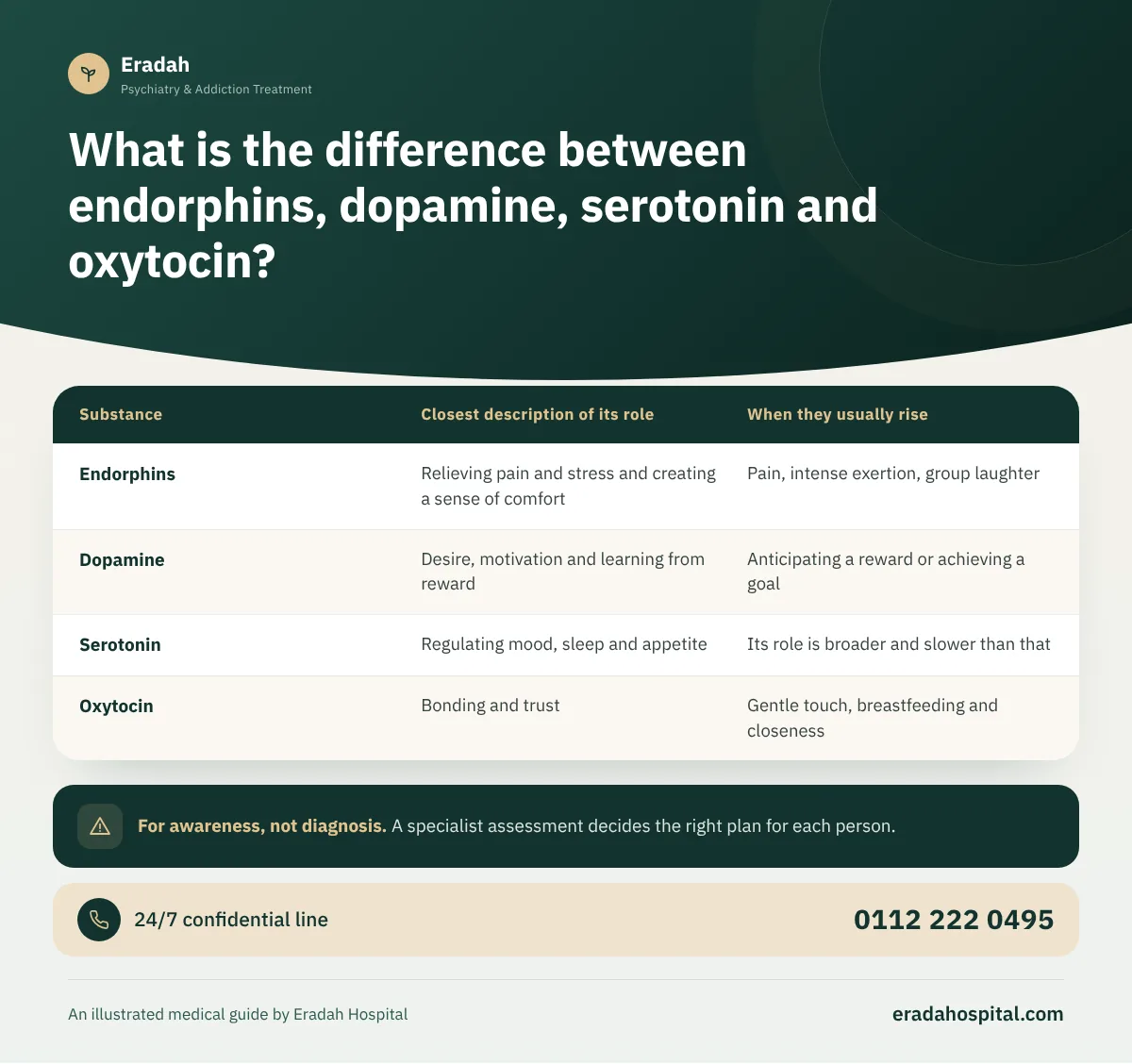
What is the difference between endorphins, dopamine, serotonin and oxytocin?
These four chemicals are called the “happiness hormones” online, but each has a different role, and they work together, not alone:
| Substance | Closest description of its role | When they usually rise |
|---|---|---|
| Endorphins | Relieving pain and stress and creating a sense of comfort | Pain, intense exertion, group laughter |
| Dopamine | Desire, motivation and learning from reward | Anticipating a reward or achieving a goal |
| Serotonin | Regulating mood, sleep and appetite | Its role is broader and slower than that |
| Oxytocin | Bonding and trust | Gentle touch, breastfeeding and closeness |
Can endorphins be measured? Is there an “endorphin deficiency”?
Beta-endorphin can be measured in the blood in research laboratories, but this number does not reflect what is happening in the brain, and it changes quickly with stress, pain, exertion and time of day. For this reason, there is no routine test doctors order to measure endorphins, and no diagnosis or treatment is based on it.
Likewise, there is no accepted medical diagnosis called “endorphin deficiency”. You may read that a shortage causes depression, chronic pain or insomnia. In fact, research points to differences in the endogenous opioid system in some people with chronic pain and depression, but this does not mean that any one person’s problem is caused by low endorphins, or that raising them would treat it. If you have ongoing pain or sadness, the way forward is a doctor, not a chemical explanation from the internet.
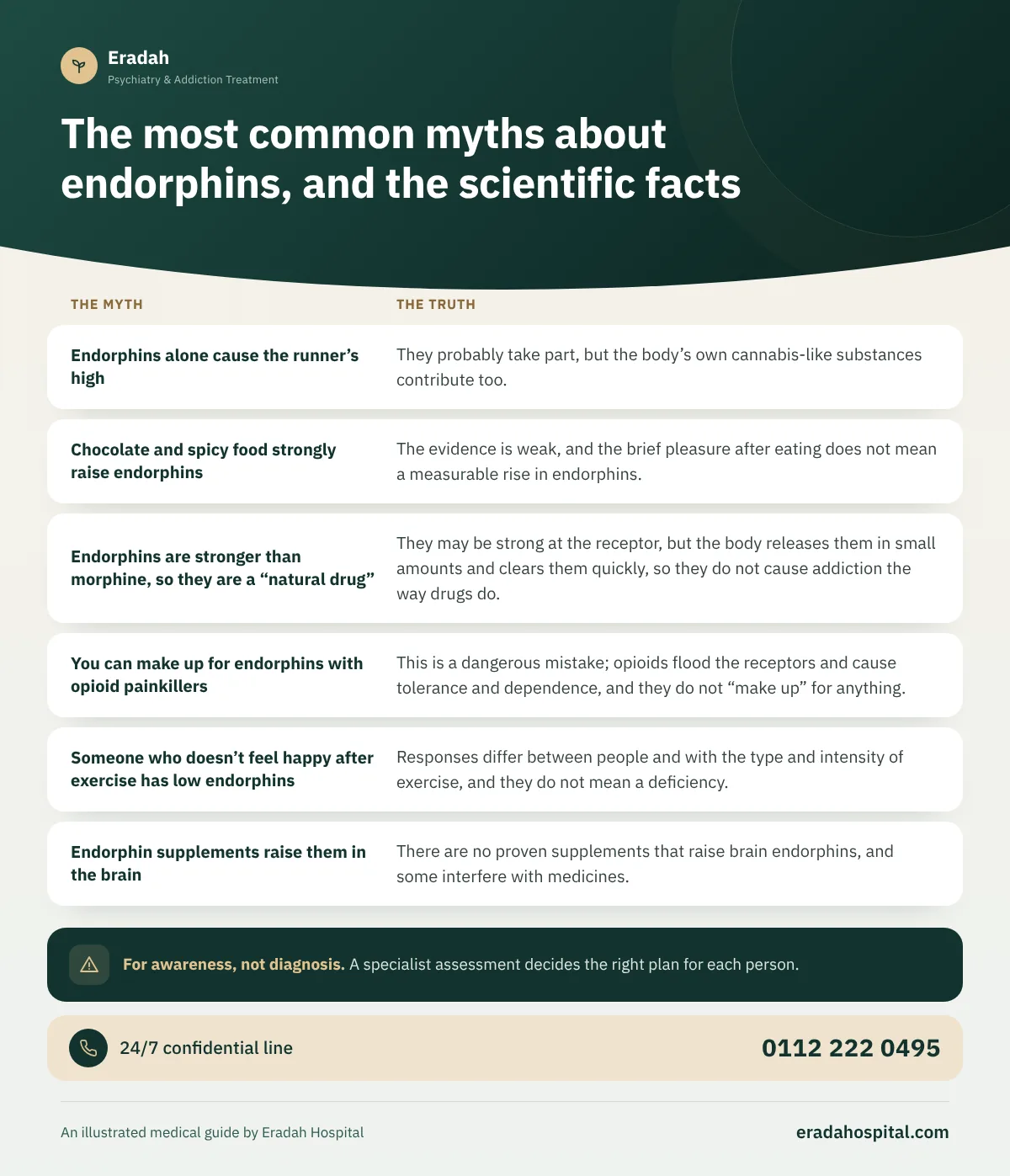
Common myths about endorphins, and the facts
| The myth | The truth |
|---|---|
| Endorphins alone cause the runner’s high | They probably take part, but the body’s own cannabis-like substances contribute too. |
| Chocolate and spicy food strongly raise endorphins | The evidence is weak, and the brief pleasure after eating does not mean a measurable rise in endorphins. |
| Endorphins are stronger than morphine, so they are a “natural drug” | They may be strong at the receptor, but the body releases them in small amounts and clears them quickly, so they do not cause addiction the way drugs do. |
| You can make up for endorphins with opioid painkillers | This is a dangerous mistake; opioids flood the receptors and cause tolerance and dependence, and they do not “make up” for anything. |
| Someone who doesn’t feel happy after exercise has low endorphins | Responses differ between people and with the type and intensity of exercise, and they do not mean a deficiency. |
| Endorphin supplements raise them in the brain | There are no proven supplements that raise brain endorphins, and some interfere with medicines. |
In short, endorphins are part of an intelligent system for easing pain and stress, working in small, temporary, controlled doses. When outside substances imitate them with far greater force, this system is thrown off balance, a story we explain in Endorphins and addiction.
Endorphin guide: everything you need to know
We have gathered everything about endorphins into 2 pages, each answering one question in detail. Choose what you are looking for:
Ways to increase endorphins naturally
What science actually supports about exercise, laughter, group singing, touch and music, with a table rating the strength of the evidence and exposing the myths, and when you need a doctor for pain or mood.
Endorphins and addiction
How opiates mimic endorphins and flood their receptors, why tolerance, withdrawal and heightened pain sensitivity occur, the relationship between alcohol and endorphins, and how the body recovers.
Opioid overdose? Call an ambulance (123) immediately
- Extreme drowsiness, or no response to calling or shaking
- Very slow or irregular breathing, odd snoring sounds, or breathing that has stopped
- Pupils that are extremely small, like pinpoints
- Bluish lips or nails, and cold, clammy skin
- Vomiting while unconscious, or choking sounds
Call an ambulance (123) immediately and try to wake the person with a loud voice. If they are breathing, place them on their side so they do not choke, and stay with them until help arrives. Emergency departments have a medicine called naloxone that temporarily reverses the effects of opioids. Do not give the person anything else, including water or coffee. If there are thoughts of self-harm, call the mental health support line 16328.
Ambulance 123 Mental health support line 16328