What is norepinephrine?
Norepinephrine, also called noradrenaline, is a chemical message that tells the brain and body: "Pay attention, something matters." It is mainly a neurotransmitter released by nerve cells in the brain and by the sympathetic nerves spread throughout the body, and in smaller amounts it is released as a hormone into the blood from the adrenal medulla.
Norepinephrine belongs to a small family called catecholamines, which also includes dopamine and adrenaline. These three chemically similar substances are made in a single production line, but each has a different role: dopamine for drive, reward and movement; norepinephrine for alertness, attention and control of the blood vessels; and adrenaline, the emergency hormone that travels in the blood.
Because its name is so close to adrenaline, many people confuse the two. For now, it is enough to remember that norepinephrine mostly acts as a short-range nerve messenger between cells, while adrenaline mostly acts as a hormone that spreads through the blood. A detailed comparison of the two is in the adrenaline guide.
Where is norepinephrine released in the body?
Norepinephrine has three main sources, and each one has a different function:
A very small cluster of cells in the brainstem, but its fibers branch out to the cortex, hippocampus, amygdala, cerebellum and spinal cord, so it sets the alertness level of almost the whole brain.
They release norepinephrine directly onto the heart, blood vessels, eyes and sweat glands, and this is the largest source of the norepinephrine found in the blood.
It releases mainly adrenaline, along with some norepinephrine, into the blood during stress, danger and exertion.
Smaller groups of cells that help control breathing, blood pressure and involuntary responses.
This distribution explains why norepinephrine affects things that seem far apart: your attention in a lecture, your ability to stand up suddenly without feeling dizzy, and your heart pounding when you hear a sudden sound at night.
How does norepinephrine work?
The body starts from the amino acid tyrosine, found in protein, and converts it to L-DOPA and then to dopamine. A specific enzyme inside the nerve vesicles then converts dopamine into norepinephrine. In the adrenal medulla the chain takes one last step, and most of the norepinephrine becomes adrenaline.
When a nerve cell is activated, it releases norepinephrine, which binds to two major types of receptors called alpha and beta receptors. After it has done its job, the cell takes most of it back up using a special pump called the norepinephrine transporter, and the rest is broken down by enzymes, including monoamine oxidase, the enzyme that MAOI medicines inhibit.
| Receptor | Where is it mostly found? | What does it do? | Why does it matter? |
|---|---|---|---|
| Alpha-1 | Walls of blood vessels | Narrows the vessels, raising blood pressure | Maintains blood pressure when you stand; overactivation raises blood pressure sharply |
| Alpha-2 | The nerve endings themselves and the brainstem | Acts as a brake that reduces further release of norepinephrine | Medicines that calm opioid withdrawal symptoms and some blood pressure medicines act on it |
| Beta-1 | Heart muscle | Speeds up the pulse and strengthens the contraction | The cause of palpitations during stress, and the target of beta blockers |
| Beta-2 | Airways and muscles | Widens the airways | Affected more by adrenaline than by norepinephrine |
What are the functions of norepinephrine in the brain and body?
Its activity rises on waking and quiets during sleep, and almost stops during dream (REM) sleep.
It helps the brain tell what matters from what does not, and works with dopamine in the prefrontal cortex, which manages planning and focus.
It is the first to respond in the fight-or-flight reaction: it wakes the brain and sharpens attention, and then the adrenal gland completes the job with adrenaline.
The sympathetic nerves release it onto the vessels, which tighten immediately when you stand, so that blood does not pool in your legs and make you dizzy.
It explains why you remember frightening or important events more vividly than ordinary days.
It contributes to the sense of energy, interest and drive, which is why some antidepressants act on it.
It is also worth knowing that mental performance needs a moderate level of norepinephrine: too little means drowsiness and distraction, and too much means tension and anxiety that muddle thinking. So the goal is never to "raise it to the maximum," but for it to work at the right time and in the right amount.
Is norepinephrine a neurotransmitter or a hormone?
The precise answer: both, but its role as a neurotransmitter is the more important one. Most of its work is done through nerve cells that release it onto a neighboring cell or a nearby organ such as the heart or the wall of a blood vessel. The amount the adrenal gland releases into the blood is far smaller than the adrenaline released by the same gland.
That is why, on the Eradah website, we classify it among the neurotransmitters, while we classify adrenaline among the hormones. If you want the full comparison table covering source, function and medical use, you will find it in the section "The difference between adrenaline and norepinephrine" in the adrenaline guide.
How does norepinephrine balance with dopamine, serotonin and cortisol?
Norepinephrine does not work alone. With dopamine it forms the attention and drive pair in the prefrontal cortex; with serotonin it helps regulate mood, anxiety and sleep; and with cortisol it forms the two wings of the stress response: norepinephrine for the fast response within seconds, and cortisol for the slower response that lasts for hours.
When stress is prolonged or repeated, this system stays on higher alert than it should, which shows up as insomnia, excessive vigilance and quick irritability. This is what families see during withdrawal from some substances, and in post-traumatic stress disorder (PTSD), where the brain stays "on guard" even after the danger has passed.
Which medicines and substances affect norepinephrine?
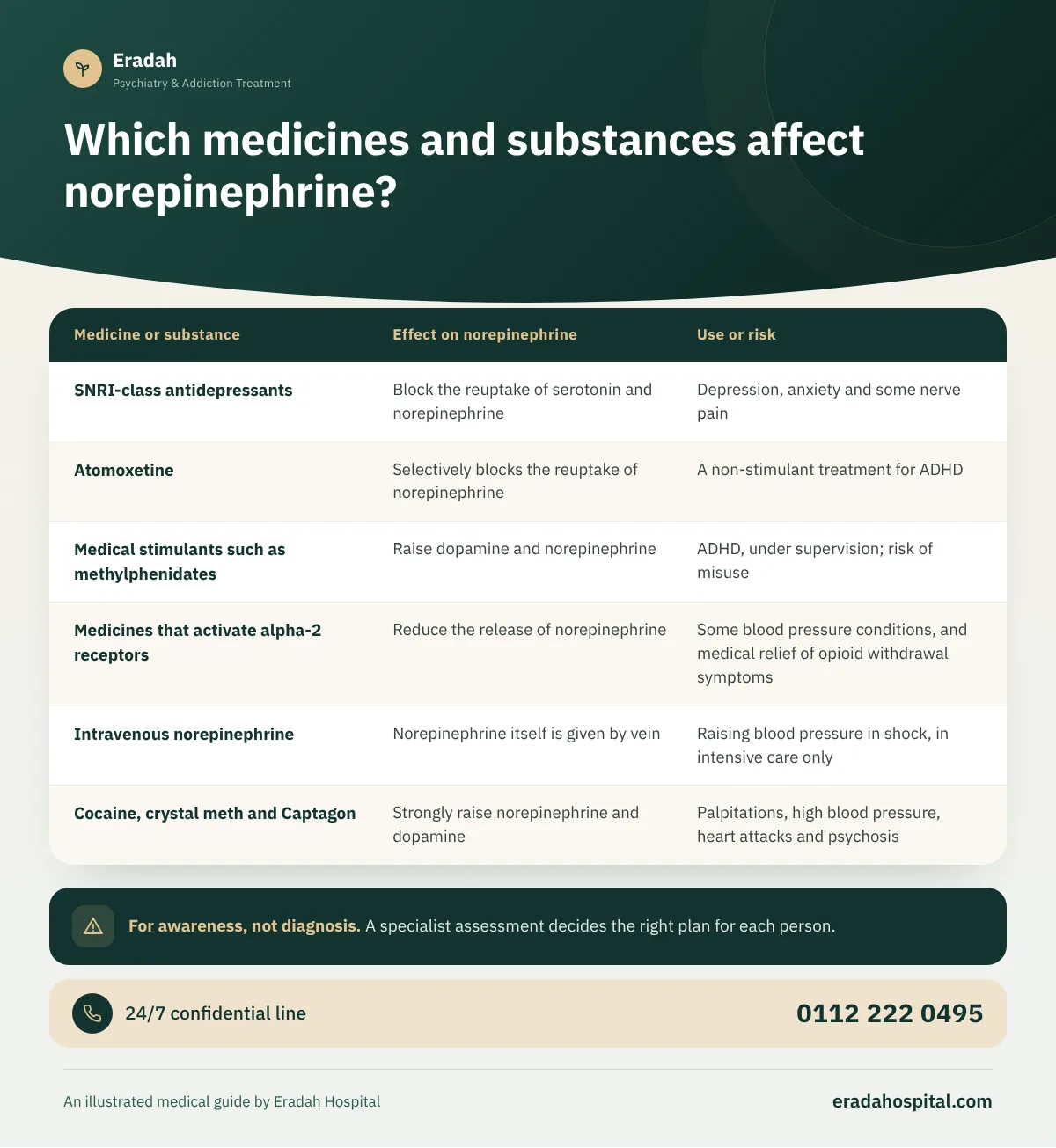
Many important medicines, and many substances that are misused, act on this system. We list them for information only, since all of them require a prescription and medical follow-up:
| Medicine or substance | Effect on norepinephrine | Use or risk |
|---|---|---|
| SNRI-class antidepressants | Block the reuptake of serotonin and norepinephrine | Depression, anxiety and some nerve pain |
| Atomoxetine | Selectively blocks the reuptake of norepinephrine | A non-stimulant treatment for ADHD |
| Medical stimulants such as methylphenidates | Raise dopamine and norepinephrine | ADHD, under supervision; risk of misuse |
| Medicines that activate alpha-2 receptors | Reduce the release of norepinephrine | Some blood pressure conditions, and medical relief of opioid withdrawal symptoms |
| Intravenous norepinephrine | Norepinephrine itself is given by vein | Raising blood pressure in shock, in intensive care only |
| Cocaine, crystal meth and Captagon | Strongly raise norepinephrine and dopamine | Palpitations, high blood pressure, heart attacks and psychosis |
Do not start, change or stop any of these medicines without your doctor. Some of them cause distressing symptoms or a dangerous rise in blood pressure if stopped suddenly.
Can norepinephrine be measured with a blood test?
There is indeed a test for catecholamines and their breakdown products in blood and urine, but it does not tell you the norepinephrine level in your brain. Most of what is in the blood comes from the sympathetic nerves in the body, and it changes within minutes with standing, anxiety, exertion, caffeine, smoking and some medicines.
For that reason, a doctor orders it for specific purposes, chiefly to look for rare tumors that release large amounts of these substances, and sometimes as part of specialized tests of the autonomic nerves when someone has repeated dizziness on standing. As for "brain chemistry tests" offered to explain anxiety or poor concentration, they have no scientific basis.
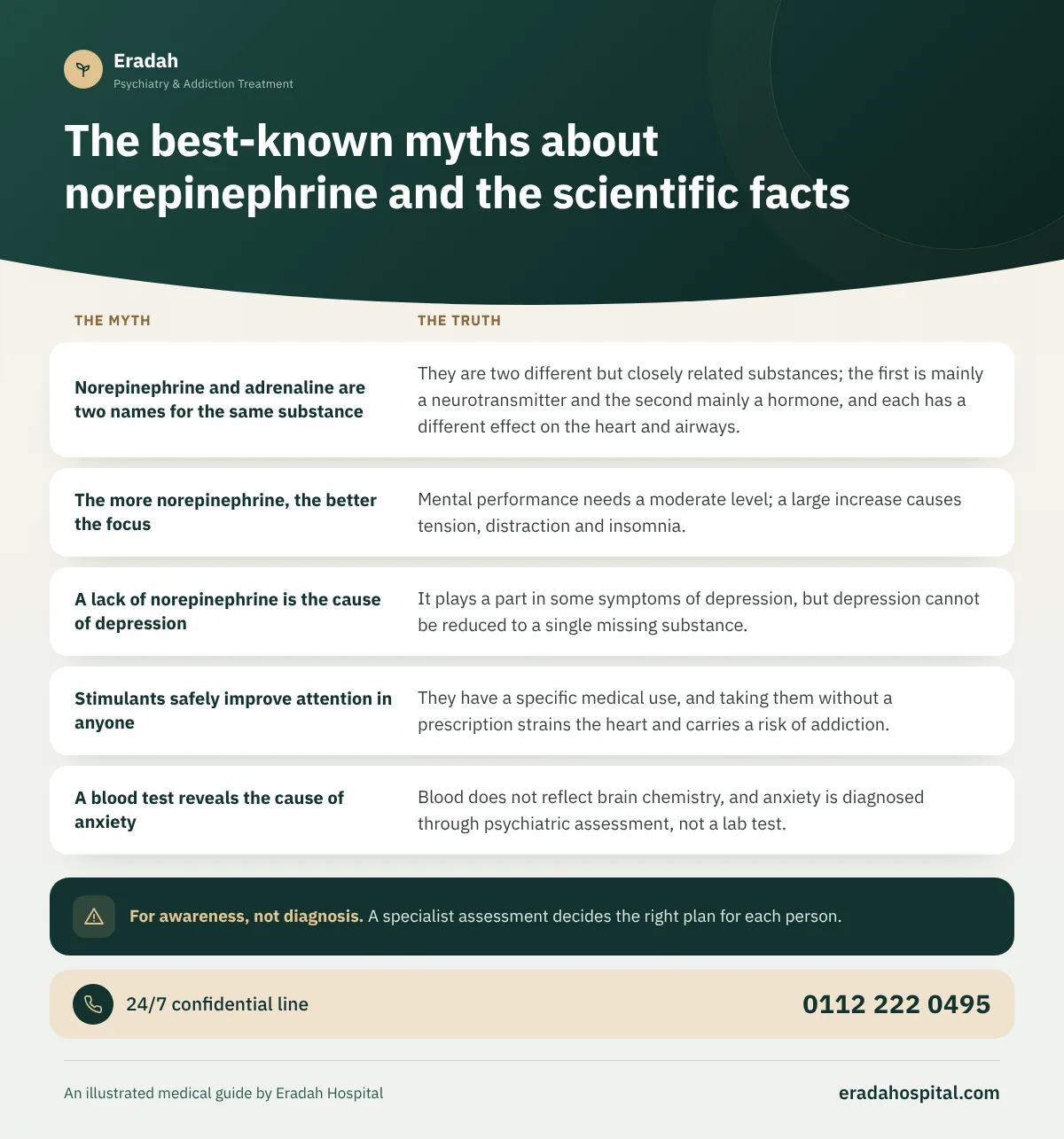
Myths and facts about norepinephrine
| The myth | The truth |
|---|---|
| Norepinephrine and adrenaline are two names for the same substance | They are two different but closely related substances; the first is mainly a neurotransmitter and the second mainly a hormone, and each has a different effect on the heart and airways. |
| The more norepinephrine, the better the focus | Mental performance needs a moderate level; a large increase causes tension, distraction and insomnia. |
| A lack of norepinephrine is the cause of depression | It plays a part in some symptoms of depression, but depression cannot be reduced to a single missing substance. |
| Stimulants safely improve attention in anyone | They have a specific medical use, and taking them without a prescription strains the heart and carries a risk of addiction. |
| A blood test reveals the cause of anxiety | Blood does not reflect brain chemistry, and anxiety is diagnosed through psychiatric assessment, not a lab test. |
Why does understanding norepinephrine matter for families and people with addiction?
When a family sees their son in the first days after stopping heroin or tramadol sweating, trembling, unable to sleep, anxious and agitated, they are partly seeing a surge of norepinephrine after opioids had suppressed it for a long time. These symptoms are real and physical, and they are not acting or exaggeration.
Understanding this mechanism explains why doctors use medicines that calm this system during withdrawal, and why it is recommended that withdrawal take place in a safe setting under medical supervision. The details are on the page about raised norepinephrine.
Norepinephrine guide: everything you need to know
We have gathered everything about norepinephrine into 2 pages, each answering one question in detail. Choose what you are looking for:
Norepinephrine deficiency: symptoms and causes
How reduced norepinephrine activity relates to lethargy, poor concentration, some symptoms of depression and ADHD, and to dizziness on standing in autonomic nerve disorders, and how the doctor assesses and treats the condition.
High norepinephrine: symptoms and causes
Palpitations, high blood pressure, sweating and insomnia, and the causes of the rise, from stimulants and opioid and alcohol withdrawal to medicine interactions and rare tumors, and when it becomes an emergency.
Chest pain, very high blood pressure or signs of a stroke? Call the ambulance (123) immediately
- Pain or pressure in the chest that may spread to the arm or jaw, with sweating or shortness of breath, especially after using stimulants
- A sudden, severe headache unlike any before, with a big rise in blood pressure, blurred vision or vomiting
- Sudden drooping of the face, weakness in an arm or leg, or sudden difficulty speaking (signs of a stroke)
- A very fast or irregular heartbeat with severe dizziness or fainting
- Severe agitation with high temperature, or seizures after using stimulants or during alcohol withdrawal
Call the ambulance (123) immediately and do not wait for the symptoms to settle, and do not try to lower the blood pressure at home with medicines the doctor has not prescribed. Have the person sit or lie down in a quiet place and stay beside them, and note the time the symptoms began, because it matters for stroke treatment. Tell the ambulance team honestly about every medicine or substance the person has taken, because it changes the treatment and may save their life.
Ambulance 123 Mental health support line 16328